
Tommy Boy
The Moral Economy of a Company Town

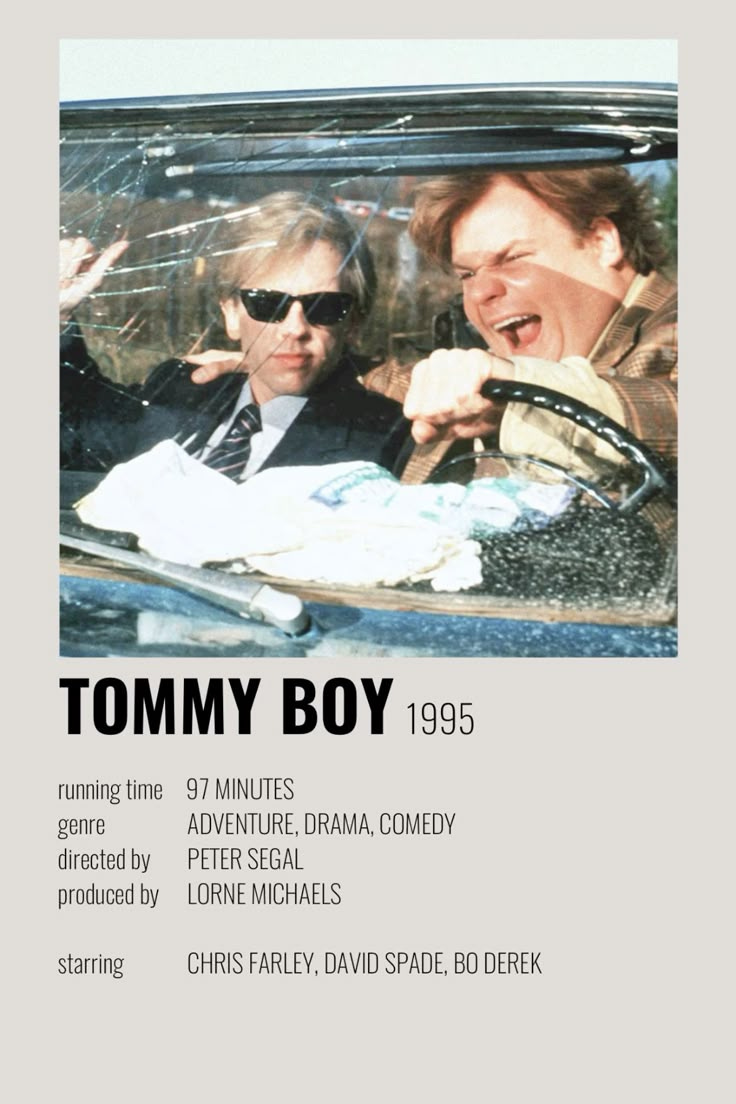
Welcome to the Callahan Family
A company town doesn’t collapse all at once.
It thins.
The rituals keep their shape a little longer than the work that created them, and the warmth keeps talking long after the structure goes quiet.
By the time Tommy Boy begins, Sandusky is already living inside that afterglow — a place where people still believe the handshake means something, even as the rest of the country has moved on.
Big Tom knows this.
You can hear it in the way he refuses the word “guarantee,” holding the box like it’s a betrayal.
He grew a business in an era when trust was personal and proximity was proof, and he’s still trying to anchor the company in that older grammar.
But the brake pads he’s so proud of haven’t been tested outside the walls that raised him, and the market he built his life around no longer speaks his dialect.
He’s not hiding a flaw in the product.
He’s hiding the gap between eras, the part no father wants to hand down.
Tommy inherits that gap more than anything else.
He grows up fluent in a language that only works inside the borders of a dying ecosystem: affection as insult, apology as reset, chaos as care.
Inside Sandusky, everyone understands the joke before it lands.
Outside Sandusky, it reads like malfunction.
The tragedy isn’t that Tommy is unprepared.
It’s that he was prepared perfectly for a world that doesn’t exist anymore.
And Richard, precise, disciplined, raised on modern professionalism, is just as misaligned.
He brings calibration into a factory built on familiarity, and the place rejects him the same way the outside world rejects Tommy.
Two men with opposite skill sets, each failing in the one environment the other was built for.
Not foils.
Parallel casualties of different economies.
Tommy Boy feels like a comedy about a man learning to sell.
But the deeper read, the one tucked under the slapstick, is a story about what remains when a company town reaches the edge of its lifecycle.
What habits survive.
What rituals repeat.
What dialects stick, even after the jobs don’t.
The film never names this.
But its rhythms carry the history that the plot refuses to hold.
Posthumous Pedagogy
The Father Who Left a Mask in Mid-Collapse
Big Tom teaches Tommy the only way he knows how: through presence, not process.
Through charm, not structure.
Through a kind of warmth that fills the room so completely that no one bothers to ask what happens when he isn’t there to generate it.
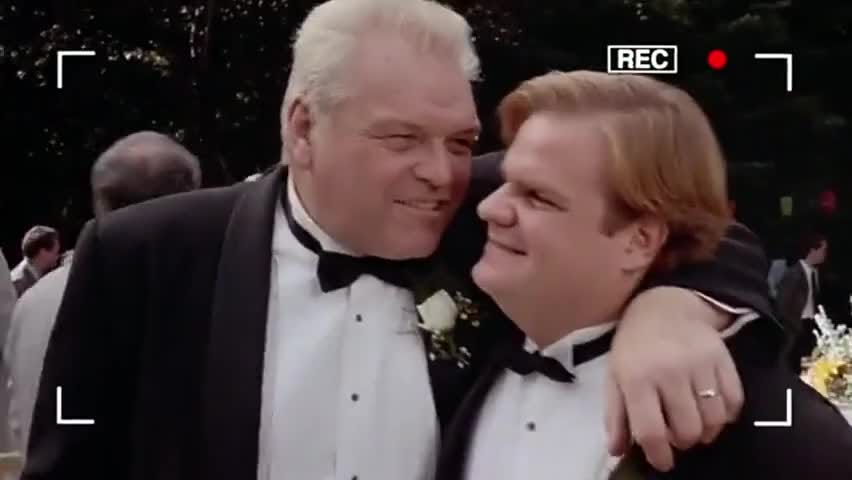
Everything Tommy knows about adulthood comes from watching a man whose confidence was never tested outside the invisible borders of his own reputation.
A handshake from Big Tom is supposed to be enough.
A smile is supposed to outrun the paperwork.
A joke is supposed to settle the account.
Inside Sandusky, that logic still holds.
It’s a company town, everyone grew up in the shadow of the same factory, the same stories, the same debt of affection.
Trust is proximity.
History is collateral.
People do business with Big Tom because they remember who he was before he became “Big Tom.”
Every sale is a reunion pretending to be a transaction.
But the world beyond Sandusky doesn’t operate on that ledger anymore.
The brake pads are solid, Richard knows the numbers, the engineering, the margins, but Big Tom’s refusal to offer a written guarantee reveals something deeper than product anxiety.
He’s protecting a worldview that no longer scales.
A guarantee is a form of distance, an admission that trust now lives on paper rather than in people.
He can feel the shift coming.
He just doesn’t know how to teach anyone how to survive it.
That’s the inheritance Tommy receives:
a mask built for a marketplace that vanished while everyone was still clocking in.
Warmth without boundaries.
Stories without judgment.
Charisma without calibration.
A mythology so close to the man that no one ever separated the two.
Tommy mimics what he’s seen, the broad gestures, the hopeful confidence, the refusal to let technical detail interrupt generosity, but the mask slips the moment he leaves its native ecosystem.
The handshake that once meant everything becomes noise.
The charm becomes static.
The smile means less than the writing on the box.
And yet this isn’t a failure of fatherhood.
It’s the cost of generational transition, the part of the story that company towns rarely survive long enough to name.
Big Tom wasn’t raising a successor; he was holding the line.
Trying to keep the older world intact long enough for one more quarter, one more celebration, one more moment where the rules still made sense.
He didn’t prepare Tommy for the fall because he didn’t believe the fall was coming.
Or maybe he did, and he hoped sincerity would be enough.
Either way, Tommy inherits a role without inheriting the conditions that made it possible.
A love that shaped him.
A lesson that never quite arrived.
A mask that fit his father perfectly and collapses the second Tommy tries it on.
The Joke Debt
A Community-Wide Dialect That Cracks Outside Its Boundaries
Tommy doesn’t inherit a personality; he inherits a dialect, one that only makes sense inside Sandusky’s borders.
In Callahan Auto, affection travels through mock violence, escalation functions as a kind of courtship ritual, and any chaos that spills over is understood as warmth rather than threat. An apology resets the world instantly, and an insult lands as proof of belonging.
Everyone knows this rhythm.
Michelle leans into it, the factory floor breathes in it, and the kids at the dock reproduce it without even knowing they’re performing a lineage. It’s not masculinity so much as geography, a communal grammar passed down through rooms where people have worked beside each other for decades. Inside this bubble, the timing is flawless, the resets are effortless, and Tommy is fluent in a way that feels natural because the environment keeps meeting him halfway.
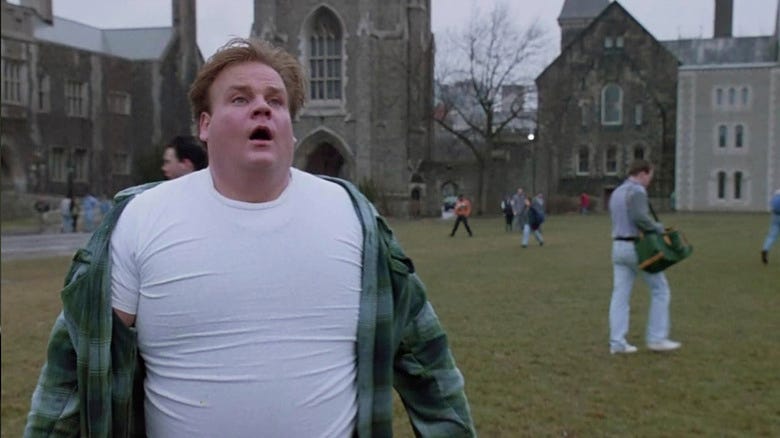
The trouble begins the moment he leaves.
College doesn’t share this cadence; his classmates don’t recognize that his loudness is devotion, that his jabs are invitations, that his apologies are meant as a reset rather than a retreat. They laugh at him, not with him, because the dialect that once carried him now has no context. He becomes a mascot, a novelty, a familiar joke with no shared origin.
When he enters the sales circuit, the mismatch becomes sharper.
The rooms he walks into don’t speak Sandusky. They don’t know Big Tom, don’t have decades of trust to cushion the noise, don’t understand why escalation reads as sincerity back home. A gesture that signals affection in one environment becomes panic in another. Chaos loses its warmth. The reset means nothing.
Richard recognizes this instantly, but only because he grew up outside the loop.
He speaks a language built on distance and precision, one where boundaries don’t erase themselves and familiarity isn’t granted by default. When Tommy erupts, Richard doesn’t recoil from the volume; he recoils from the mismatch, the way Tommy keeps trying to open doors with a key forged in a different world.
Tommy isn’t failing. He’s mis-languaged.
He keeps trying to export a dialect tied to a dying ecosystem, a grammar that once protected him but now reads as static. Every failed sale is a translation error. Every outburst is a misunderstanding of emotional currency. Every apology is a reset no one recognizes.
This is the Joke Debt:
the cost of inheriting a language only built to function where everyone shares the same history.
Tommy doesn’t realize the world outside Callahan won’t meet him halfway.
Sandusky always did.
And the echo that once told him he belonged now returns nothing at all.
The Factory as Father
Miscalibrated Sons of Different Systems
Tommy doesn’t grow up in a family so much as he grows up in a circumference.
Everyone at Callahan Auto raises him in small, affectionate pieces, a joke from one worker, a nudge from another, the kind of familiarity that feels like guidance even when no one is actually guiding.
Sandusky closes around him with the confidence of a place that believes it already knows how men turn into adults.
You absorb it by proximity.
You grow into it the way the factory itself grows into the skyline.
Inside that ecosystem, affection performs the work that structure should have done.
Boundaries blur under warmth.
Accountability dissolves under loyalty.
People assume competence will appear eventually, because in a company town, identity is something inherited by osmosis.
If Big Tom was built by this place, then Tommy will be too.
The assumption becomes the education.
Richard enters the same space with none of that cushioning.
His professionalism, neat, clipped, calibrated, hits the factory floor like a foreign sound.
He’s competent in the way the outside world rewards, but that competence has no emotional foothold here.
Sandusky hears his clarity as arrogance, his precision as distance, his caution as condescension.
He was raised in a world where adulthood is earned, not granted.
Where boundaries stay firm.
Where familiarity arrives slowly, if at all.
Tommy and Richard aren’t opposites; they’re reflections shaped by incompatible environments.
Tommy is fluent in intimacy and lost in structure.
Richard is fluent in structure and lost in intimacy.
Each man carries a different grammar for how to move through the world, and the tragedy isn’t that either grammar is wrong; it’s that neither one is portable.
Tommy doesn’t just inherit a dialect; he inherits a position, power without preparation, affection without accountability.
You can see it in the way the factory responds to them.
Tommy walks through the floor and the room shifts to meet him: jokes soften his entrance, affection disguises its concern, and people do the emotional translation on his behalf.
Richard steps in and the room stiffens, not because he’s unloved, but because the Callahan dialect demands a kind of looseness he hasn’t learned how to simulate.
He speaks a different language, one tuned to stability rather than legacy.
The factory raises Tommy by absorbing him.
It rejects Richard by misunderstanding him.
And in doing so, it reveals the limits of both environments: one builds men who cannot scale beyond the bubble, the other builds men who cannot integrate within it.
Tommy inherits capital and myth, but not the skill set that myth was built to hide.
Richard inherits discipline and competence, but not the communal grammar that makes those traits legible in Sandusky.
They’re both raised well and badly at the same time: one taught to be loved without earning it, the other taught to earn without expecting love.
The film treats their tension as comedy, but underneath the banter sits a deeper truth:
they are two products of two incompatible systems, trapped in the same story without a shared vocabulary.
One can’t perform adulthood outside Sandusky.
The other can’t perform belonging inside it.
The factory is their common father, but it teaches them different lessons, and neither lesson survives contact with the world.
The Salesman Inversion
Collapse, Not Technique, Carries Him Forward
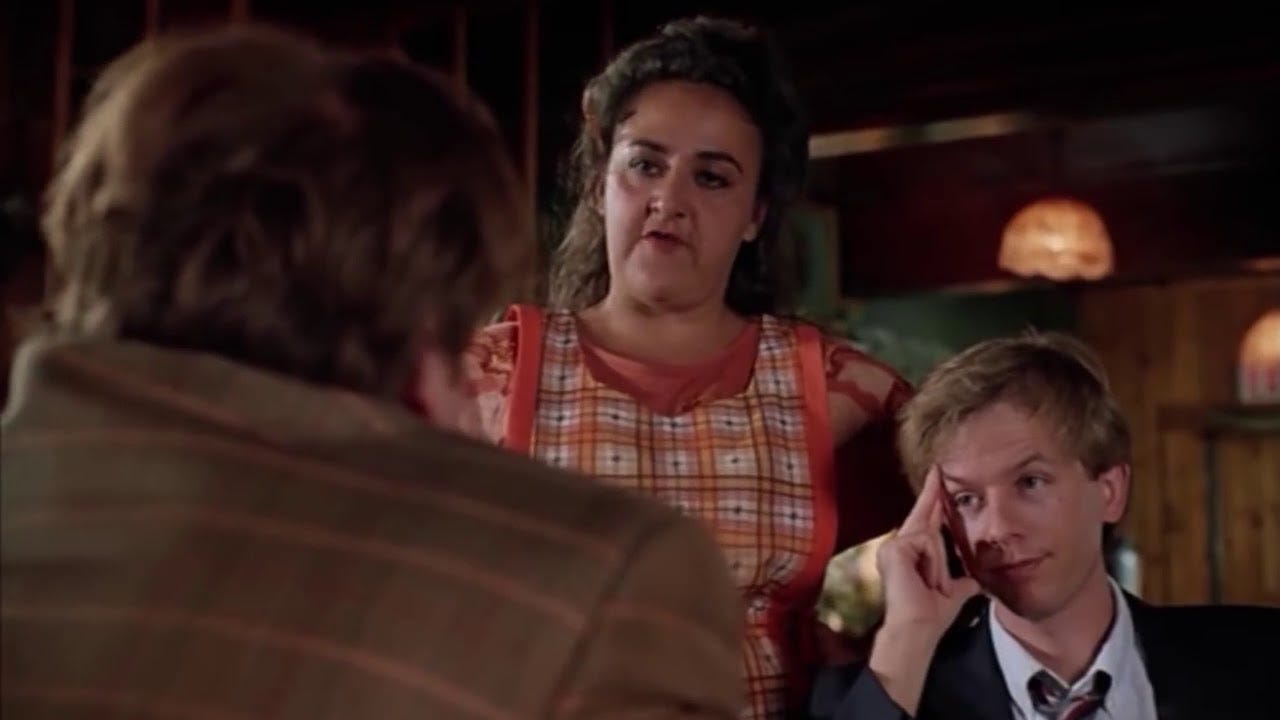
The first time Tommy “sells” anything, he isn’t selling at all.
He’s unraveling.
That diner scene, the chicken wings, the frantic gestures, the panic blooming behind his eyes, is the closest thing the film gives us to truth.
He isn’t failing strategically.
He’s failing honestly, in real time, with a kind of chaotic sincerity Helen responds to because she sees the boy still trying to imitate the father.
She gives him the wings not because he persuaded her, but because she recognizes the exhaustion sitting underneath the performance.
The film frames the moment like a breakthrough, but it’s a confession.
It’s the first time Tommy’s mask slips far enough that someone outside Sandusky can see the person behind it.
He doesn’t win her over with technique.
He wins her because he stops trying to sound like Big Tom long enough to sound like himself.
What follows is a montage, a clever sleight of hand that moves the audience past the uncomfortable truth that Tommy doesn’t actually improve.
We see contracts signed, hands shaken, buyers smiling — but we never hear the pitches.
Not once.
The film hides every moment where language is required, where proof is needed, where precision matters.
Instead, we’re shown the outcomes, as if results can stand in for process, as if charm can be reverse engineered into competence.
This is the inversion: the movie doesn’t show Tommy learning.
The movie learns to stop showing him fail.
Richard sees all this and can’t say it.
He knows Tommy’s breakthroughs aren’t breakthroughs; they’re stumbles that happen to fall in the right direction.
He’s watching a man survive by accident, buoyed by a warmth he doesn’t understand and powered by a myth he cannot carry.
Tommy’s sincerity works only when it collapses, when he becomes visible not as an heir or a salesman, but as someone desperate to do right by a world he wasn’t prepared for.
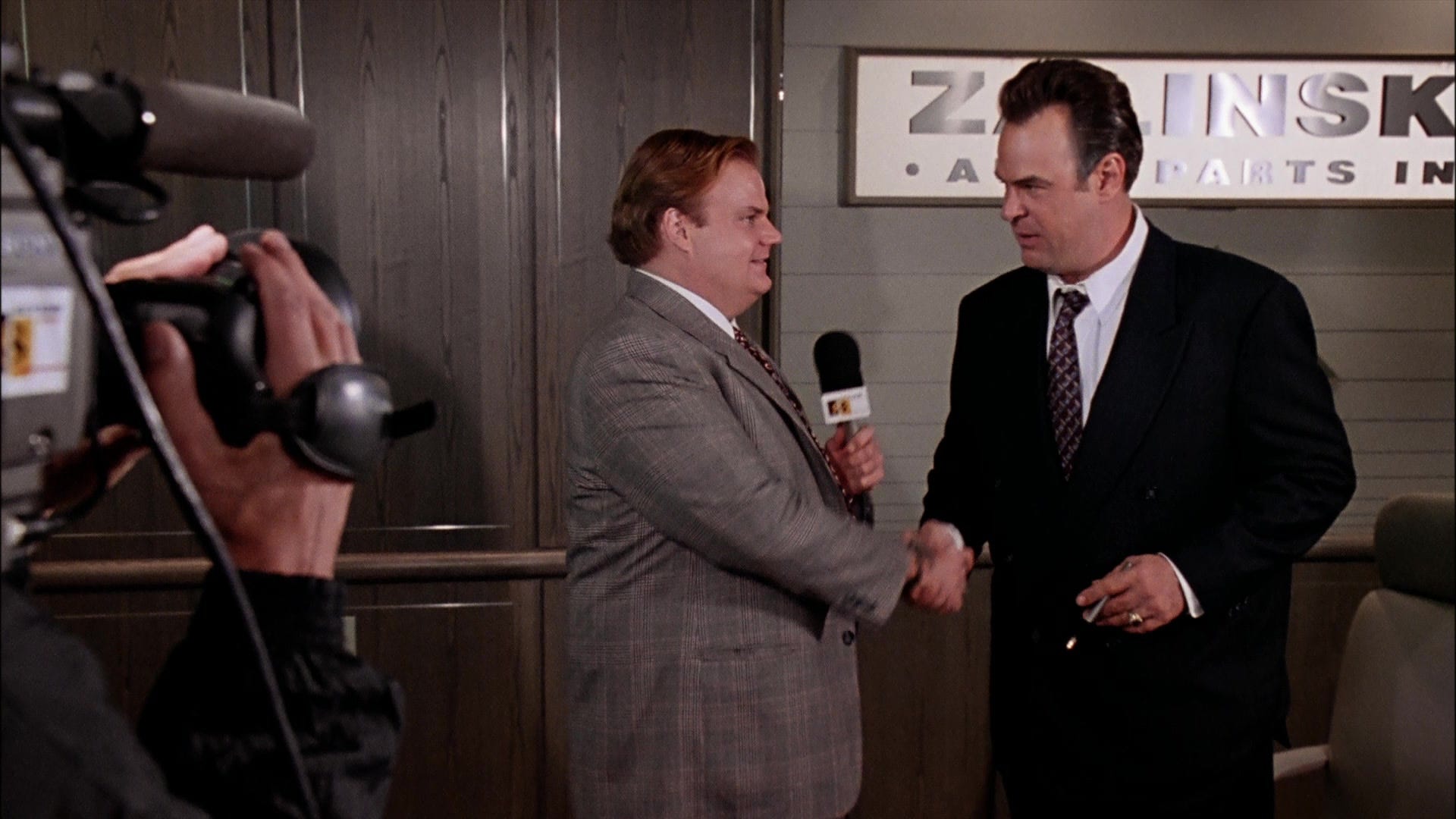
The final confrontation with Zalinsky proves the point.
There’s no sale happening in that boardroom.
No pitch.
Tommy corners him with cameras, turns the moment into a spectacle, and traps a man who cannot afford to look heartless on television.
Coercion presented as triumph.
And yet the movie treats it as the culmination of Tommy’s growth.
As if sincerity matured into skill.
As if the boy finally became the man his father imagined.
But there is no transformation.
Only recontextualization.
And this is where the inversion completes itself.
The movie becomes the salesman.
It sells us Tommy’s growth the same way Tommy sells anything, with charm and collapse and a little panic dressed as heart.
It hides the hard parts in montage, floods the screen with sincerity, and trusts the audience to confuse emotional exposure for evolution.
The film performs the same sleight of hand Tommy does, not by proving a change but by insisting one must have happened because the story needs it.
Tommy doesn’t inherit Big Tom’s talent.
He inherits Big Tom’s visibility, stripped of its authority, stripped of its scale, stripped of the world that once made it effective.
The crowds still gather.
They still look.
They still respond to his fear and earnestness and stumble-through-it energy.
But they’re not responding to the salesperson he thinks he has become.
They’re responding to the collapse he can’t help but reveal.
The salesman mask never fits.
The film just learns how to light around the seams.
If Tommy’s collapse makes him visible, Beverly’s fluency makes her invisible, the same dialect producing opposite consequences.
The Counterfeit Family
Beverly as the Fully Weaponized Version of the Callahan Dialect
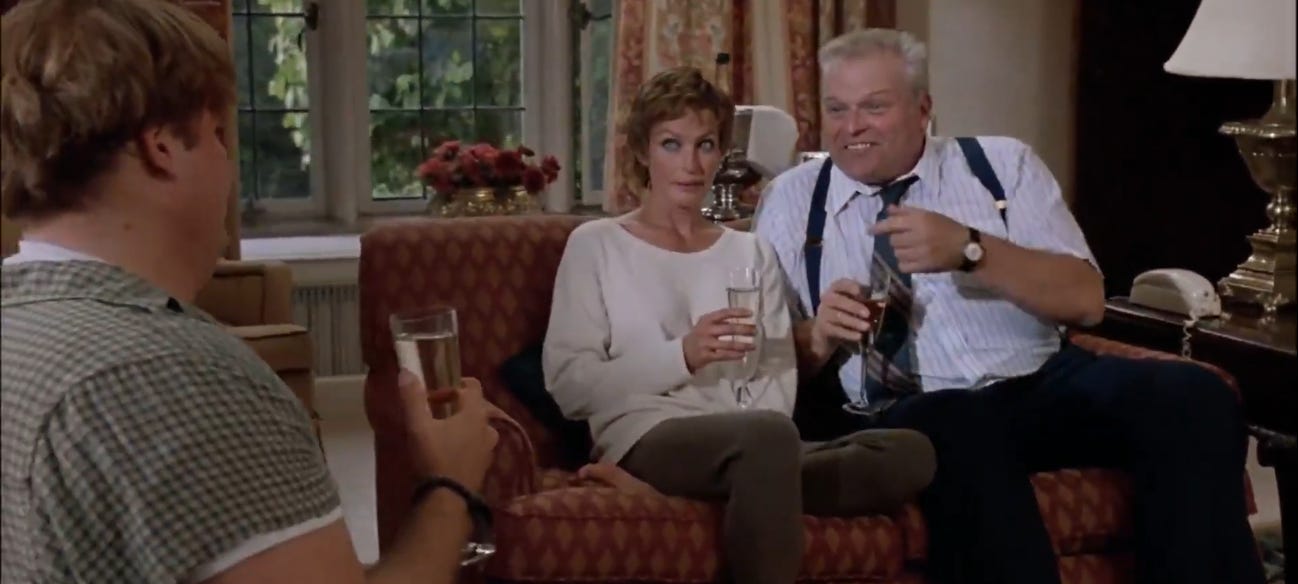
Beverly enters the story already fluent in the language Tommy barely understands.
She smiles in the right places, softens her voice at the right angles, and moves through the Callahan household with the same warmth that Sandusky mistakes for sincerity.
She doesn’t imitate the dialect; she perfects it.
She understands that in a company town built on familiarity, the quickest way to power is to act like you’ve always belonged.
Big Tom never notices the difference.
Why would he?
He has spent his life believing warmth is proof of loyalty, that performance signals affection, that a person who makes the room brighter must mean it.
Beverly uses this reflex the way a locksmith uses pressure: gently, consistently, until the tumblers fall.
Her marriage to Big Tom is not seduction but infiltration.
She steps into the emotional architecture of the family and rearranges it without ever raising her voice.
When she takes control of the company, she does it with a kind of breezy inevitability, as if she has inherited something rather than stolen it, as if legacy moves toward her by gravity.
Nothing she does feels abrupt because nothing she does disrupts the rhythm.
She keeps the mask intact, and the town mistakes that continuity for truth.
Paul, meanwhile, becomes the Tommy of her counterfeit family: earnest, hungry for approval, desperate for a connection that isn’t coming.
He believes her attention is affection.
He believes her promises are commitment.
He believes her warmth is real because he was raised in the same emotional ecosystem Tommy was, where heat and sincerity blur together until you can’t tell them apart.
Beverly never lies loudly.
She lies quietly, in the same key as Sandusky itself.
She mirrors the softness, the touch, the casual familiarity that the town reads as love.
Her betrayal feels sharp only because the audience can see the cut coming before the characters do.
The con works not because Beverly is brilliant, but because Callahan Auto is built on trust without verification.
The emotional economy of the factory, the resets, the teasing, the assumption of goodwill, creates a perfect pathway for someone who knows how to mimic the local weather.
Tommy fails outside Sandusky because the dialect doesn’t scale.
Beverly succeeds inside Sandusky because mimicry requires no roots.
The tragedy is not that she fools them.
It’s that the system makes her indistinguishable from someone who belongs.
Warmth erases scrutiny.
Charm dissolves doubt.
The dialect collapses under its own generosity, unable to defend itself against someone who can perform it flawlessly.
Tommy survives her not because he uncovers the truth or pierces the mask, but because the mask fractures on its own, a moment of misalignment, a glance held too long, a loyalty that flickers.
Richard sees it.
Zalinsky sees it.
Paul never does.
Beverly is the proof of everything the town refuses to admit:
that a system built on unguarded affection will always be most vulnerable to the person who knows how to counterfeit it.
She doesn’t destroy Callahan Auto.
She simply walks through the open door the town refused to lock.
The Audience as Factory
How the Callahan Dialect Reproduces Itself
The emotional language of Tommy Boy doesn’t stay inside Sandusky.
It spills outward the moment the film begins, not because the story teaches it, but because the story archives it.
Whether this rhythm is intentional or accidental doesn’t blunt its effect; the film still teaches its dialect to anyone who watches long enough.
What we’re watching isn’t fiction so much as a captured rhythm: Farley’s real friendships, Spade’s real deflections, the mock-violence that doubled as affection long before a camera appeared.
Pete Segal didn’t direct these patterns into existence; he recognized them, collected them, and stitched them into the film’s fabric.
The Callahan dialect becomes cinema simply because he refused to correct it.
And that’s why it transfers so easily to the audience.
Children don’t learn the economic logic of company towns or the soft hierarchies of Midwestern factories.
They learn cadence.
They learn the permission structure tucked inside the humor.
They absorb the way panic becomes comedy, the way humiliation resets itself, the way affection can survive only if it moves fast enough to outrun embarrassment.
They don’t hear the dialect as local.
They hear it as natural.
The movie becomes a delivery system for a language that was never meant to leave its environment.
The dock kids confirm it onscreen, a miniature echo of Tommy’s own rhythms, and the audience absorbs that echo again.
It’s a form of cultural inheritance disguised as slapstick, a closed-loop grammar gaining new territory because the film treats it like something safe, something harmless, something warm.
But what the audience inherits is not competency or work ethic or even confidence.
They inherit the tone that floats above the narrative: the belief that warmth makes up for structure, that sincerity compensates for precision, that panic becomes endearing as long as you laugh at the end.
These ideas are strangely durable, not because the film argues for them, but because it never interrogates them.
The camera treats the dialect as atmosphere, a natural condition rather than a learned one, and anything treated as natural becomes easier to imitate.
This is how the dialect survives the factory that created it.
Company towns disappear.
Steel plants shut down.
The childhoods shaped by those spaces scatter across the country.
But the emotional grammar remains, carried forward by the people who grew up repeating it and the audiences who encountered it packaged as comedy.
A generational language that outlives the world that made it coherent.
The film documents a dialect on the edge of extinction, and then, without meaning to, gives it a second life.
Children repeat the rhythms.
Adults carry the lines forward.
The cadence becomes a cultural artifact, stripped of its context and carried by memory alone.
It’s how a phrase like “holy schnikes” becomes less a catchphrase than a borrowed piece of emotional grammar, a way children learned surprise, panic, and affection from a town they’d never been to.
Tommy never learns to sell.
The movie never learns to question.
And the dialect that once held a company town together keeps traveling, carried by people who have no idea where it came from and no reason to believe it belonged to a world already fading.
The audience becomes the factory.
The language keeps running even after the machines stop.
What Survives the Factory
When the credits roll, Sandusky looks unchanged.
The factory still stands.
The people still laugh.
The dialect still moves the way it always has.
But the world around it has shifted just enough that Tommy’s victory feels more like a pause than a promise.
He didn’t fix the company; he bought it a little time.
He didn’t become his father; he revealed the limits of the mask he inherited.
And the dialect he carries, loud, earnest, clumsy, hopeful, feels less like a tool and more like an artifact, preserved not by design but by affection.
The film never asks whether that affection is enough.
It assumes it is.
It trusts the audience to fill in the rest, to believe warmth compensates for structure, to believe sincerity can hold what legacy can’t, to believe that the world will meet Tommy halfway the way Sandusky always did.
Maybe that’s why the film endures.
Not because it teaches us anything about selling, but because it captures a moment when a company town’s emotional economy still had gravity, still had rhythm, still felt portable even as it fractured.
We keep returning to it because we recognize the inheritance — the warmth, the noise, the permission to stumble through things and still be loved.
And maybe that’s the quiet truth sitting under every joke in the film:
The things that hold us together don’t always survive the world we grow into.
But the memory of them does.
That’s what Tommy carries forward.
That’s what the audience carries too.
Maybe that’s the Callahan dialect in the end, imperfect, inherited, trying to carry warmth into a world that no longer speaks it.
The dialect lives because someone loved it enough not to correct it.
I wrote something I care about.
It looks at Tommy Boy from the inside, not as a nostalgia object, but as a record of a place, a language, and a kind of affection that doesn’t scale.
If any of this resonates, I’d love to hear how the movie lived in your own memory, or what parts of its rhythm you carried without noticing.
I’ll be around in the comments.
In Memory of Chris Farley
Chris Farley didn’t play Tommy.
He revealed him.
What stays with me isn’t the slapstick or the explosions of energy, but the moments when the mask slipped, the way his face fell after a joke landed wrong, the way sincerity leaked into the cracks of the comedy, the way vulnerability sat just under the volume.
The film protects him, but it also captures him.
Not as an icon, not as a caricature, but as someone trying, really trying, to give everything he had to a world that didn’t always know how to hold him.
His work remains because it was never just work.
It was contact.
It was generosity.
It was a kind of emotional clarity wrapped in chaos, a reminder that people can be loud and hurting and still making the room warmer by accident.
Rest in peace, Chris Farley.
The laughter endures because the heart behind it was real.
And this essay, in its own small way, tries to honor that.
Works Cited
This essay draws from a mix of film transcripts, production interviews, economic history, and critical writing. A few key pieces shaped the backbone of my reading:
• Pete Segal’s 25th Anniversary Interview — for insight into the real Farley–Spade rhythm and how the film captured it rather than created it.
• “Tommy Boy” Script and Scene Transcripts — for confirming dialogue beats, blocking, and the framing of key moments.
• Richmond Fed Economic History: Company Towns — for contextual grounding on paternalistic labor structures and the emotional economies they create.
• Lecture Notes on “Death of a Salesman” — to clarify the cultural function of the salesman myth and its limits.
• Assorted Critical Essays and Retrospectives — including Geeks’ “There’s More to Tommy Boy Than Meets the Eye” and community analyses that surface the film’s hidden emotional grammar.
On top of those, the film itself remains the most important source.
Everything else is an echo.
Acknowledgements
To the readers who’ve stayed with me through the emotional architecture of these essays, thank you.
These pieces are built from the rhythms you help me hear, the questions you push me to ask, and the shared language we’re building one film at a time.
To Pete Segal, David Spade, and the memory of Chris Farley, for giving us a film that holds humor and vulnerability in the same breath.
And to every reader who grew up repeating these lines without knowing where they came from, you’re part of this dialect too.
Disclaimer
This essay is a work of critical interpretation.
It does not represent the views of the filmmakers, the studio, or the original cast.
All analysis reflects my own perspective based on publicly available materials, personal research, and close viewing of the film.
Quotes, paraphrases, and references to scripts or interviews are used under fair use for purposes of criticism, commentary, and education.
Any remaining errors or leaps in interpretation are mine alone.
And as always, these essays are invitations, not verdicts.
Your reading is welcome to differ.
Also a Chris Farley fan—thank you for sharing this with us. So special, I’ve never seen anyone dissect Tommy Boy this way, adds a whole new dimension to it. Really enjoyed it.❤️🔥
You're a pinball wizard.