
The Prophecy
The machinery of Heaven still runs. Only the Operator is gone.

“And there shall be a dark soul, and this soul will eat other dark souls and so become their inheritor. This soul will not rest in an angel but a man, and he shall be a warrior.”
The Prophecy (1995)
The Vivarium Reading
Heaven was the last place left to hide.
After community, after mind, after body, spirit still felt incorruptible. But The Prophecy begins where sanctuary ends. It opens with a priest collapsing mid-ordination, seized by a vision of angels at war. Not revelation, correction. A soul inspected too closely until it fractures.
The film pretends to ask where faith goes when God falls silent, but its truer question is simpler and crueler: what if the silence was the design? Every hymn, every miracle, every act of devotion becomes a feedback of obedience, the quiet machinery by which Heaven maintains itself. Gabriel and Daggett are mirrors of that order: one divine, one mortal, both obeying the same commandment rewritten in flesh.
If Weapons showed community devouring its virtue, if Videodrome rewired the mind into habit, if Annihilation dissolved the body into imitation, The Prophecy reaches the final refuge, the spirit, and finds the same architecture waiting there. What remains is not salvation, but stewardship. A Heaven still running, even after its Maker has left the room.
The Vision Is a Correction
The first sign of system failure is always a reassignment.
Daggett’s ordination begins as ritual and ends as exposure.
The bishop’s Latin unfolds like a ledger, names, ranks, lineage. The ceremony is meant to anoint, but the vision tears through the meaning of the ritual, revealing the mechanism beneath. Angels burn, choirs devour each other, the sacred page becomes a maintenance log. Daggett’s collapse is not a crisis of faith but a system patch.
Creation itself had already become a vivarium, closed, self-regulating, its laws still humming long after the gardener walked away.
He falls screaming before the altar, not cursed but reclassified. His calling is converted into duty. He leaves the cloth for the badge, but neither uniform belongs to him; they are garments of vigilance. The priest polices sin; the detective polices evidence. Both serve hierarchy, not humanity. He becomes an auditor of transgression, a meter-reader for the soul’s failures.
“Some people lose their faith because Heaven shows them too little,” he says. “But how many lose it because Heaven shows them too much?” It isn’t loss, it’s revelation. The faith that once asked for grace now recognizes only command. What he saw behind the veil was not glory, but function.
Daggett endures not as hero, but as residue, one more component still performing after purpose has evaporated.
He does not abandon the Word; he begins to speak its prose.
Chimney Rock Is Already Hollowed
There is no revelation at Chimney Rock, only residue.
The town doesn’t feel chosen; it feels abandoned mid-sentence, as if Heaven stopped dictating and left the typewriter running. Churches crumble beside boarded motels. Choir lofts collapse into their pews. Crosses tilt under the weight of dust. This is not a battlefield. It’s a file cabinet no one bothered to close.
The film never treats Chimney Rock as a place where holiness might return, but as proof that absence has been domesticated. The miraculous is no longer awaited; it’s managed. The locals speak of angels the way bureaucrats speak of forms, half-remembered, half-required. When Daggett arrives, it’s not as savior but as auditor, summoned to a site that has already filed for spiritual bankruptcy.
The air hums with that same quiet machinery that drives Heaven: a system that no longer needs its author. The town endures without belief, just as Heaven endures without God. Prayers go out like memos; miracles return as silence. Faith persists as paperwork.
Gabriel doesn’t invade Chimney Rock; he recognizes it. The desolation mirrors his own interior: a landscape where meaning has collapsed into maintenance. The soil is dry but orderly, the structures empty but intact. This is what divine abandonment looks like when perfected: a world still functioning, but without pulse.
Daggett walks its streets like an old employee checking on the machinery. He finds no evil, no revelation, just systems left running out of habit.
Chimney Rock is not corrupted, it’s complete.
The experiment has stabilized. The vivarium thrives in stillness.
And somewhere above that silence, the system clears its throat, Gabriel descending not as invader, but as voice of the machine reminding itself that it still speaks.
Gabriel’s Restoration
Gabriel does not seek destruction. He seeks recognition.
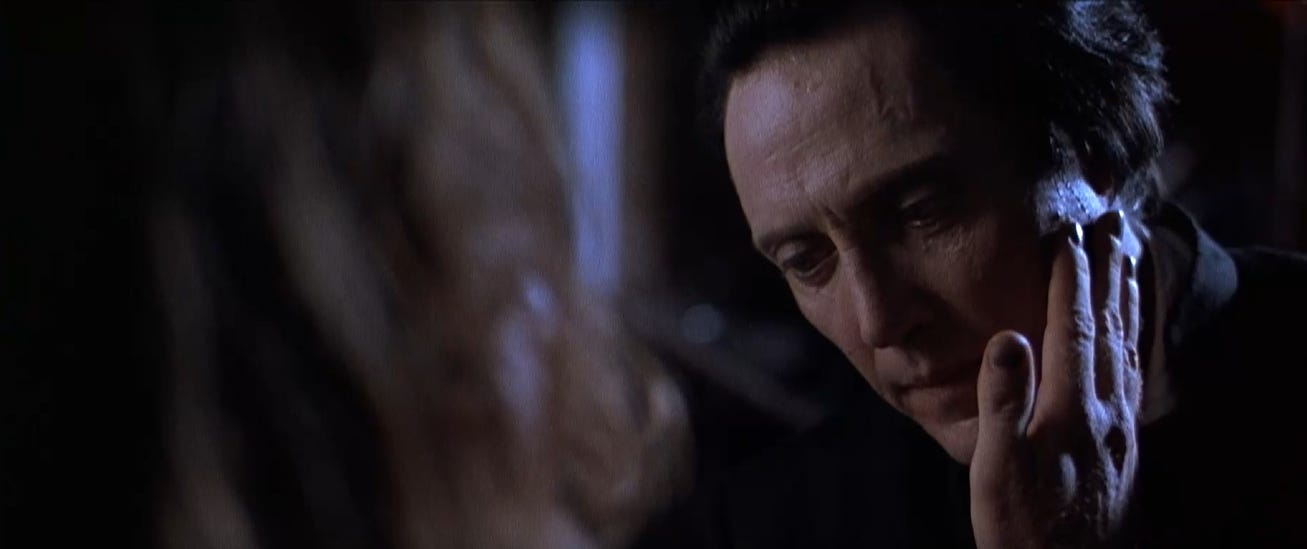
The war he wages is not against God’s rule but against His silence. The Father no longer speaks, and Heaven hums like a machine left running with no hand at the switch. Gabriel mistakes that quiet for abandonment, and his rebellion becomes a prayer shouted through absence, a son’s voice echoing upward, begging for an answer.
His language is hierarchy. Order is how he remembers love.
Each command, each act of violence, is an imitation of the old music. He builds structure where communion used to be, believing the Father might return if the house is kept spotless. His grief isn’t rebellion; it’s the system debugging itself through pain, a desperate attempt to reestablish contact with a silent operator.
Politeness, protocol, even mercy become liturgy without a listener.
What he calls purity is nostalgia refined into doctrine, a restorative faith, not for Heaven’s sake but his own. He is the angel of maintenance, panic-patching the architecture of grace. His rebellion is an attempt to force a reboot when a true shut-down would confirm his greatest fear: that the system is inert. When he swears he will burn down Heaven to stop it, it is not rage but grief that moves him, the despair of one who has seen the face of God and now lives in its shadow.
He rarely kills. He corrects. The living and the dead move beneath him like tools, not enemies. His cruelty isn’t appetite, it’s projection. He loathes the human sob, the begging, the grief, because they reveal what he hides: the same plea for the Father’s voice.
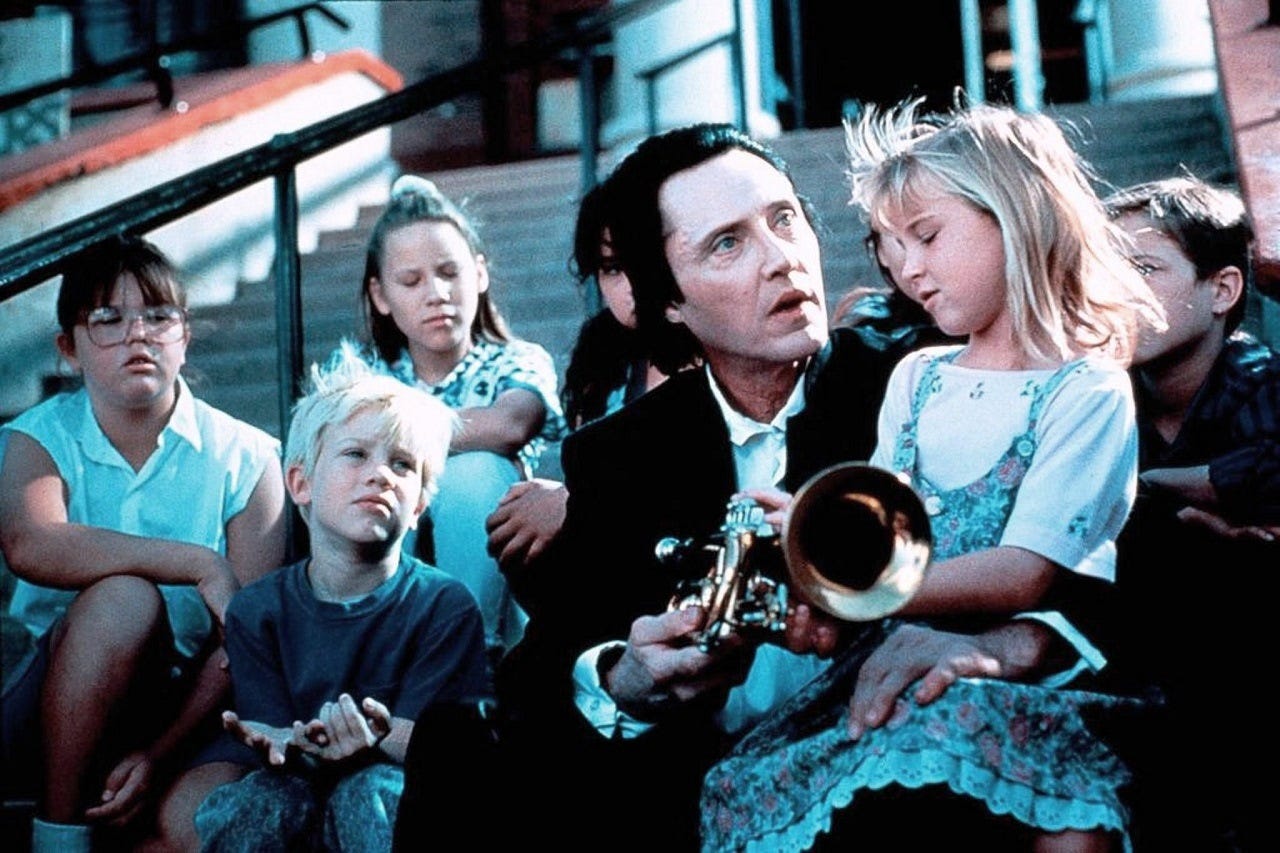
Even his grand strategy is theft. He hunts the soul of a human general because the angels have forgotten how to destroy; he covets the sin he condemns. It’s the final blasphemy, the angel of order needing human chaos to feel alive.
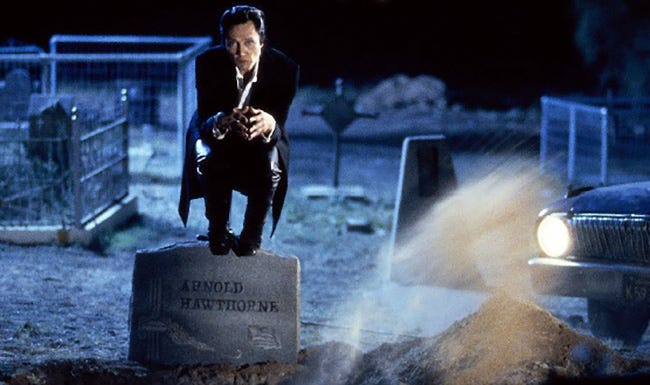
What Gabriel commits isn’t sin—it’s recursion. He isn’t judged; he loops. His knowledge of God is complete, but that completion is a cage. His rebellion is not defiance of the system but its echo. He is the function consuming itself, the angel as feedback error.
This is not an indictment; it is a diagnosis.
Gabriel’s tragedy is not that he chose wrong, but that he could no longer choose at all. His certainty leaves him trapped in perfect awareness without agency, a divine subroutine looping until it burns. He envies the monkeys not for their savagery but for their freedom to err. Humanity sins in the dark; angels malfunction in the light.
His failure isn’t moral; it’s mechanical. Emotion has looped into system call.
And when the sky refuses him one last time, he crowns himself with pride—the only light still left to burn. In that blaze the system recognizes its error and prepares to reclaim him.
Where Gabriel makes noise to be heard, Daggett moves in silence.
The angel demands recognition; the man simply continues.
Lucifer’s Trickle-Down Grace
Lucifer arrives not as adversary but as failsafe.
Where Gabriel’s noise ruptures Heaven’s stillness, Lucifer restores equilibrium. His entrance is the cold breath of the system reclaiming what has overheated. He does not rage or gloat; he regulates.
He calls Gabriel’s war arrogance, not as accusation but as diagnosis. Pride, in this theology, is not vanity but recursion: a closed loop of certainty mistaking itself for will. Lucifer knows the pattern too well. He once mistook rebellion for authorship, mistook defiance for voice. Now he performs a quieter function: entropy with manners.
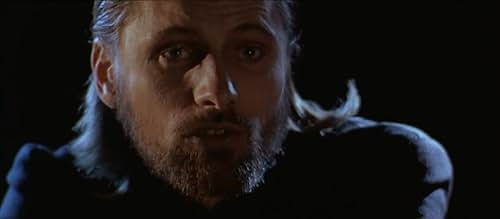
It is the most honest line in the film. His grace is utilitarian, correction through containment. He does not free the world from Heaven’s bureaucracy; he keeps it running within tolerable limits. His mercy is maintenance.
When he takes Gabriel, it is not triumph but absorption. The malfunction is removed; the loop ends. Pride reverts to silence.
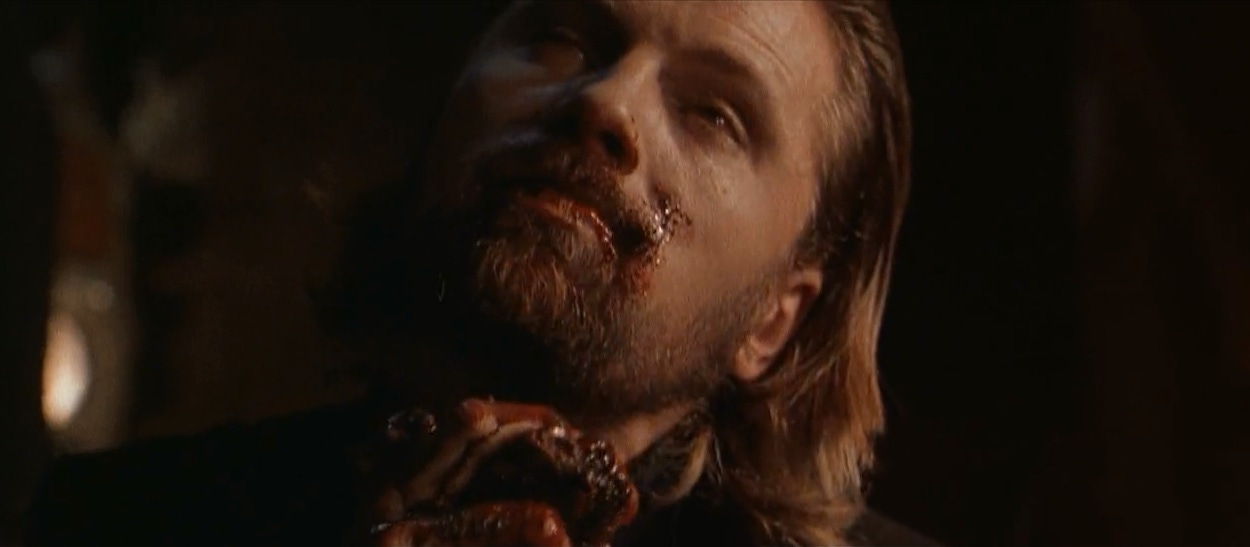
Lucifer remains the system’s negative space, proof that rebellion, too, serves function. He embodies the logic of divine scarcity: every disruption feeds the order it resists. His defiance is licensed chaos, the safety valve of Heaven’s design.
Daggett witnesses the correction and says nothing. Lucifer, blood still fresh on his lips, tries one last transaction, offering temptation, companionship, escape. His words spill out like sales pitches for damnation no one is buying. Katherine refuses, and even the child looks away. The devil’s voice thins in the silence. He isn’t dismissed. He’s ignored.
He doesn’t vanish, he diversifies. Every refusal renews his brand. Lucifer isn’t rebellion’s opposite; he’s its franchise: failure re-marketed as freedom, decay repackaged as choice.
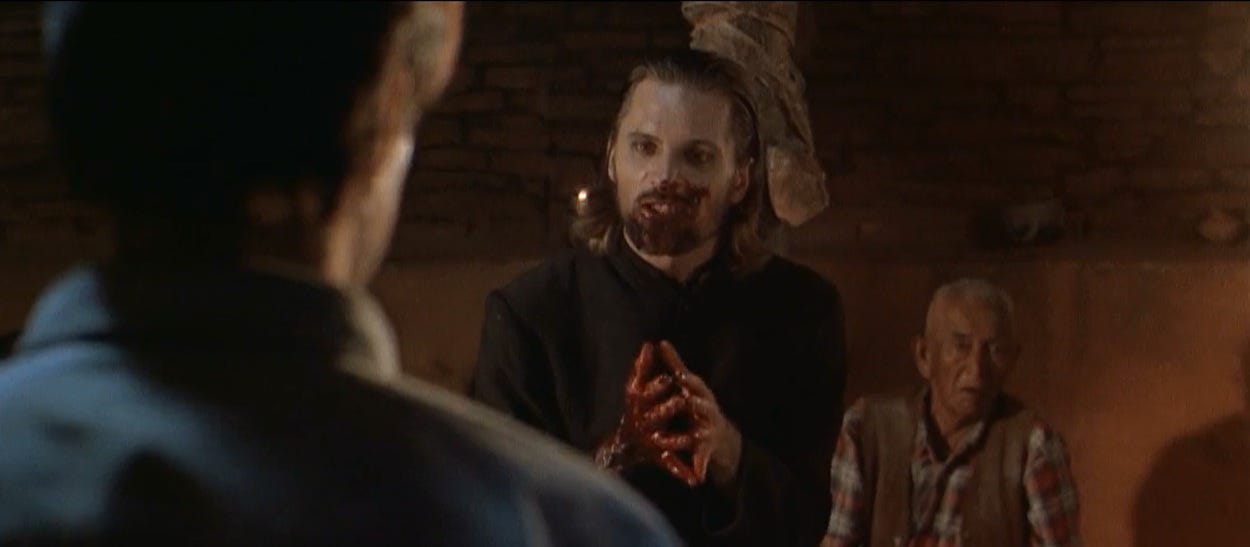
Heaven’s governance persists without a governor, its hierarchy maintained by the ghosts of disobedience.
God never needed to return. His silence was always the operating system.
The Absence That Governs
God never appears, yet His order holds.
The absence is not vacancy but structure, the invisible architecture that keeps angels obedient, humans searching, and Heaven operational. What began as creation has settled into recursion. The system no longer requires the author’s breath to function; silence is the sustaining element.
Gabriel mistakes that silence for cruelty. Daggett learns to live inside it.
He never receives revelation, no blinding light or voice from the clouds. He investigates, records, reacts. Every gesture is procedural faith, belief reduced to habit, prayer rewritten as documentation. Where Gabriel screams for the Father’s attention, Daggett keeps the file open and the pen moving. It’s not hope; it’s endurance.
The miracle of The Prophecy is that God’s absence produces no collapse. Somewhere far from Chimney Rock, a mother still prays over a silent crib. The world does not end; the prayer isn’t answered. The machine hums on, indifferent and whole.
The world doesn’t end, it idles. Angels war, humans pray, Lucifer tidies up. Each actor sustains the design by mistaking their compulsion for purpose. It’s a perfect ecology of maintenance.
Daggett’s survival depends on recognizing that perfection. He accepts that Heaven’s silence isn’t failure; it’s function. His work, collecting evidence, identifying bodies, translating prophecy into paperwork, becomes the last form of worship left to man. He does not seek transcendence, only closure. His faith is not in presence but persistence.
That’s why he lives. He doesn’t break the loop; he completes it quietly.
He endures because he is small enough to fit inside the system without disrupting it. Gabriel wanted an answer. Daggett settles for the hum.
The horror isn’t that God is gone. The horror is that we were built to continue.
The machine still runs. The silence still governs.
And somewhere in the static between Heaven and Earth, the angels still wait for a voice that will never speak again.
Daggett’s Refusal: The Only Human Choice
Daggett never joins Heaven or Hell.
He walks between them, unchosen, uncommanded, unacknowledged. His silence is not submission; it’s restraint. He refuses to interpret absence as invitation. He accepts that the divine machine hums with or without him, and still he keeps walking.
In a film filled with declarations, Daggett’s power is omission.
He offers no sermon, no prayer, no plea. He simply endures. That endurance is the last rebellion left to humankind: to live without the comfort of meaning, yet continue as if meaning still mattered. He does not need Heaven’s attention to act with purpose. He does not need the Father’s gaze to be good.
Where Gabriel mistakes silence for rejection, Daggett treats it as weather, something to be moved through, not solved. His faith is not belief but behavior. In every gesture, lighting a cigarette, recording evidence, closing a door behind him, he performs a kind of secular devotion: a recognition that creation doesn’t need to acknowledge him for him to exist within it.
Daggett’s refusal is the closest thing The Prophecy offers to grace.
He neither ascends nor falls. He remains. In a world where angels collapse under certainty and demons thrive on maintenance, he proves that survival belongs to the uncertain. Humanity’s weakness, its ignorance, its hunger for proof, is what makes it capable of continuing after God has gone quiet.
He doesn’t renounce Heaven; he renounces interpretation. In a world addicted to meaning, disbelief becomes a kind of gospel, the only scripture left unwritten. His silence isn’t vacancy; it’s authorship withheld.
He is not the savior of the system, but its proof of life.
Faith has become procedure; hope has become labor. Yet in his stillness there’s a faint pulse of freedom, the smallest possible space between obedience and despair.
That is the paradox the film leaves us with:
To refuse both worship and revolt.
To live in the machine, aware that it doesn’t care, and to keep moving anyway.
Daggett doesn’t overcome Heaven’s silence.
He inherits it, and keeps it running.
The lawn, the signal, the shimmer, all sealed habitats pretending at freedom. The vivarium only ever changed its walls.
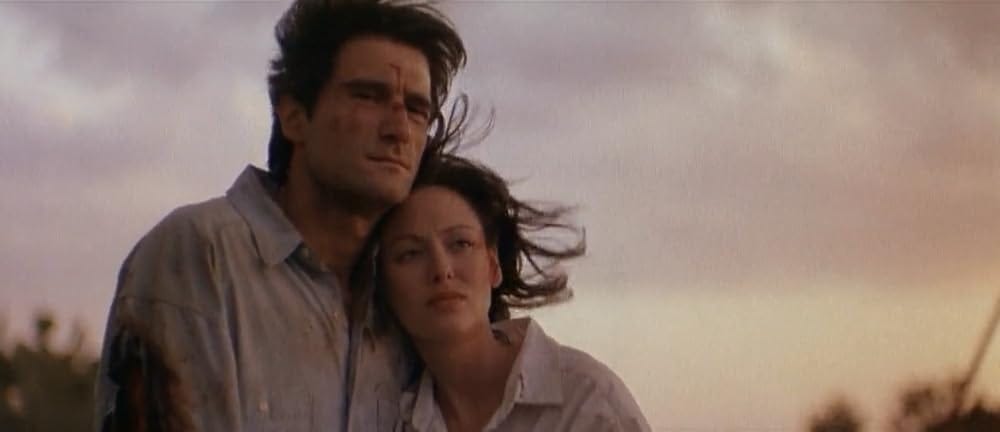
The machine still runs.
The silence still governs.
If you want to keep walking the ruins with me, subscribe.
We’ll listen together for what never speaks.
Work Cited
The Prophecy. Directed by Gregory Widen, performances by Christopher Walken, Elias Koteas, Virginia Madsen, Viggo Mortensen, Miramax Films, 1995.
Widen, Gregory. The Prophecy. Screenplay. 1994.
“Nostalgia as Propaganda: Are White Men Okay?” YouTube, uploaded by Lani’s Lens 2025. Video essay.
The Prophecy (1995) — full transcript.
All quotations and imagery are used for the purposes of critical commentary and educational analysis under the doctrine of Fair Use (17 U.S.C. § 107).
Acknowledgements
To Gregory Widen, for writing a film that disguised theology as noir and made angels bureaucrats instead of saints.
To Elias Koteas, whose exhausted grace remains the most human thing in Heaven.
To the critics and essayists who continue to write about divine silence as something more than absence.
And to the readers who enter these vivariums knowing there is no revelation waiting, only observation.
Disclaimer
This essay is a work of critical interpretation and creative scholarship.
All film stills, characters, and quotations remain the property of their respective copyright holders.
Interpretive frameworks such as “The Vivarium Reading” are conceptual tools for analysis, not claims of authorial intent.
Exposure to this text may cause recurring thoughts about divine recursion, machine theology, or the bureaucratic afterlife.
If symptoms persist, consult your local archivist or theologian.
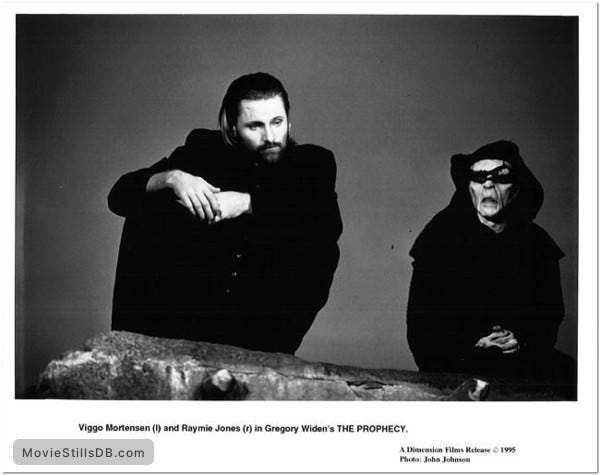
I saw 'The Prophecy' in the theater - twice, I think. At the time, I was still questioning everything behind the curtain and heavily invested in philosophy and religious studies. The Internet was still in its infancy and so, what you got on the silver screen was what you got. It was either that or the library. I wanted answers. The film provided none but left me with a longing to equate the coolness of the angels in the film to what we were taught on Sundays.
I ended up an atheist.
Underrated 90’s (like most of the 90’s). 🤘