
Sinners
On rhythm as rebellion, survival as fracture, and the breath that outlived the burn.

Preface
This is not neutral ground.
The film does not ask to be understood first.
It asks you to sit with it.
Not with spectacle.
With memory. With breath. With what refuses to resolve.
This is not a clean account.
It will not turn survival into triumph.
It will not offer relief on schedule.
Step in without expecting closure.
Listen for what strains to keep breathing.
Verse I: The Fire That Refused to Stay Contained
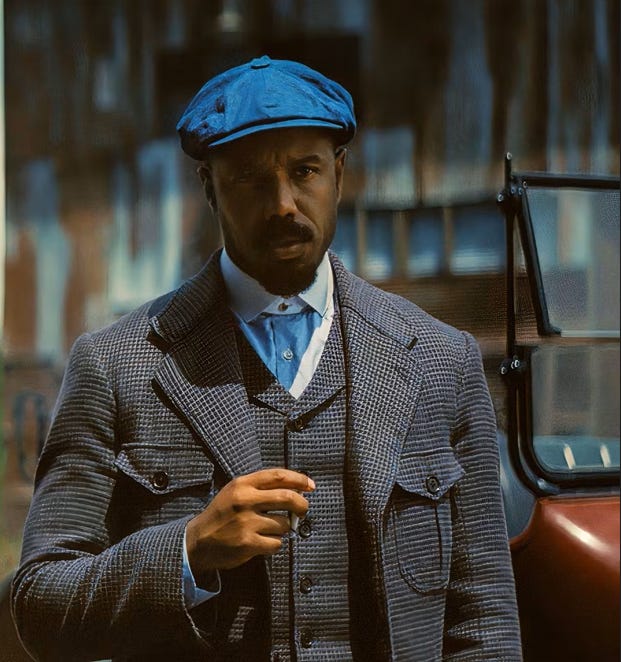
In Sinners, the roof burns not because empire sets it alight, but because the music makes the room impossible to hold.
The sound comes first.
Too alive. Too full. Too crowded with memory.
Bodies move before permission arrives.
The floor answers back.
Empire is not distant here.
It is local. Familiar. Intimate.
It lives in the sheriff’s pen that turns breath into labor.
In the bossman’s coins that keep hands busy and futures small.
In the neighbor’s hymn sung clean on Sunday, and the hood pulled tight that same night.
Everywhere the same instruction repeats:
Work, but never own.
Pray, but not too loud.
Live, but not in a way that lingers.
The burning is not destruction staged for release.
It is pressure escaping containment.
The frame carries it.
Grain thickens. Light bleeds. Movement shudders instead of gliding.
The image breathes unevenly, like a chest refusing to calm down.
Wide when the room swells with communion.
Narrow when a body stands alone.
Community and isolation trade places inside the frame itself.
This is not beauty extracted from pain.
It is refusal rising despite it.
There is danger here.
In calling this moment beautiful.
In mistaking survival for spectacle.
The film knows this. It hesitates.
It does not let the fire feel clean.
Smoke knew the risk.
He knew rhythm could call things back that would not stay quiet.
Blues here is not performance.
It is invocation.
A cracked note.
A voice dragged rough across memory.
Not summoning applause.
Summoning ghosts.
He feared Sammie’s gift might become bait.
That the song would travel farther than they could follow.
The walls burned because memory would not fit inside them anymore.
Smoke was already leaving before empire touched him.
Even standing still, something in him was thinning.
It was never a question of if they would catch him.
Only what would remain.
Verse II: Inheritance Without Repair
Smoke dies.
The night continues.
Sinners does not pretend survival arrives whole.
It does not offer repair as a reward.
What the twins inherit is not freedom.
It is fracture.
Passed down the way breath sometimes is.
Uneven. Interrupted. Still moving.
Their names already carry the split.
Elias and Elijah. Smoke and Stack.
Echoes of one voice bent into two directions.
They are not legible to empire.
Not clean enough for triumph.
Not broken enough for tragedy.
Smoke burns.
Stack remains.
But remaining is not resolution.
Survival here is not a lesson.
It is a condition.
Stack carries his brother’s rhythm forward, yes.
But also something heavier.
Something that does not translate.
Decades later, when he stands at Sammie’s door, the weight is still there.
Not guilt exactly.
Not regret.
Something unfinished.
Something that did not die when Smoke did.
The film does not name it for us.
It leaves it there.
There is a temptation, watching this, to turn fracture into strength.
To call adaptation a choice.
To smooth the split into something noble.
Sometimes that is true.
Here, the break comes from a wound.
Not a decision.
This is not evolution.
It is a way to keep breathing when the air thins.
Sinners does not ask the twins to be proud of it.
It does not ask us to admire it.
It lets the fracture stand.
Verse III: The Hollow Jig
There is a moment when the dance keeps going but the air leaves the room.
The bodies still move.
The beat still lands.
Something is gone.
The vampires do not just drink blood.
They drink memory.
They drink breath.
What they offer looks like protection.
Looks like family.
Looks like relief.
The movement becomes smooth.
Repeatable.
Safe.
A hollow jig.
The newly turned hit every note.
Clap on time.
Glide where others once stumbled.
But the story is gone.
This is not just horror grammar.
It is empire’s oldest trick.
Let them move.
As long as the steps belong to someone else.
The film tells this story with its body.
When the vampires arrive, the image cools.
Motion stiffens.
The chaos that once felt alive turns mechanical.
Not a glitch.
A decision.
The ritual remains, but transformation is removed.
What is left is performance without memory.
Once survival becomes product, it stops being sacred.
That is why the roof had to burn.
Not as rebellion alone.
As refusal.
The moment the song breaks containment again, the jig collapses.
Closing Breath
Smoke dies.
The roof falls with him.
What rises does not rise clean.
There is no promise here.
Only scattered memory.
In his final moments, the film gives him something empire never did.
A hand on his daughter’s back.
A breath held close.
A warning whispered.
His name becomes flesh one last time.
Then ash.
The fire does not end.
It does not resolve.
It moves.
Somewhere else, someone else is still breathing with it.
Not free.
Not whole.
Still here.
Stay with the fracture. Return for the twin.
Sinners left its survivors with no promises, just the rhythm of breath and refusal.
But what happens when the state offers a flag instead of justice?
Survival isn't freedom. Not when you're still expected to carry their silence with you.
Works Cited
Sinners (2025), directed by Ryan Coogler.
Coogler, Ryan. Interview on the making of Sinners, Kodak Film. [YouTube, 2025]. Link
Lyrics from "The Roof Is on Fire" by Rock Master Scott and the Dynamic Three (1984).
Quote from Poetics of Relation by Édouard Glissant (1997).
Williams, Saul. She. MTV Books, 2005.
Additional references to biblical passages (Corinthians 10:13, Genesis 4:7, Matthew 16:26) are drawn from the King James and NIV translations for thematic discussion.
Disclaimer
This essay is an independent analysis rooted in personal reflection and public materials.
It is not affiliated with Warner Bros., Ryan Coogler, or the production team of Sinners.
Interpretations offered here are subjective, stitched from film imagery, cultural memory, and the shared breath of survival stories.
If this work leads you to look deeper, listen closer, or carry these rhythms forward, then it has done its work.
Acknowledgments
With respect to the artists, ancestors, and communities whose stories shaped this work, and to those whose breath still rises after the fire.
© 2025 Offscreen Observations. All rights reserved.
This article may not be reproduced, reprinted, or reposted without permission. Excerpts and quotes are welcome with attribution.
really enjoyed your interpretations! After all the the things people were saying to look out for in this movie and some I was finding on my own, I never even once thought about the roof on fire. Loved that parallel you drew. Also liked the description of the lifeless hollow man jig as a contrast.