
Sunshine
Completion Without Witness

The shield percentage holds. The hum does not change.
Sunshine understands this fear instinctively. It does not weaponize space; it lets space remain indifferent.
Darkness is not hostile here, only enormous. The sun is not malevolent, only total. The terror isn’t that humanity might die, but that it might disappear without the cosmos having to change at all. The film lingers on shields, readouts, distance markers, reminders of how fragile mediation really is. How thin the line is between containment and contact.
What unsettles me most is not the danger, but the beauty that accompanies it. The way annihilation is framed as calm. The way scale becomes serene. The way watching someone step closer to the light can feel less like horror and more like relief. This is not a fear of death. It is a fear of how easily awe teaches us to stop resisting.
The Sun as the Sublime
Then the edges thin. The frame tries to hold, fails quietly, and keeps recording anyway. Detail doesn’t vanish all at once. It recedes in stages. Contrast softens. The image stops offering places to stand.
The lens does not protect you. It does not compensate. It accepts.
By the time the frame fills, you are no longer tracking bodies. You are no longer counting distance. You are looking at light, and the film has already trained you not to look away. The sun hasn’t threatened anyone yet. It doesn’t need to. It has already taken the image.
Only after this does the film begin to explain itself.
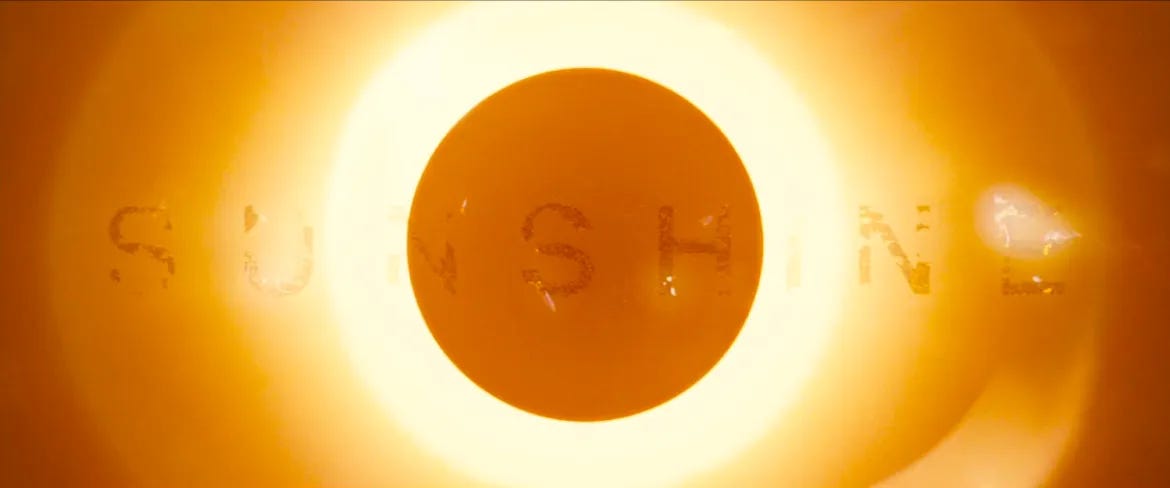
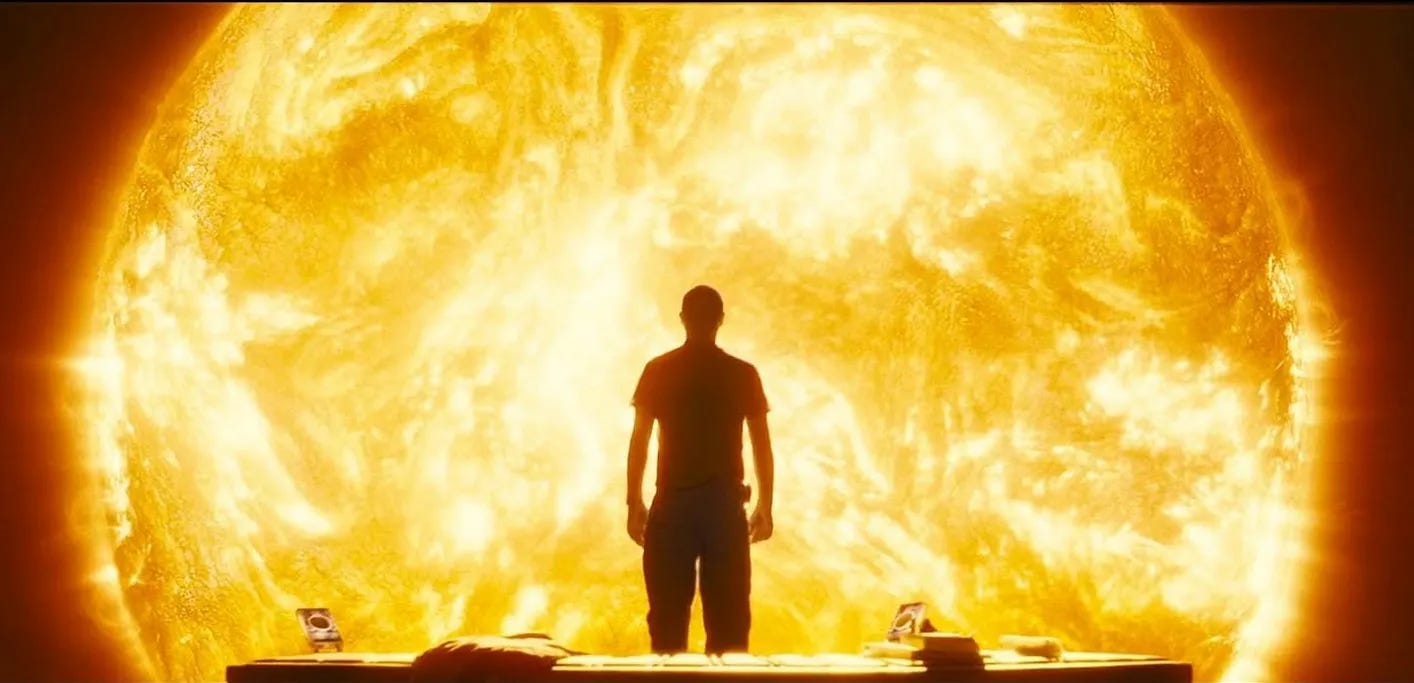
This is not an antagonist introduced through danger cues or narrative warning. This is visual occupation. Through overexposure, lens flare, gold saturation, and frame-filling light, the camera renders the sun as something that overwhelms perception before it endangers bodies. Darkness recedes. Edges dissolve. The image does not recoil.
The image doesn’t simulate damage. It sustains it. To achieve that burn, exposure is pushed until information is physically destroyed. What disappears cannot be recovered. The sun doesn’t just overwhelm the frame. It consumes it.
This is not narrative theology. It is cinematographic argument.
Meaning in Sunshine does not arrive through dialogue about physics or extinction. It arrives through how the image behaves under pressure. The camera insists on proximity long before the plot demands sacrifice. To look is already to risk erasure.
And once that risk is normalized, it does not stay contained inside the frame.
Priesthood as Distance Management
The shield holds.
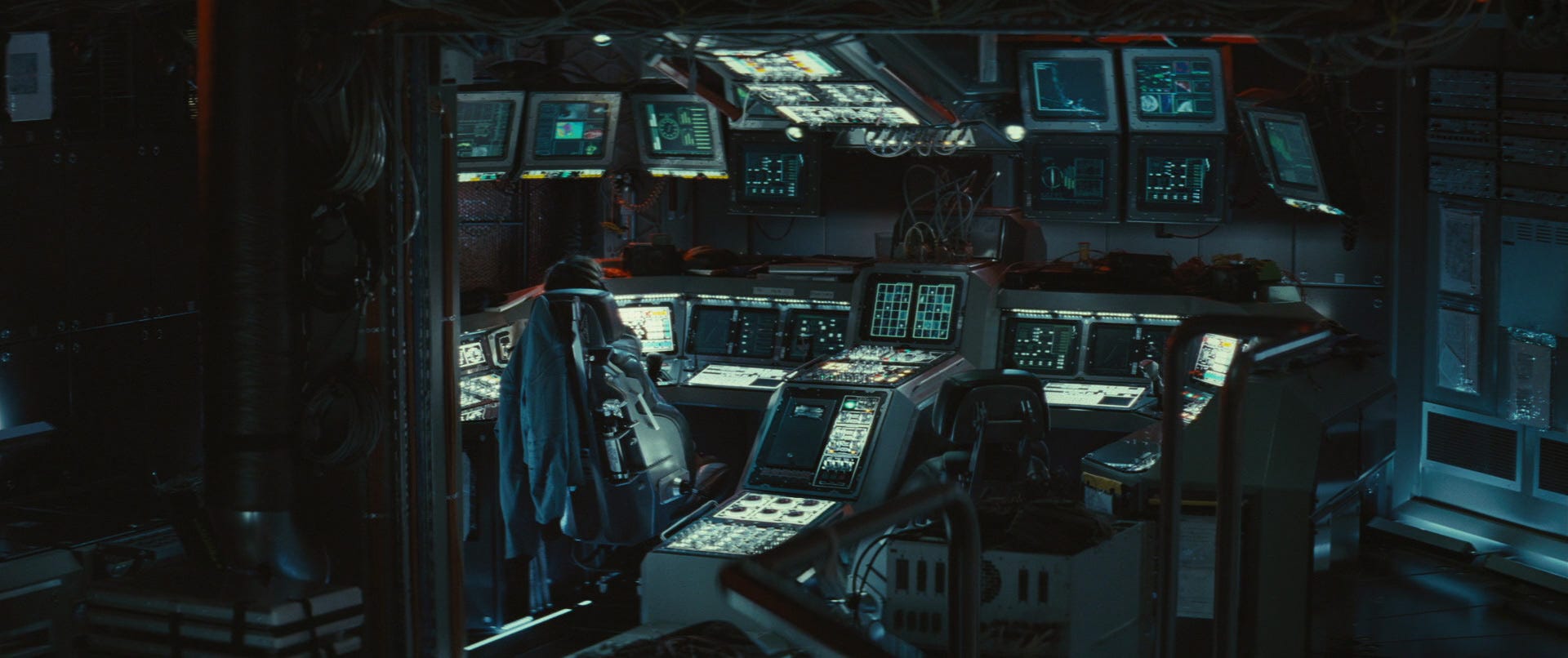
Readouts steady. Exposure locked. Angle correct. The hum does not change pitch. No alarms. No voices raised. The ship continues doing exactly what it did a moment ago, and that continuity feels like relief.
Nothing dramatic occurs. That is the point.
Distance is preserved through adherence. A sequence of checks. A refusal to look longer than permitted. A decision made once and then repeated until it disappears into routine. The film lingers here long enough for calm to feel earned.
Only then does Sunshine reveal what this calm is built from.
The crew are not explorers. They are not seekers. Their labor exists to regulate proximity to something that cannot be safely approached. Every system aboard the Icarus II is designed for this purpose: exposure thresholds, shield angles, restricted sightlines, observation limits. The ship is not a vessel of encounter. It is an instrument of separation.
Persuasion happens quietly.
Through repetition, silence, and sound, the film trains the viewer to accept mediation as virtue. The constant hum is not atmosphere. It is proof that containment still holds. As long as it persists, distance remains ethical. Discipline becomes safety. Looking less becomes responsibility.
The crew’s authority resembles a priesthood without belief. They perform rituals of restraint without reverence. They do not worship the sun. They manage it. Their legitimacy comes from procedure, not conviction.
And the film rewards this posture.
Competence is framed as virtue. Breach is framed as failure. Those who maintain distance are granted composure. Those who cross the boundary are destabilized.
Mediation becomes the unspoken ethic of survival.
Not as doctrine.
As work.
Pinbacker, Untransmittable
Something is wrong with the image.
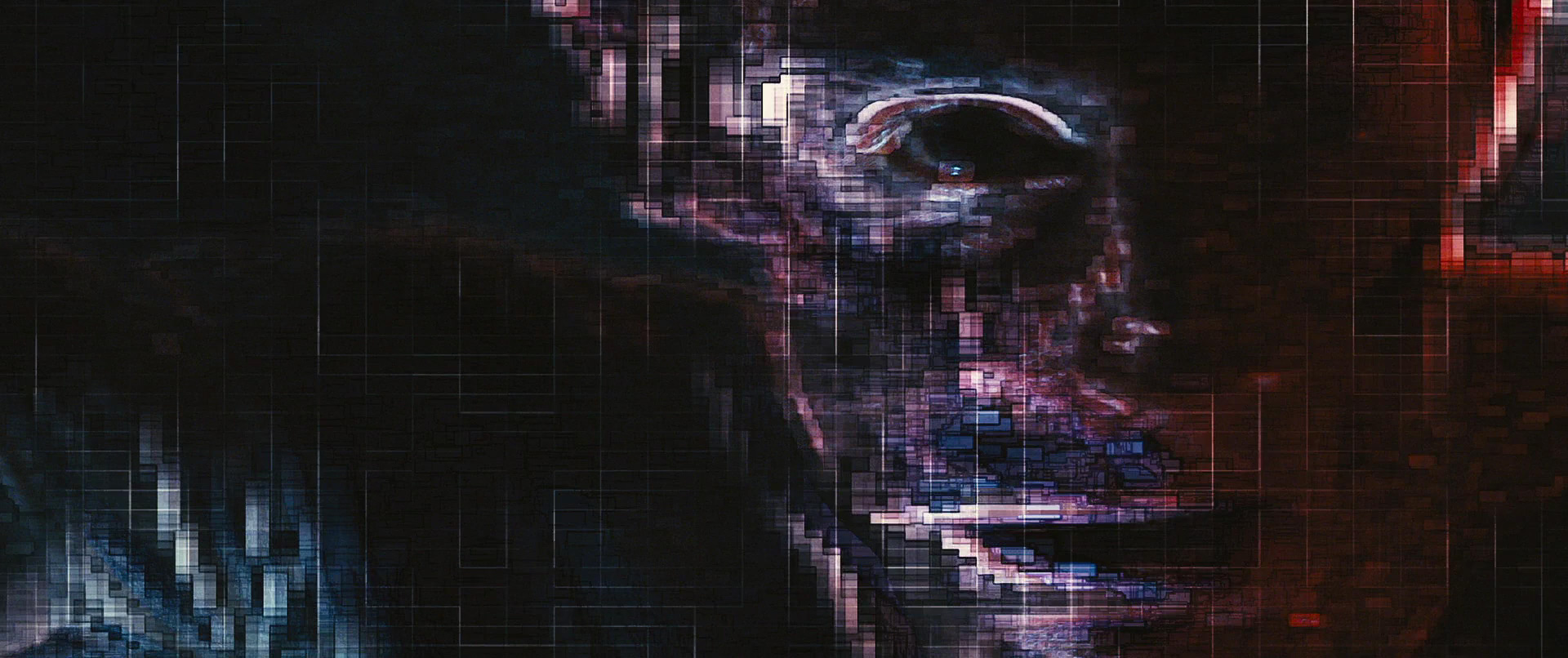
Not announced. Not escalated. It arrives as distortion. Motion smears. Focus slips. Cuts misalign. The camera records, but what it records will not settle.
You do not get an entrance.
You get interference.
Pinbacker does not appear so much as interrupt. He is never granted a stable outline. The closer the film gets, the less coherent he becomes. Faces refuse to hold. Time stutters. The visual grammar the film relied on begins to fail at the point of contact.
The film offers burns, scripture, testimony, seven years speaking to God, but the image refuses to stabilize him long enough for belief to become explanation.
The ship depends on regulated transmission. So does the camera. Distance, filtration, containment. Pinbacker exits that economy. He does not cross a boundary. He renders the boundary meaningless.
That is his danger.
He threatens representation before he threatens bodies. The film cannot look at him without breaking its own rules. So it glitches. The distortion is not atmosphere. It is structural failure.
When the image can no longer govern what it records, the system that relied on mediation is already compromised.
The camera keeps recording.
But it no longer knows how.
Cosmic Bliss and Asymmetrical Seduction
The death is clean.
Not narratively. Visually.
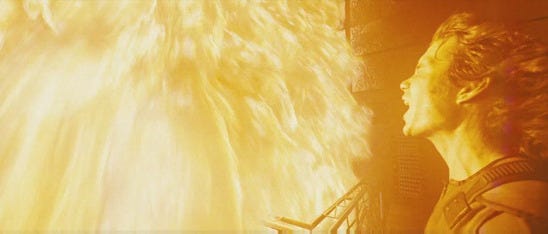
The frame opens. Scale replaces urgency. The light is unbearable but precise, arranged, almost tender in how it spreads. The score rises into something steady, something patient. Time slows just enough for the moment to feel earned.
Kaneda is still.
The film does not follow him inward. It does not give you fear, resistance, or pain. It gives you distance. Long enough for awe to take hold. Long enough for the sensation to register as calm rather than panic.
This is where the seduction completes its work.
Because the bliss does not belong to him.
The film withholds Kaneda’s interiority until sequence becomes pure spectacle. Scale. Stillness. Light. The absence is functional. It allows the viewer to experience annihilation without inhabiting it. The cost is removed. The pleasure remains.
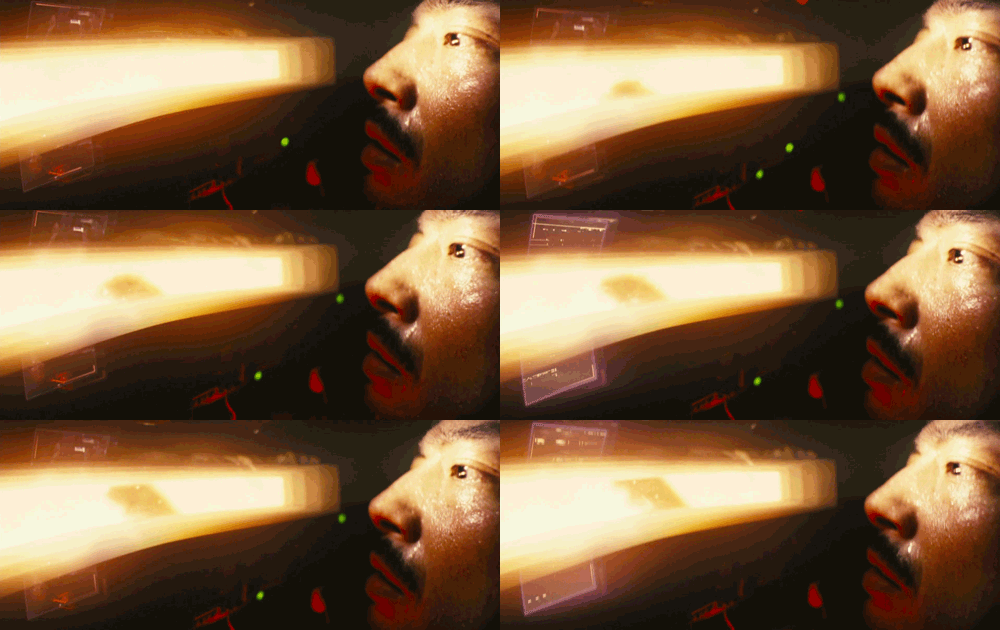
You are safe. He is gone.
Only later does the imbalance become visible.
The image offers transcendence, but only from the protected side of the glass. The audience receives the aesthetic reward of dissolution while the character absorbs the consequence. The film does not ask you to choose this position. It assigns it. The shield holds for you. The heat does not.
This is not an accident of tone. It is a structural asymmetry.
The same visual language that framed the sun as sublime now frames erasure as beautiful. The camera lingers where it should recoil. The score elevates where it should interrupt. The sequence teaches the viewer how to enjoy what they are not required to survive.
This is the danger the earlier discipline was preparing for.
Distance made the image ethical. Distance made the work possible. But here, distance also makes bliss consumable. The viewer is invited to feel calm at the moment someone else is erased. Not because the film tells them to, but because the image has been training them all along.
Nothing is explained. Nothing is corrected.
The film simply lets the pleasure land.
And by the time you notice that it landed unevenly, the frame has already moved on.
Fear as Tether
Fear arrives quietly.
Not as panic. Not as collapse. As hesitation. A pause where momentum should be. A refusal to step closer when the image keeps inviting it.
The film has taught you, by now, how to read this pause. It looks like weakness. It sounds like doubt. It slows the rhythm at the exact moment the spectacle wants to accelerate.
But this hesitation does not break the system. It holds it together.
Fear, here, is not the failure to surrender. It is the mechanism that keeps surrender from becoming theft. It preserves attachment. It keeps bodies from dissolving into images too easily. It remembers that proximity has cost.
Where bliss erases distance, fear restores it.
This is why refusal matters. Not as heroism. As restraint. The choice not to look longer than permitted. The choice not to confuse awe with obligation. The choice to complete the task without mistaking annihilation for meaning.
Fear keeps intention legible.
Without it, devotion and duty collapse into the same posture. Both move toward the light. Both require proximity. Both look identical when framed at scale. The difference cannot be seen. It has to be felt.
Fear keeps that difference alive.
The film does not reward fear with triumph. It allows fear to remain intact. It lets responsibility survive the image’s demand to dissolve it. It lets the work be finished without declaring the act beautiful.
This is not moral correction. Nothing is resolved. The image still wants what it wants.
But fear interrupts the seduction just long enough to make consent possible.
It does not save anyone.
It keeps something from being lost.
The Hecatomb, Completed Without Witness
The work is finished the way it began.
Quietly.
No crowd. No shared gaze. No one left to receive the image as reward. The frame does not open outward. It closes down into procedure. Hands move where they are told. Time is counted. The body remains secondary to the task.
The camera does not offer transcendence here. It offers proximity without celebration.
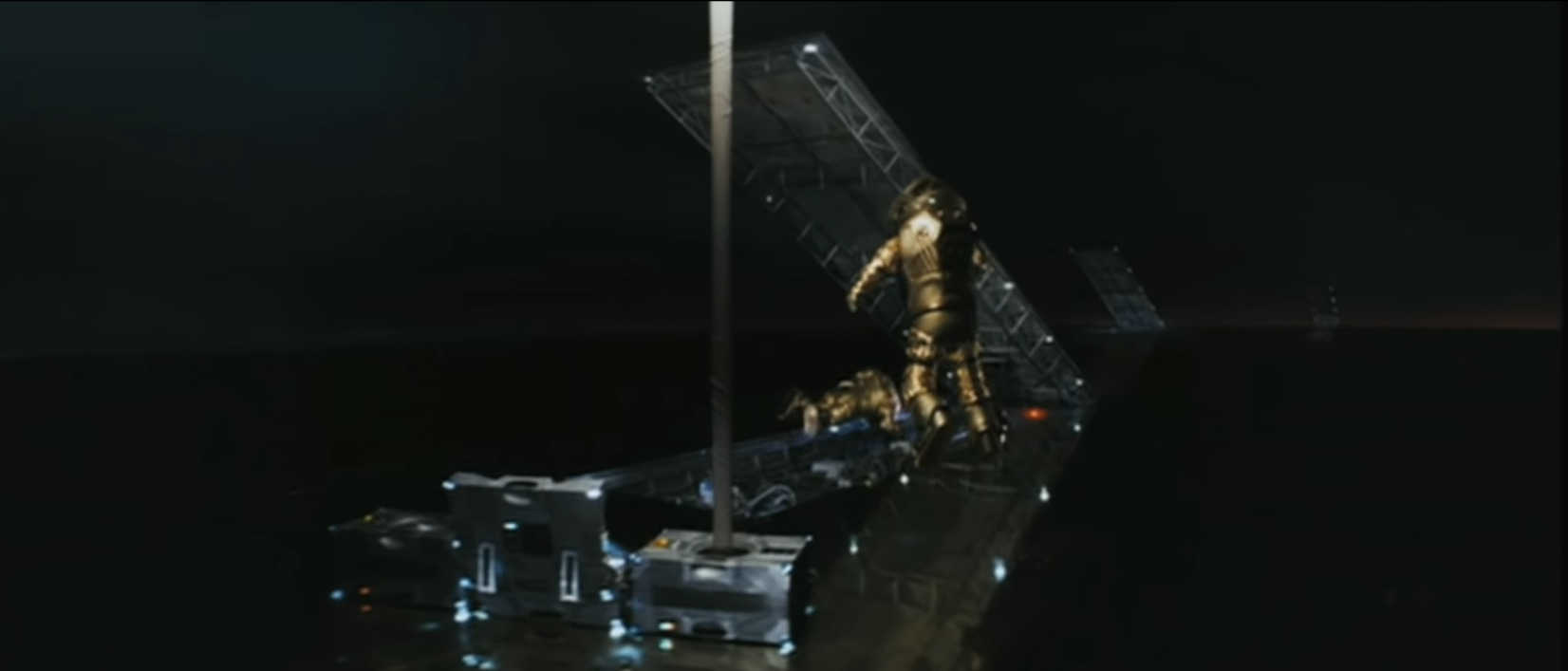
Capa’s final act is not framed as surrender. It is framed as completion. He does not seek union. He seeks an ending that holds long enough for others to live. The movement is deliberate. The posture is restrained. The action is small compared to the scale surrounding it.
And yet the image hesitates.
The same visual language that once made annihilation beautiful returns, unwilling to fully distinguish intention from posture. Reaching toward the payload visually rhymes with earlier acts of surrender. The camera cannot entirely separate duty from devotion when both require closeness to erasure.
That unresolved rhyme is not a flaw. It is the cost of finishing the work.
The sacrifice succeeds precisely because it is unseen. No audience receives it. No witness converts it into meaning. The image does not linger long enough to let bliss take hold. There is no time for awe to settle into pleasure.
What remains is absence.
A system that continues without those who completed it. A hum that does not return. A task fulfilled without reward. The film refuses to make this moment warm. It refuses to make it exemplary.
The hecatomb does not redeem the seduction that preceded it. It does not correct the pleasure the viewer was taught to feel. It simply ends the sequence of looking.
The frame closes. Nothing follows.
The Escaped Idea
What if the danger was never the sun.
What if it was how easily the image taught us to enjoy watching others burn
and how little it needed from us
to do so.
The frame is already closed.
This essay is one attempt to sit with what Sunshine leaves unresolved.
If you want to stay with it longer, comments are open.
This is the peril of the sublime that annihilates. Its inverse is the sublime that adopts, a system that upgrades rather than erases, a subject explored in my reading of Avatar. One god consumes. The other compiles. Both train the eye to accept the cost.
Works Cited / Referenced Thinking
Burke, Edmund. A Philosophical Enquiry into the Origin of Our Ideas of the Sublime and Beautiful.
Boyle, Danny (dir.). Sunshine. 2007.
Garland, Alex. Sunshine (screenplay).
Select writings on cinematic rhetoric, visual persuasion, and ethical spectatorship referenced implicitly throughout.
Acknowledgements
This essay exists because Sunshine exists, because of the collective labor that made it possible.
To Danny Boyle, Alex Garland, Alwin H. Küchler, John Murphy, the cast, and every department whose work made light, scale, and restraint feel tangible: thank you for a film that refuses comfort and still earns awe.
Whatever this essay sees, it sees because the craft holds.
Disclaimer (Important but brief)
This essay interprets Sunshine through its images, rhythms, and effects on the viewer. It makes no claim about authorial intent or definitive meaning. Any coherence found here belongs to the reading, not the film, which remains productively unresolved.
Love this movie. The distress call from Icarus One was my ringtone for many years.
I don't remember the existence of this film whatsoever, but I am intrigued!