
Repo Man
The Trunk Comes First

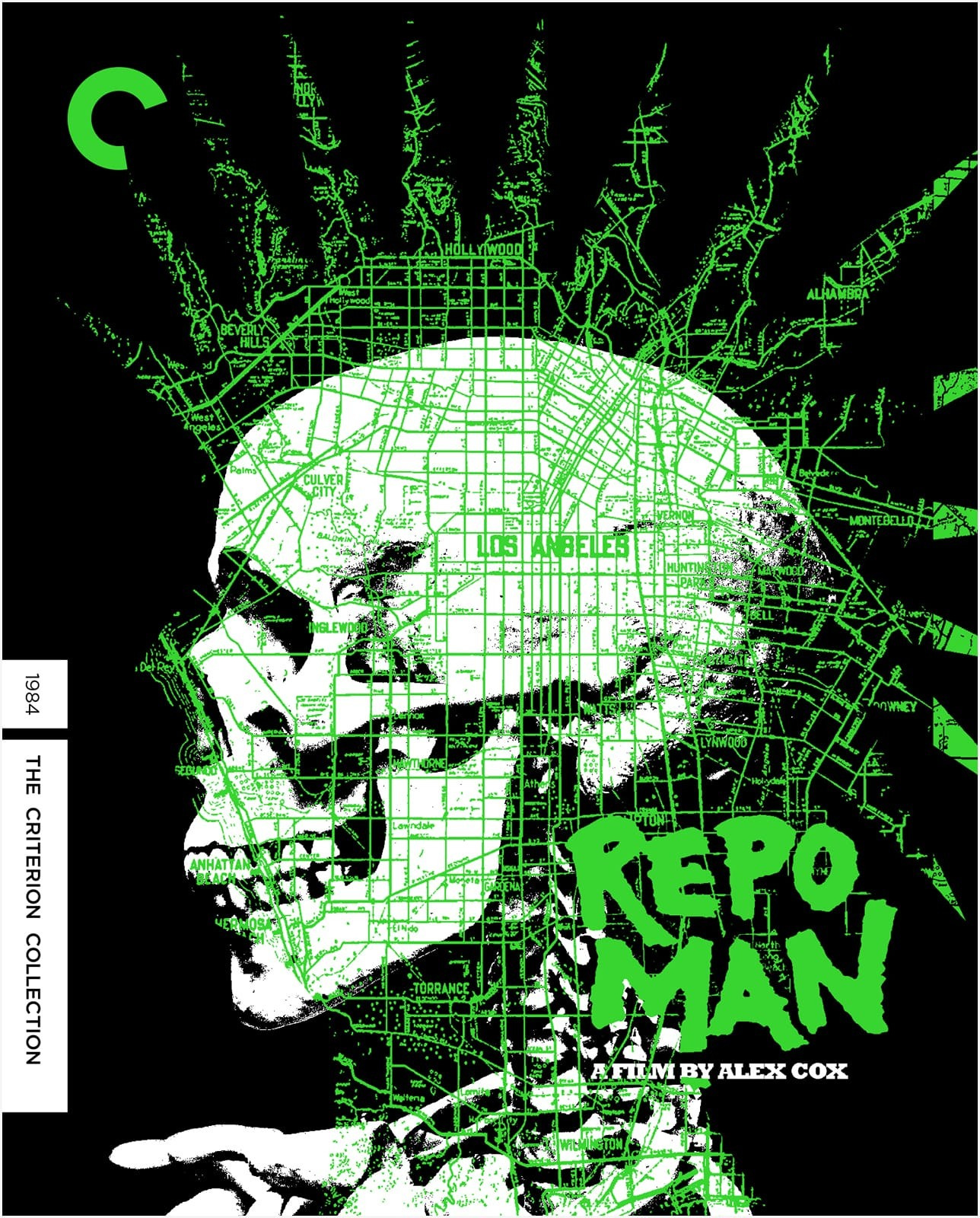
Repo Man begins with America reduced to a route.
Green text on black. Los Alamos to Santa Fe to Albuquerque, then west along U.S. 66, the old road pulling everything toward California before anyone has explained what is being carried there. The map has the clean confidence of official knowledge. It gives the movement a shape. It does not make the movement safer.
Then the Malibu appears.
A green 1964 Chevy crossing the desert while J. Frank Parnell sings “Clementine” badly enough that the song feels less performed than leaked from some older, broken version of the country. A folk tune. A highway. A cop. A trunk. All the pieces are familiar before they become dangerous.
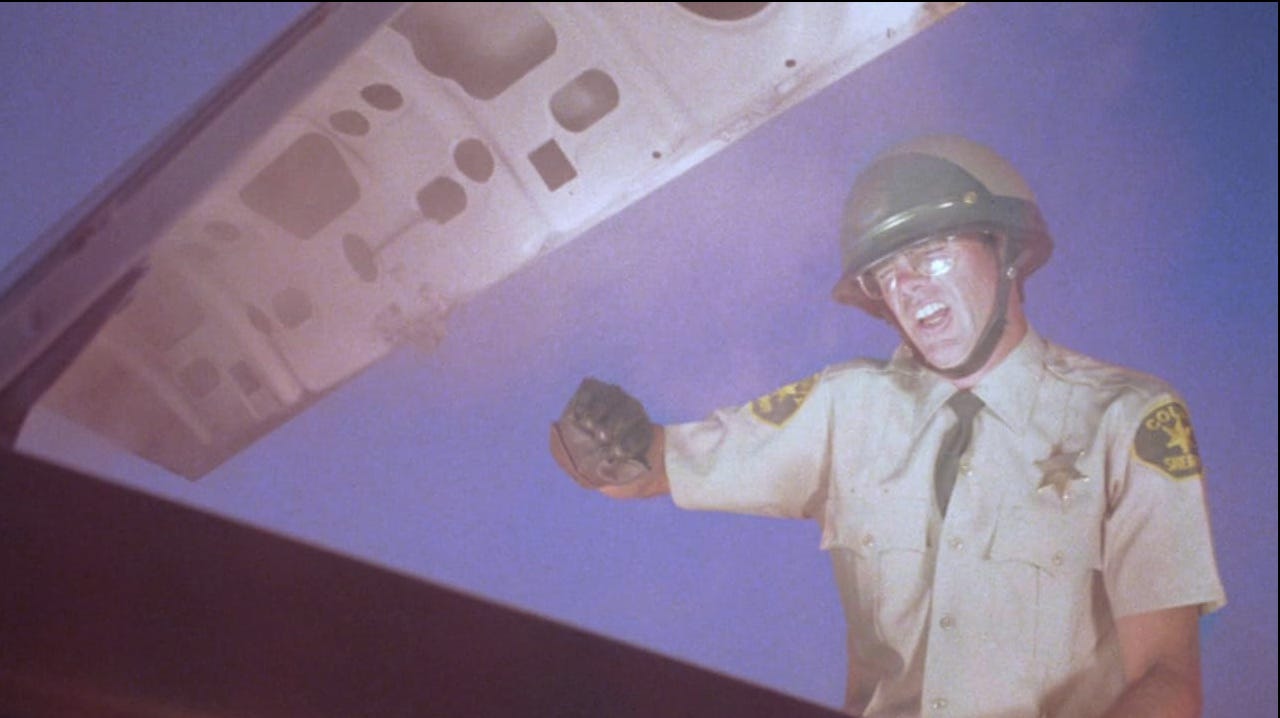
The motorcycle cop pulls him over.
License. Questions. Keys.
Parnell gives him the only warning available.
“You don’t want to look in there.”
The cop looks anyway.
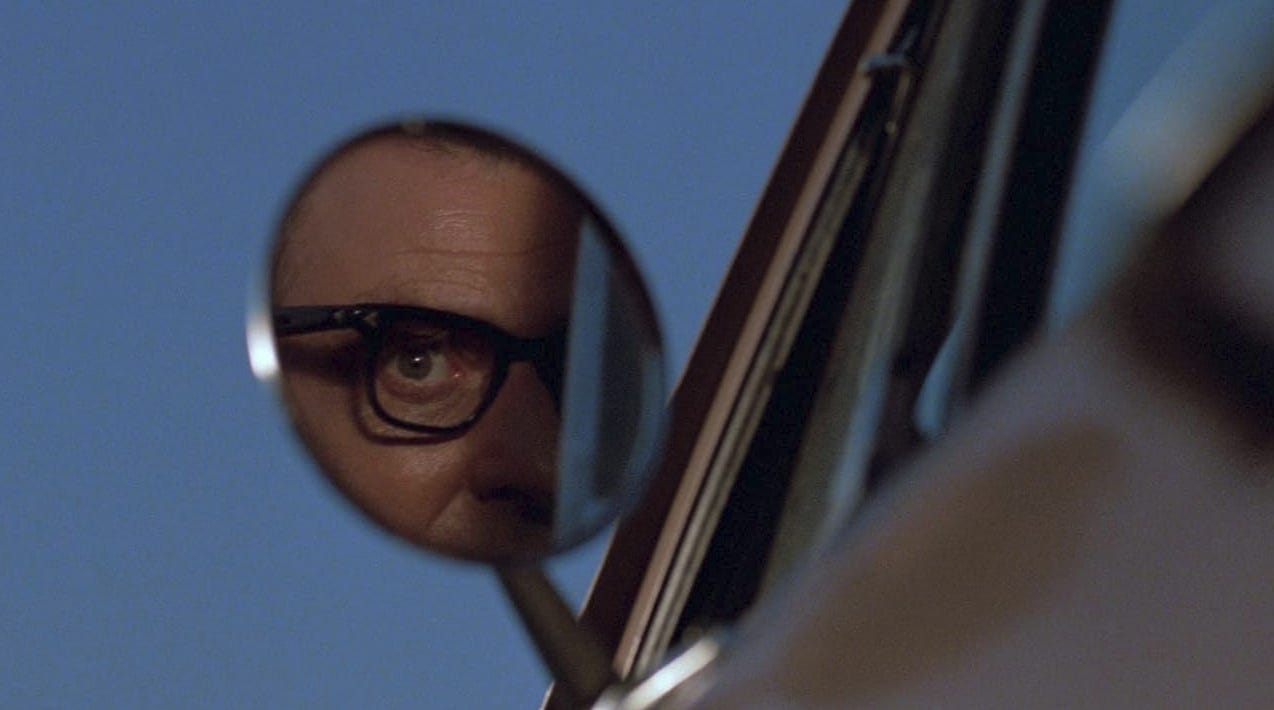
Light. A scream. Then only boots. Flaming boots left in the road while Parnell watches from the side mirror, one lens missing from his sunglasses, still singing as if nothing behind him has changed. The car moves on. The song moves with it. The trunk has already taught us more than anyone has explained.
Then come the canned peaches.
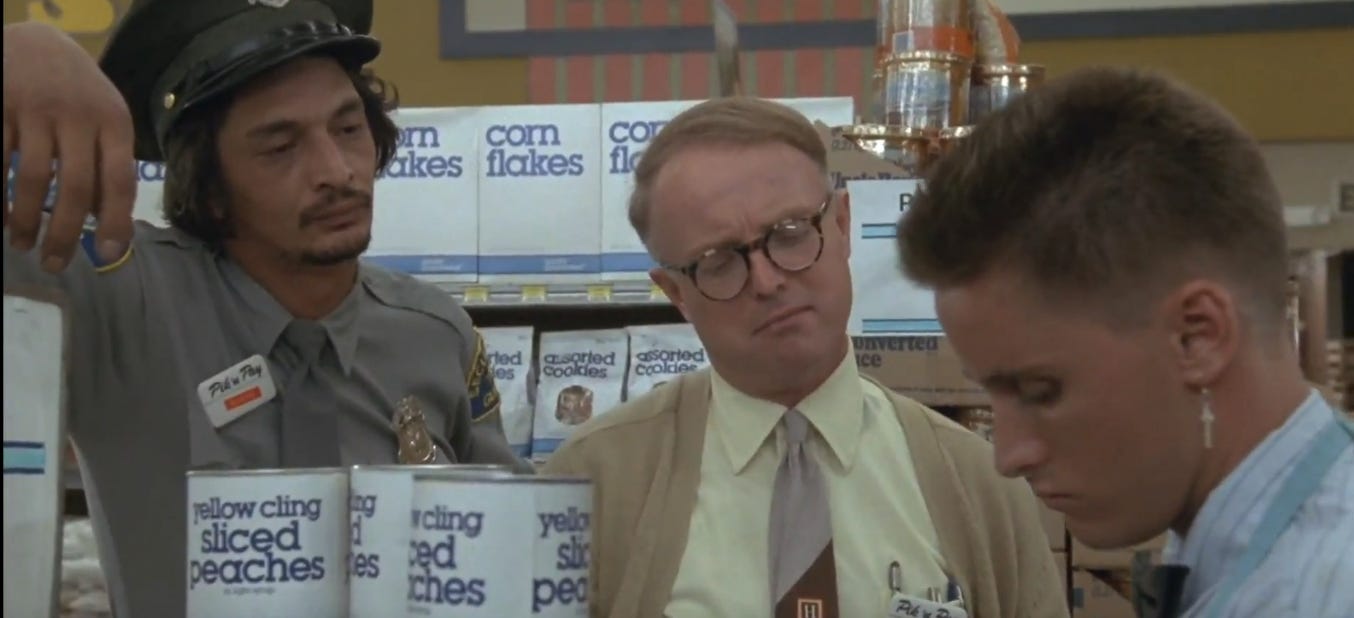
Not real peaches, exactly. Generic yellow cling sliced peaches. White labels. Blue letters. Product stripped down to category. Kevin sings a 7-Up jingle beside Otto’s irritation while Mr. Humphries talks about lateness, can spacing, and young men in uncertain times, as if uncertainty can be stacked into rows.
Otto puts a price sticker on Kevin’s glasses.
Louie pulls a gun.
The cans collapse.
The store looks organized until someone touches it. The badge lasted until the trunk opened. The aisle lasts until a body hits it. The label says peaches. The room says order. The bodies disagree.
So the Malibu keeps moving.
Not as an answer. Not yet.
A hot trunk. An old song. A road headed west. A car everybody will try to name before it ever agrees to be understood.
The trunk comes first.
Then everyone talks.
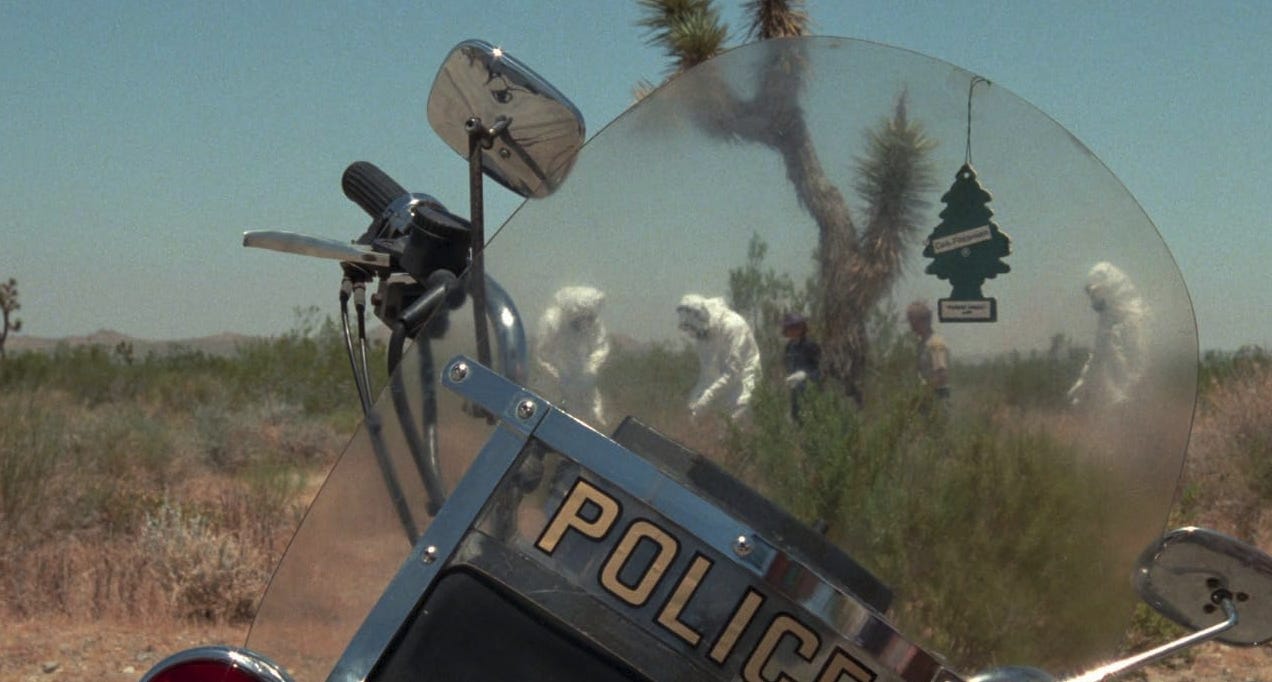
By the time the government reaches the desert, the body has already learned more than the report can hold.
Radiation suits move through the open space. A sheriff tries ordinary damage first. Gasoline. Napalm. Something with a name. Agent Rogersz gives him something thinner.
“It happens sometimes. People just explode. Natural causes.”
The lie barely rises to concealment. It sounds like procedure filling a hole. Then the screen gives fragments: suspect presence confirmed, west coast possibility, locate immediately, do not notify police. Radio calls. Probability. Containment language. Secrecy. Enough to hide the disturbance. Not enough to command it.
The Malibu keeps moving.
Parnell should be the closest thing to an answer. He comes from the world that made this brightness imaginable. Los Alamos is already behind the opening map. His body carries damage before his language names it: hair loosening, mind eroding, one lens missing, speech looping through old songs, weapons projects, Utah, lobotomy, classification, radiation.
He knows the machinery.
The machinery does not answer to him.
Later, when Otto catches the Malibu at the railroad crossing and Parnell lets him in, explanation enters damaged. Parnell can talk about missile tracks across Utah, Arizona, and Nevada. Bombs hidden in locomotive sheds. The neutron bomb small enough to fit in a suitcase. A weapon that destroys people and leaves buildings standing. Work immoral enough to turn the mind against itself.
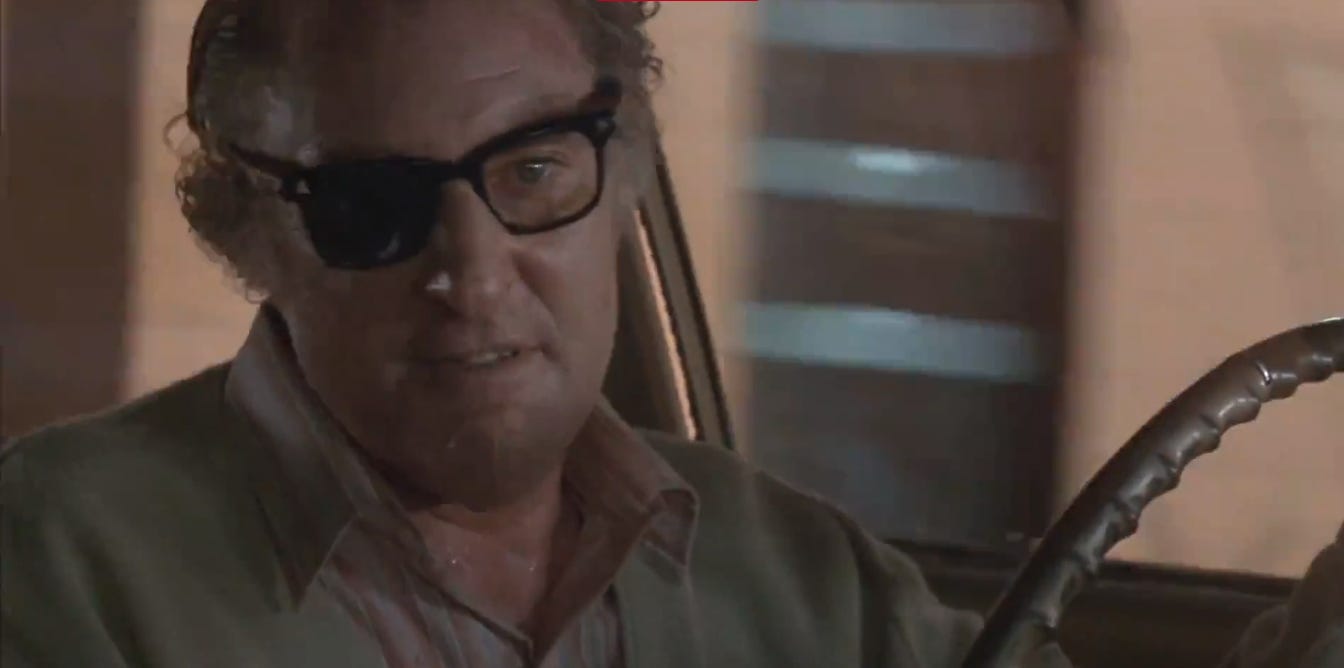
Still, he drives until he cannot.
He talks around the trunk as if language can delay contact. He passes out at the wheel. Otto dumps him and takes the car.
Leila arrives with a different confidence.
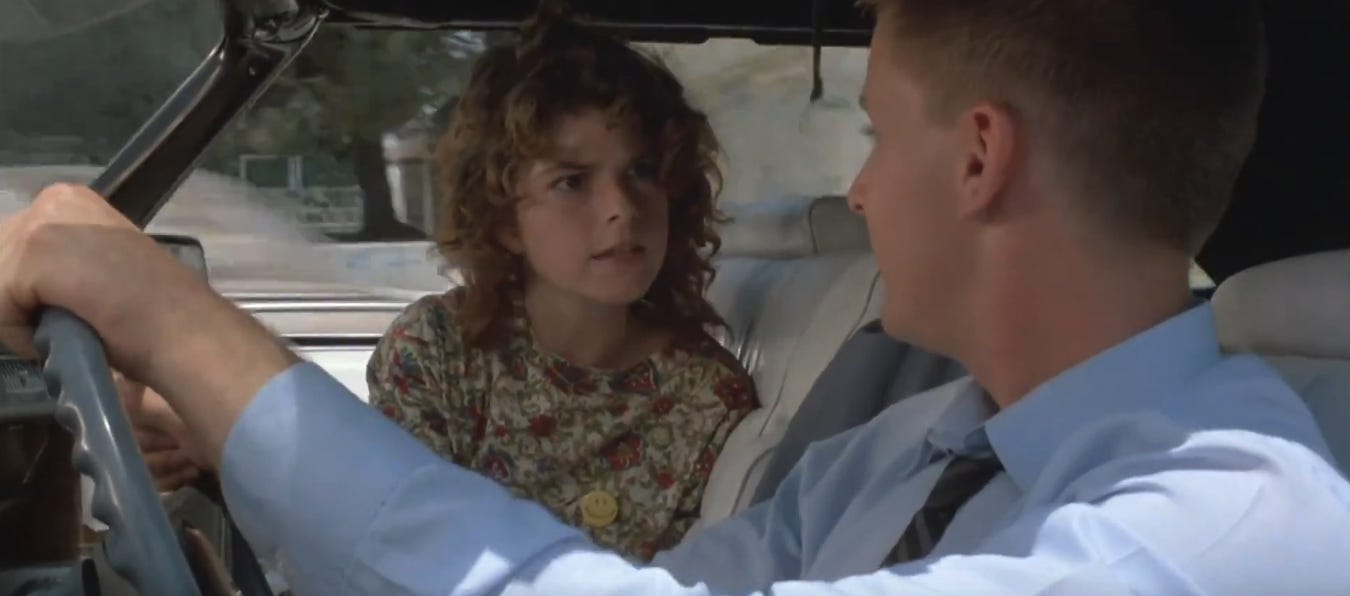
She has the photograph. Dead aliens, she says. A secret network. A scientist in the sect. A Chevy Malibu with corpses in the trunk. A press conference coming. Major newspapers. Public exposure. Johnny Carson, if necessary.
Otto laughs because the proof does not look like proof. Condoms filled with water, little grass skirts, a conspiracy reduced to something close to a gag. The image humiliates the claim before the claim can defend itself.
The laugh makes her small.
The movie does not let her stay there.
She may be closer to the truth than almost anyone Otto meets. The Malibu may contain exactly the kind of impossible cargo she says it contains. The government may be hiding exactly what she thinks it is hiding.
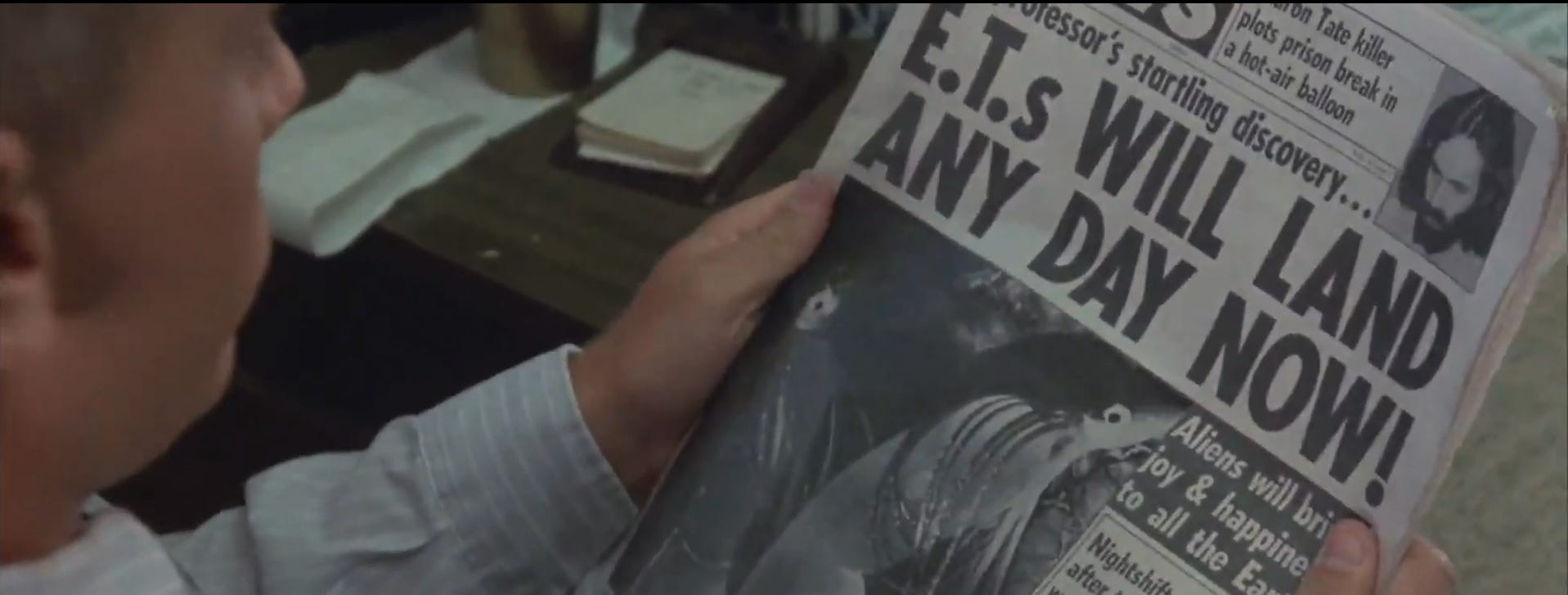
She has proof without leverage. Disclosure without a path. Belief without an institution that will become honest because truth has entered the room. The world does not have to become accountable when Leila knows something. It can laugh at her, watch her, absorb her, redirect her, or hire her.
The believer may be right, and it still may not matter enough.
By then, the car has gathered too many languages. Police language. Federal language. Scientific language. Conspiracy language. Press language. Each one reaches for the trunk and comes away smaller. The badge becomes boots. The report becomes nonsense. The expert becomes wreckage. The witness becomes comic and endangered at once.
Then the bounty makes the impossible look usable.
Twenty thousand dollars for a 1964 Chevy Malibu.
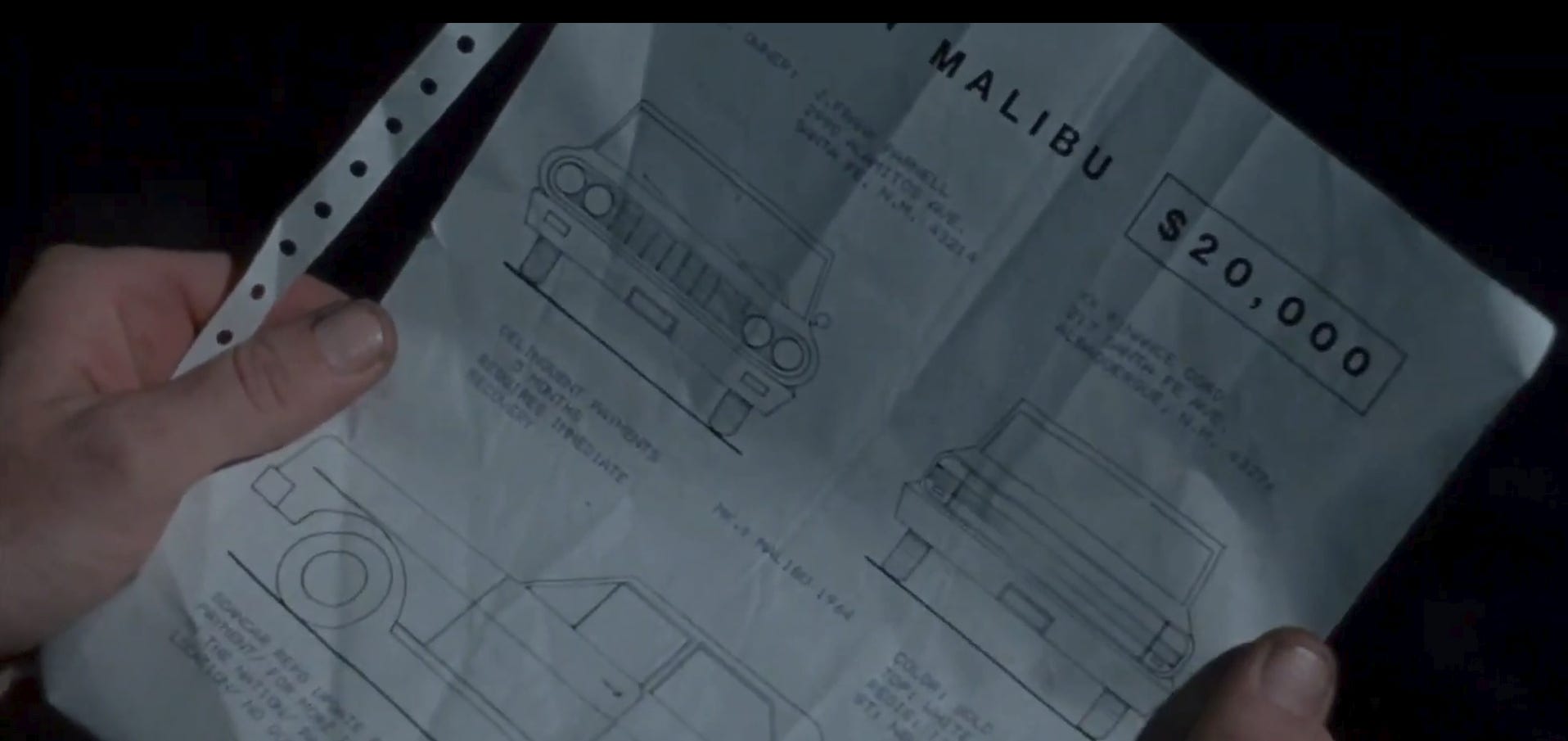
Now the object has a price.
The repo world understands price better than mystery. Debt, contracts, paper, commission, pink slips, ownership, recovery. Oly does not need revelation. Marlene does not need awe. Bud does not need disclosure. The number is enough to reorganize the city.
Twenty thousand dollars turns the unknown into a job.
It gives everyone a reason to move without giving anyone a reason to understand.
The Malibu is not random.
It has rules.
But the rules never become authority.
The trunk punishes contact. The heat becomes physical. The glow intensifies. The warning counts. Looking costs. Touching costs. Standing too close can change the room.
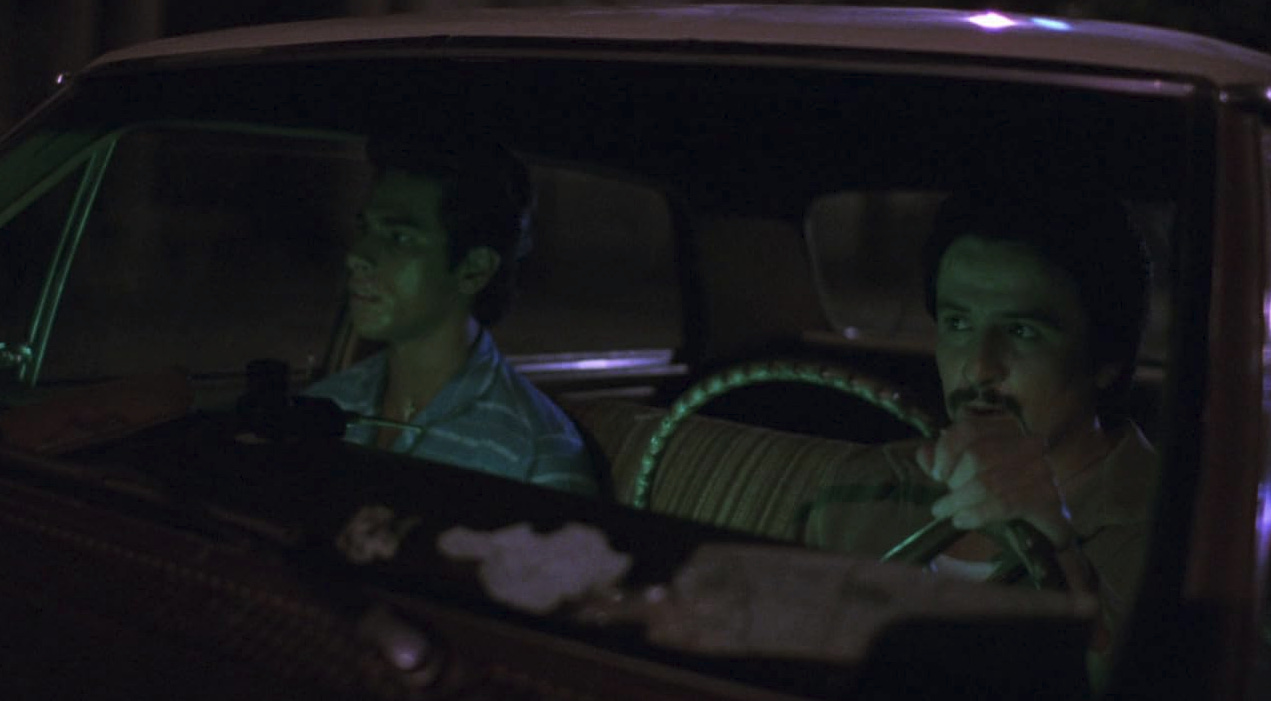
The Rodriguez brothers can tell the car is hot before they can say anything useful about why. Duke burns his hand. Archie opens the trunk and disappears. The body keeps learning what the mind cannot organize. Every explanation arrives one step late, and every institution that wants the car mistakes access for mastery.
The police want violation.
The agents want containment.
Leila wants disclosure.
The repo men want commission.
The punks want possession.
The Malibu gives them contact.
That is all.
It does not reward the person with the correct theory. Parnell knows more than Otto and still collapses behind the wheel. Leila believes more than Otto and still cannot turn belief into force. The agents control more than everyone and still chase the car like fools. The repo men know how to take cars from people, but this car turns their knowledge into heat, light, panic, movement.
The scientist does not reveal the secret.
The believer does not get vindicated.
The government does not get exposed.
The worker does not claim the prize.
The rebel does not steal freedom out from under the system.
The car keeps refusing promotion.
It remains a Chevy Malibu.
A junk object with cosmic pressure inside it. A road machine. A debt object. A weapon. A rumor. A payout. A destination nobody understands well enough to deserve.
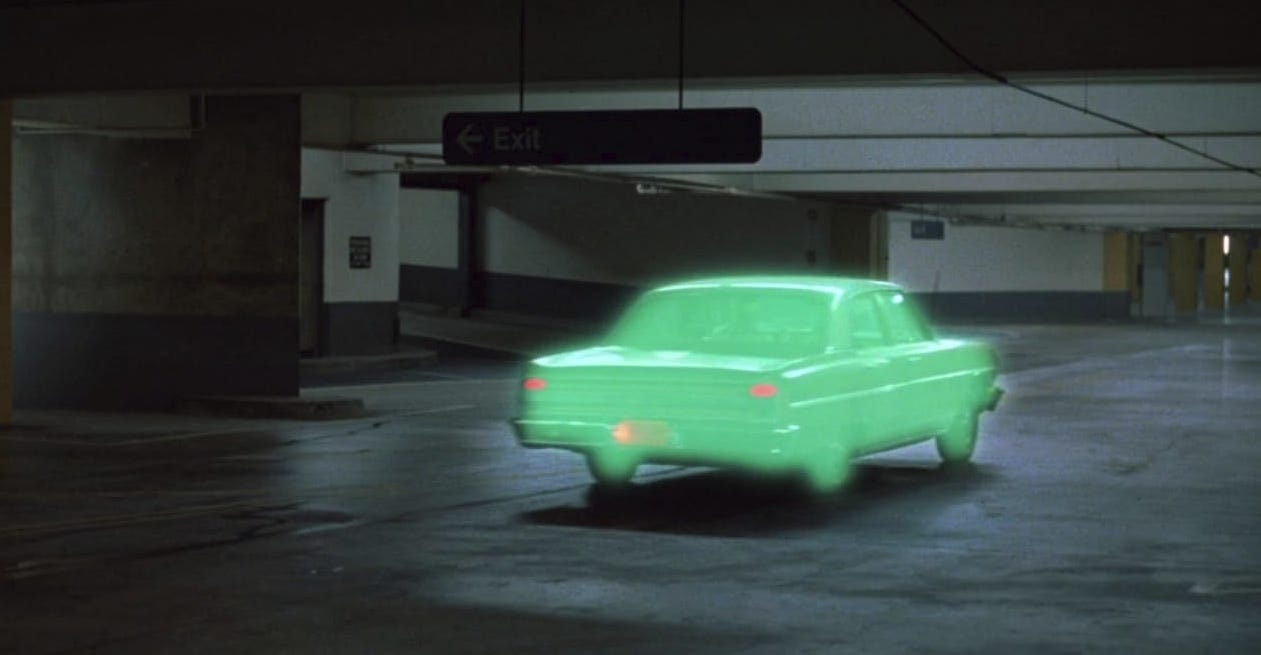
The glow is harsh, radioactive, physical. It does not bless the frame. It contaminates it. It makes the car impossible to miss, then punishes the impulse to look too closely.
The first warning keeps returning.
You do not want to look in there.
There is something in the trunk.
It has rules.
Looking costs.
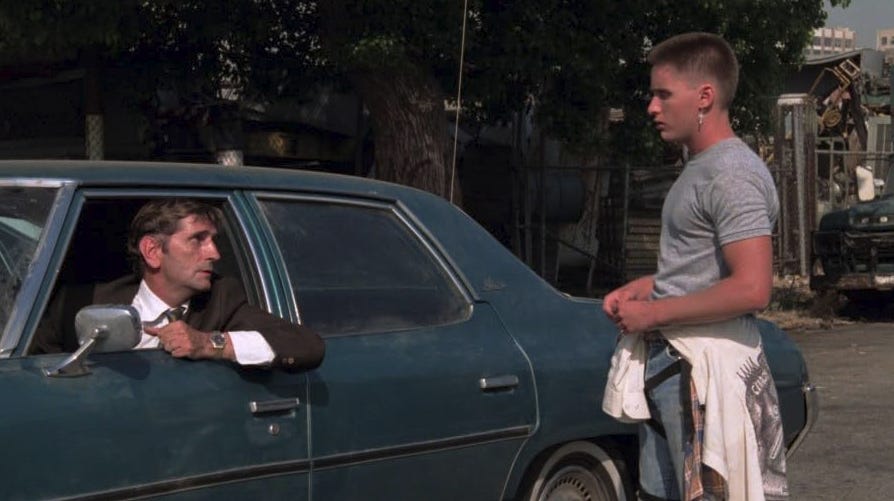
Sick wife. Pregnant. Twins. Bad area. Helpful soul. Twenty-five dollars.
Bud’s story changes shape fast enough that Otto can feel the scam and still enter it. The woman is not there. The emergency is not real. The car does not belong where Bud says it belongs. But the lie does its work. It moves Otto across the line and puts him behind the wheel.
By the time he reaches Helping Hand, the job has already taught him something.
A car can be taken before anyone agrees on what taking means.
The office gives the lie a desk.
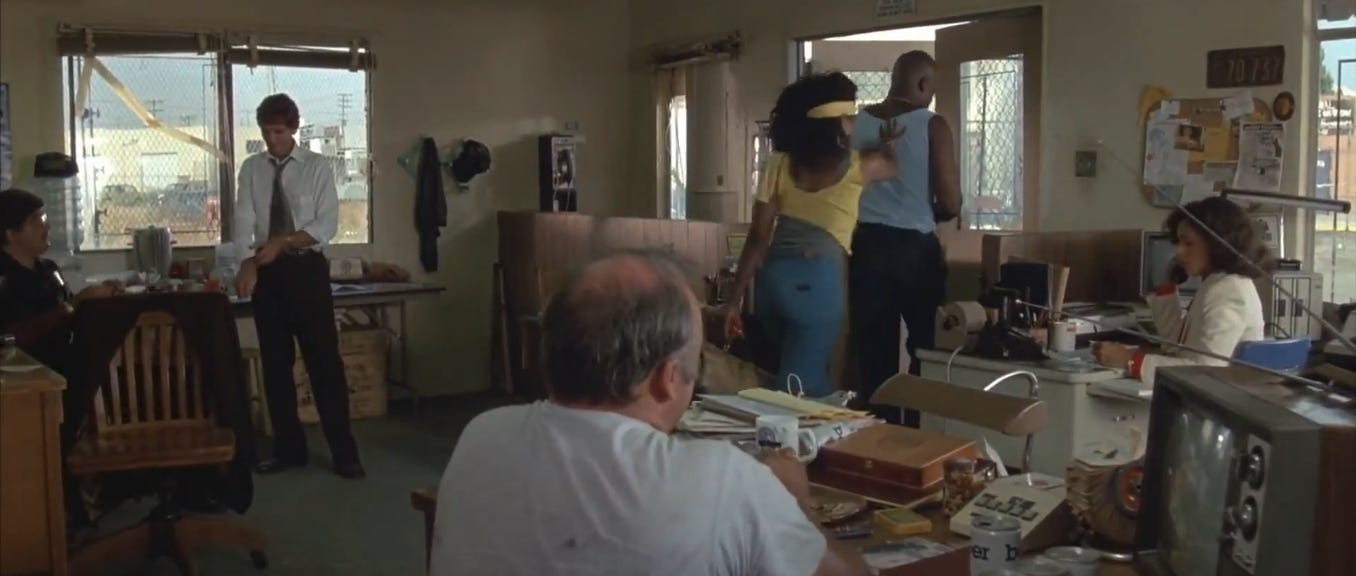
Phones ring. Marlene switches calls. Oly insults victims. Plettschner sits with old authority hanging from him like a costume. A man demands his Cadillac back and gets told, flatly, that it is not his car. Possession depends on paper. Paper depends on payments. Payments depend on someone else’s record of your failure.
Then Bud starts teaching ethics.
“Never broke into a car. Never hot-wired a car. Kid. I never broke into a trunk. I shall not cause harm to any vehicle nor the personal contents thereof. Nor through inaction let that vehicle or the personal contents thereof come to harm.”
He calls it the repo code.
The words almost sound noble until the object of care becomes clear. No harm to the vehicle. No harm to the contents. Nothing about the person whose life is being interrupted, cornered, lied to, baited, outmaneuvered, humiliated. Bud’s code has manners around property because property is where the job still believes consequence lives.
The body outside the car can absorb the damage.
Bud is proud of the code because it gives him a shape he can stand inside. He is not a thief. He is not ordinary. He is not some soft body avoiding tense situations. He has rules. He has craft. He has a way to make the work sound cleaner than it looks from the sidewalk.
“Not many people got a code to live by anymore.”
Then the work resumes.
A business card with I. G. Farben printed on it. A fake branch manager. A father sent back into the house to call a number that cannot possibly help him. Bud tells Arthur Pakman the law requires him to stay right there, and the sentence has the sound of authority even though everything inside it is a trap.
Otto watches the trick work.
The car leaves.
Pakman runs after it with shaving cream still on his face.
Bud knows where the pauses go. He knows how long an official sentence has to last before the mark turns his back. The law does not have to be true. It only has to make Pakman behave as if it might be.
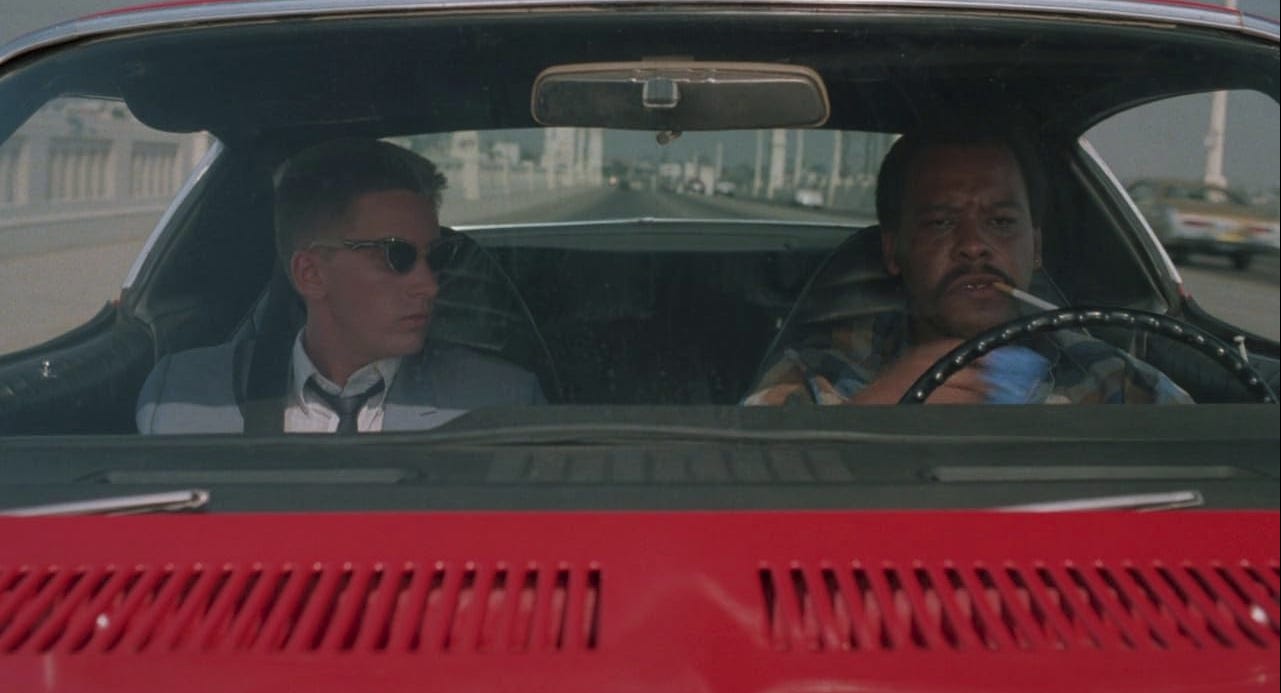
Lite teaches the same lesson with less paperwork.
Seatbelt first. Gun close by. Music chosen. Fear treated like an instrument. He tells Otto he would kill anybody who crosses him, then later fires at Otto’s feet with blanks and lets the lesson stand in the dirt between them.
“Blanks get the job done too.”
The blank is still a shot if the body jumps.
A fake branch manager can still move a debtor. A false emergency can still put Otto in a stolen car. A badge can still pull over the Malibu before the trunk proves how little the badge understands. Performance does not have to become truth to organize a body.
The Rodriguez brothers puncture the costume from inside the same game.
Bud calls them notorious delinquents. Lite corrects Otto when Otto calls them scumbags.
“They ain’t scumbags. They car thieves just like us.”
No sacred trust. No professional romance. No detective drag. The distance between repo work and theft narrows until only the preferred vocabulary keeps the two kinds of taking apart.
Even Lagarto and Napoleon keep one border for themselves.
Los Hermanos Rodriguez do not approve of drugs.
It is funny because it is selective, but selective does not make it meaningless. They steal cars, manipulate credit, dodge payments, hustle everyone around them, and still need one line they can point to and say: not that kind of bad.
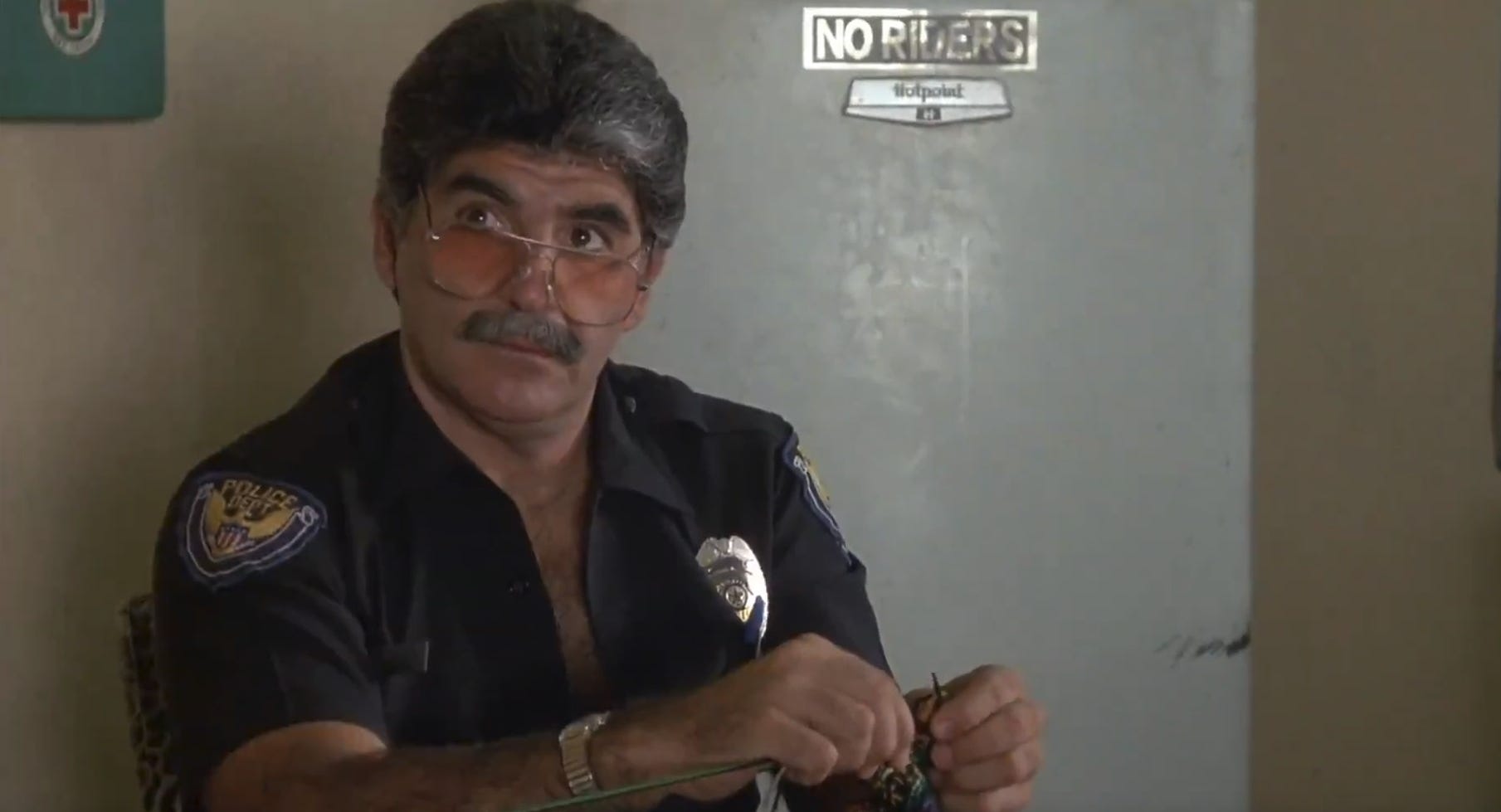
Plettschner makes that need louder.
He is not just Plettschner. He is decorated. Hardened. Authorized by history, by labor, by rooms where people died or were made to suffer. He was killing people before Otto was born. He worked in a slaughterhouse. He worked as a prison guard. His suffering sits behind him like credentials.
Otto says, “So what?”
The whole performance shakes.
So what if Bud has a code?
So what if Lite has rules?
So what if Plettschner has medals?
So what if Oly has papers?
The question cuts because none of those things can answer for the damage done in their name.
Then the room gathers around John Wayne.
Otto has been beaten in the line of duty, so someone has to pay. The men need an old image big enough to bless the retaliation without making them say too plainly what they want. The clean American idol. The straight-line man. The body that can turn group injury into permission.
Miller dirties the shrine.
John Wayne in a dress. Mirrors in Brentwood. A heroic image made private, theatrical, strange, less useful to the men who need him clean. Miller does not become wiser than everyone else. He only puts a crack through the picture.
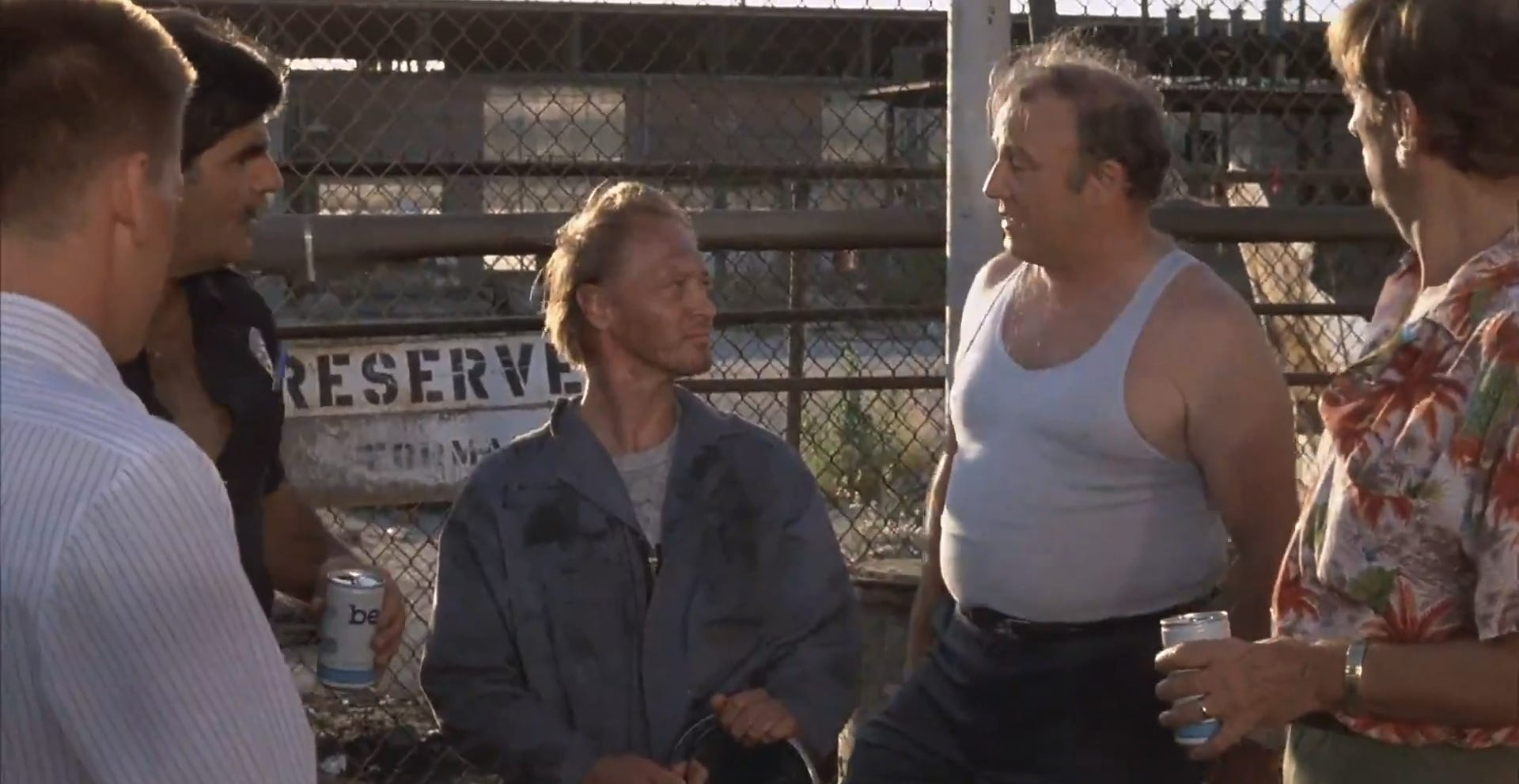
The room recovers through violence.
Lite demands a name. Oly turns revenge into professional duty. Bud protects the mythology of the injured worker. Otto’s wound becomes common property because common injury gives private cruelty a uniform.
They go to Humphries’s house and beat him instead.
The mistake exposes the ritual. The code can organize men into action. It cannot guarantee justice. Justice was never the object the room needed most. The wrong body is enough if the ritual completes.
That is the pressure Bud’s teaching keeps hiding.
A man may not break into a trunk. He may still break a person’s day open. He may not harm a vehicle. He may still lie someone out of it. He may respect personal contents. He may still treat the owner as an obstacle attached to the asset.
“Credit is a sacred trust.”
Bud says it like a creed because finance has given him one. Pay and you are real. Fall behind and your life becomes recoverable. He does not want commies or Christians in his car because both threaten the fantasy that obligation can be purified into an economic fact.
The job asks whether they paid.
Everything else becomes attitude.
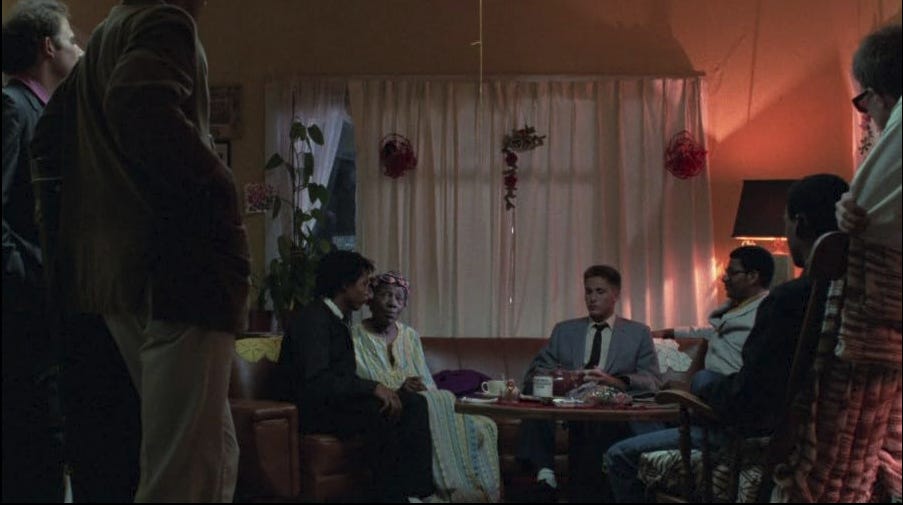
Mrs. Parks gets the soft version.
Otto sits in her living room and performs reluctance. He tells her he does not want to take the car. His job is on the line. He sounds gentle enough for Mrs. Parks to introduce him as the man from the finance company who says he will not take the car, even though he could.
Then her son comes home.
The room changes. Otto fumbles with his briefcase. The tea becomes one more awkward object between manners and theft. He tries to leave with the car anyway.
It does not go cleanly.
He is alone in the driver’s seat when they pull him out. A guitar comes down over his head.
Politeness did not make the work less violent. It only delayed the moment when the violence had to show its body.
By then, Bud’s lesson has lost its shine without disappearing. The rules still work. They make exploitation feel professional and debt feel sacred.
They just cannot become moral authority.
They can only imitate its outline.
Otto learns the outline before he learns the cost.
At the start, Otto belongs to other people’s rooms.
The grocery aisle gives him cans to stack. Mr. Humphries gives him discipline. Kevin gives him noise. Debbi gives him a beer run and a closed door. His parents give him a plate, a television, and a promise already spent somewhere else.
He keeps moving, but none of the movement belongs to him yet.
Then Bud pulls up.
A car door opens. A lie works. Twenty-five dollars changes the direction of Otto’s day. Suddenly the city has handles.
Keys. Lots. Streets. Tow trucks. Beer. Speed. Guns. Sunglasses. A slim jim sliding between glass and rubber.
Every object gives him a new way to stand.
Repo work gives Otto a shape before it gives him a belief.
He does not wake up believing in finance. He does not suddenly decide debt is sacred, or that taking cars is cleaner than stealing them, or that ordinary people deserve what happens when payment records turn against them.
First comes posture.
Suit. Tie. Detective drag. The kind of clothes that make strangers imagine a weapon before they see one. Bud tells him how people look at you when you dress square enough. How they back up. How they finish the threat themselves.
Otto absorbs that quickly.
The old grocery job made him one more bored kid under fluorescent light. Helping Hand gives him rooms that change when he walks in. Victims yell. Women notice. Men threaten. Doors open. Windows break. Engines start.
The world begins answering his presence.
That is the first narcotic.
He tells Leila he is a repo man before he knows what the title has done to him. She guesses used car salesman. He rejects that too fast because the difference matters to him now. Repo man has charge. Repo man has danger. Repo man sounds like someone who enters the scene after ordinary life has failed to protect itself.
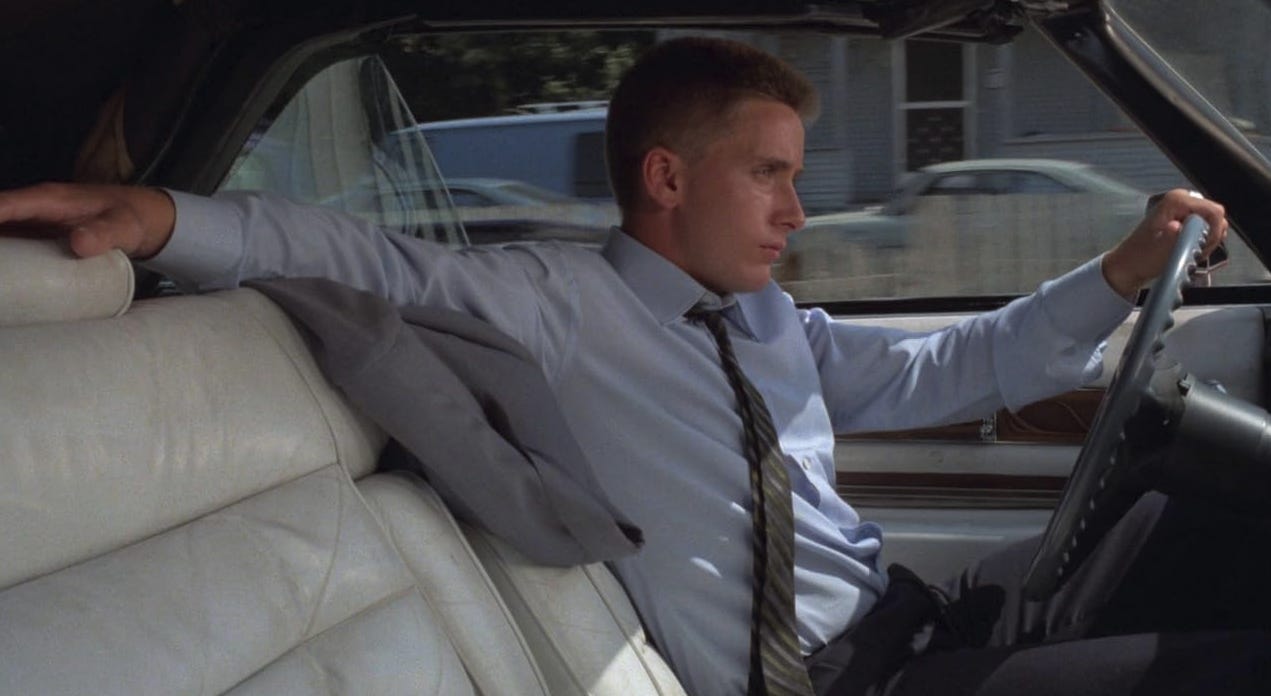
The Cadillac lets him stretch the lie.
He makes possession sound casual, as if the car extends from him by right instead of commission. The reach is almost adolescent. He wants the vehicle to make him larger before he understands how little any of these cars belong to the people inside them.
Leila gives him another role to try on.
Secret network. Dead aliens. Press conference. Major newspapers. The Malibu as proof. Otto laughs at the photograph, but he keeps circling her orbit anyway. The conspiracy gives him heat. It gives him a place where he can be wanted, questioned, pulled closer to danger, and therefore closer to importance.
Bud gives him apprenticeship.
Leila gives him mystery.
The yard gives him a tribe.
Then each room starts charging interest.
His parents’ living room is one of the coldest because it does not know it has gone cold.
Reverend Larry fills the television with holy appetite. Money, God, bibles to El Salvador, salvation spoken in the rhythm of extraction. Otto asks for the Europe money, trying to reclaim an older promise, and the answer has already been spent. His father does not simply say no. He sanctifies the loss. The money became a gift from all of them jointly.
Otto asks the only question left.
“Well what about me?”
No one in the room has a language for that.
The meal sits there. The television keeps talking. His parents keep staring forward. Belief has failed to notice the body asking to be counted.
Later, the same room looks almost fossilized.
His parents sit under cobwebs while Reverend Larry keeps preaching end times. Men in sunglasses have come looking for Otto. His parents told them the truth, gave them his work address, still smiling inside obedience. Their surrender is domestic, routine, polite. They have been trained to give him away and call it honesty.
Otto turns off the television.
A hand. A button. A little silence.
Enough to show the voice was never just background.
Bud’s voice takes longer to turn down.
There is real attachment there, ugly and partial and wrapped in the language of work. Bud teaches him tricks. Gives him speed. Gives him contempt. Gives him a version of masculinity that can survive by turning every fear into a tense situation.
When Bud feels Otto slipping, he sounds almost hurt.
“I feel like we’re not communicating any more.”
The loneliness reaches the sentence before the joke can finish with it.
Bud thought he was sharing something. Maybe he was. The job is dirty, but the bond is not imaginary. That is what Otto cannot throw away cleanly. Bud’s code is compromised. Bud’s tenderness comes bent through anger, speed, and grievance, but it still arrives.
The hospital turns that bond into usable information.
Bud lies wounded. Marlene wants the Malibu. Otto tries to apologize. He reaches for a childhood story, big wheels, some clumsy confession about leaving Bud behind at the liquor store. The words wander toward feeling.
Marlene cuts through them.
“Otto.”
Ask him about the Malibu.
The injured mentor becomes a lead. The wound becomes route planning. Otto has used rooms this way too, but now the method touches him from the other side.
Then the convenience store strips the posture down to bodies.
Bud is shot. Louie is shot. Duke is shot. The counterman is shot. Work, crime, protection, rebellion, all of it falls into the same fluorescent mess. Nobody’s role keeps its dignity for long.
Debbi remains standing.
Otto remains standing.
Duke tries to die inside a larger story.
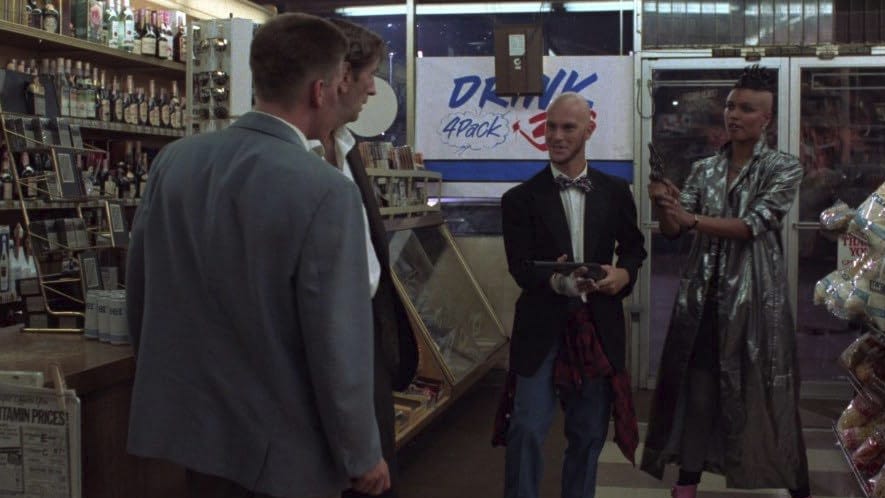
“The lights are growing dim. I know a life of crime led me to this sorry fate. And yet I blame society. Society made me what I am.”
He reaches for the frame before the body is gone. A life of crime. Sorry fate. Society. One more language arriving to make the damage feel less local.
Otto refuses him.
“That’s bullshit. You’re a white suburban punk, just like me.”
It is one of Otto’s clearest moments, which does not make it wisdom. It makes it exhaustion. He has heard enough borrowed language. Enough costumes. Enough explanations large enough to move blame out of reach. Duke wants a final myth big enough to rescue him from the smallness of his choices. Otto denies him the upgrade.
Then Duke answers from below the argument.
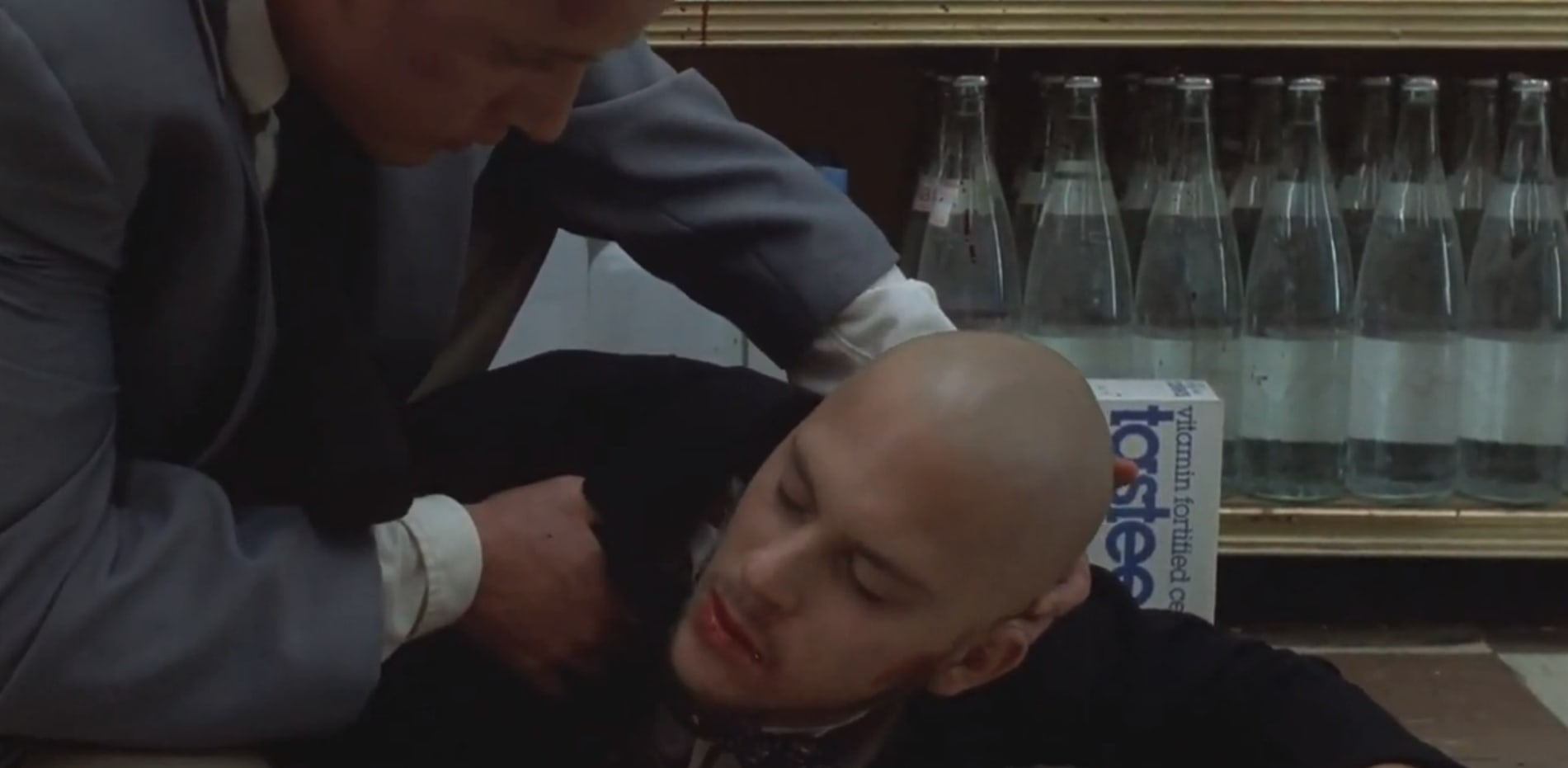
“But it still hurts.”
The excuse fails. The pain remains.
Otto can strip away the story. He cannot cancel the wound. He can name the suburban punk underneath the performance. He cannot make the dying body less real by being right about it.
After that, belief has a harder time getting through him.
He is still rude, horny, impulsive, opportunistic, still drawn toward motion before he understands what motion costs. But the roles have started arriving cracked.
Punk friend.
Repo apprentice.
Conspiracy boyfriend.
Fugitive.
Chicken man.
None of them hold for long.
The agents capture him and give authority another voice. Agent Rogersz announces torture like a professional courtesy. It is not personal. Time is short. Otto may lie. Otto says he will tell them anything. They hurt him anyway.
“No one is innocent. Proceed.”
Debt says it. The repo yard says it. Reverend Larry says it. Plettschner says it. The agents only remove the cushion.
Otto comes out more worn.
Less porous.
When Plettschner tries to trap him in another frame, hero or chicken man, Otto does not accept the terms. When Rogersz asks about the Malibu, Otto gives the only answer he has: he does not know. When everyone keeps trying to turn the car into leverage, he looks tired of leverage itself.
Just harder to keep.
Parnell keeps singing after the first body is gone.
That is where the sound starts to matter. Not as explanation. Not as release. A song survives the event it cannot understand. The road stays open. The car keeps moving. The boots burn behind him, and “Clementine” drifts on as if catastrophe has only changed the scenery.
Then Kevin sings in the supermarket.
A 7-Up jingle. Bright, branded, automatic. Rhythm without thought. Feeling without feeling. Otto stands beside him, already irritated, while the cans wait in their rows and Mr. Humphries talks about lateness, spacing, young men in uncertain times. Kevin says he was not singing.
Otto heard him.
The voice was already in the room before anyone chose it.
That keeps happening.
Radios talk. Televisions preach. Punk tracks enter rooms already too small for the bodies inside them. The noise fills space. It gives scenes motion. It makes certain lives feel larger for a few seconds than the room is willing to let them be.
The Helping Hand office gets the colder version.
Marlene answers calls. Phones keep ringing. Repo men move through their small economies of grievance. From the television, the news murmurs about U.S. war planes, refugee camps, guerrilla bases, Guatemala, retaliation, bodies folded into official sequence.
The words are severe.
Nothing in the room changes shape around them.
Marlene keeps working.
The phones keep ringing.
Debt keeps moving.
Information enters and becomes atmosphere. Not because no one hears it. Because hearing does not make the room accountable to what has been heard.
The punk songs seem like they should break that numbness.
They hit harder. They move bodies. The warehouse has slam-dancing, sweat, collision, motion that looks like refusal because it has no patience for the grocery aisle or the stale rooms Otto is trying to leave behind. Duke, Debbi, and Archie still seem like a possible tribe there, or at least a possible noise.
But the music cannot make the rebellion coherent.
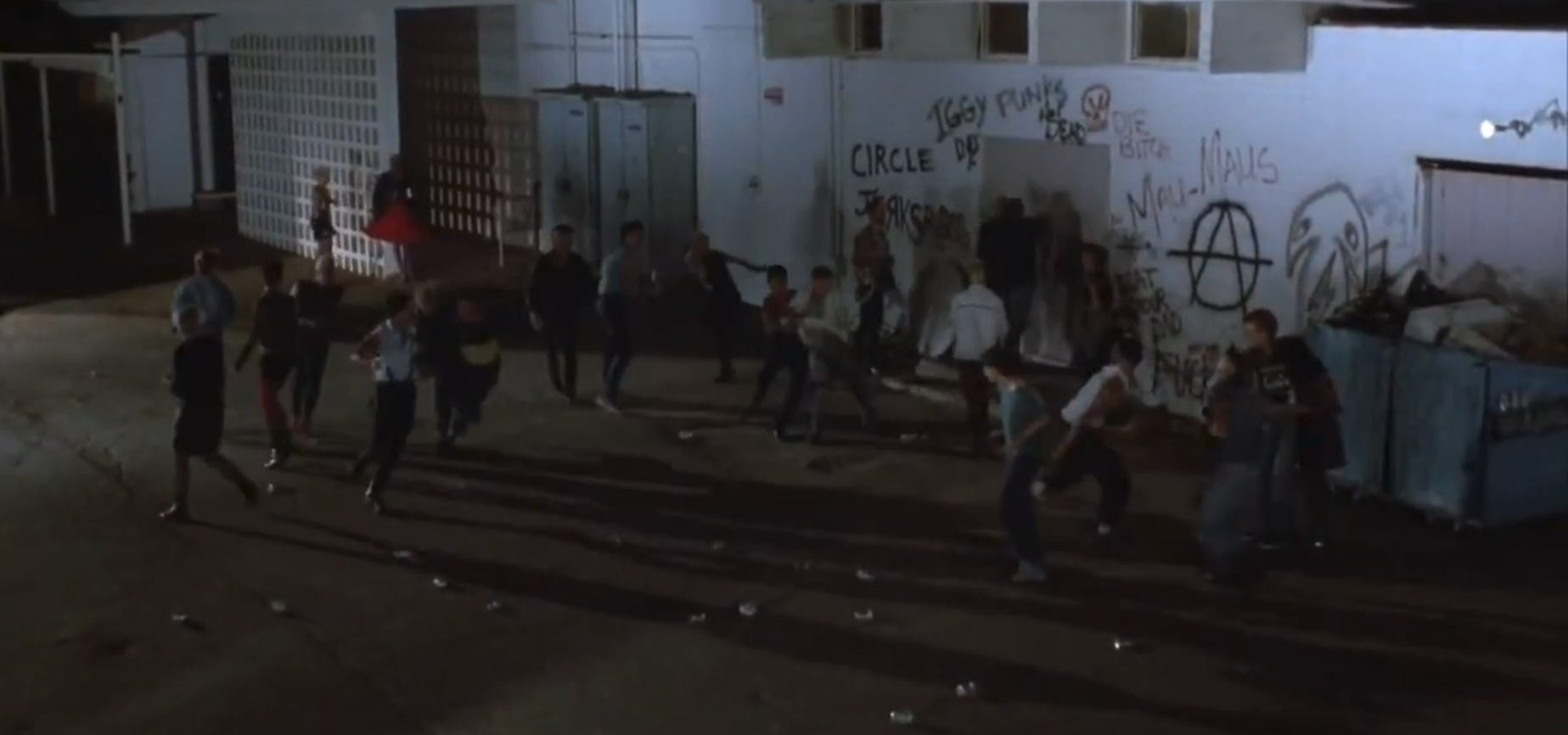
The bodies collide, then scatter into smaller hungers. Liquor stores. Pills. Stolen cars. Dares around a trunk nobody understands well enough to fear correctly. The sound supplies force. It does not supply direction.
Even the Circle Jerks scene will not let punk stay intact.
“When the Shit Hits the Fan” arrives slowed down, almost lounge-like, rebellion turned into its own tired echo. Otto hears the distance immediately.
“I can’t believe I used to like these guys.”
Taste has changed faster than understanding. He has not outgrown the city. He has only lost access to one of its noises.
Every car carries weather.
Bud has jazz. Lite has his chosen track. The Rodriguez brothers bring their own music through the streets. Each vehicle becomes a moving room with its own atmosphere, each driver wrapped in a rhythm that helps him feel continuous. Bud can talk credit, speed, codes, tense situations while jazz smooths the ride. Lite can perform menace with music behind him, fear and masculinity sitting in the same front seat.
Chases do not become heroic because the music has energy. Violence does not become noble because the room is loud. The camera stays at enough distance that the music never takes over. Bodies remain awkward. Streets remain flat. Offices remain cheap. Parking lots remain parking lots. The wide, sun-bleached spaces leave the songs without traction.
Noise strikes the surface.
The surface does not answer back.
By the end, the Malibu has collected every voice trying to name it, price it, expose it, contain it, steal it, survive it. Music can intensify the convergence. It can make the glow feel charged, absurd, irresistible.
It cannot make the glow trustworthy.
The light remains harsh. The car remains unmastered. Miller’s presence does not turn the ascent into revelation. Otto’s departure does not turn the noise below him into a solved pattern. The city has been loud from the beginning, and loudness has mostly produced motion, appetite, and atmosphere.
Sometimes that is enough to move a body.
It is not enough to make the body right.
So the first song keeps returning.
A song can survive the event it cannot understand. A jingle can outlive attention. A news report can outlive grief. A punk track can outlive rebellion.
The noise goes on.
That does not mean it knows where it is going.
Then the car comes back to the yard.
Hotter now.
Ice falls from the sky. Men gather around the glow with guns, papers, suits, grudges, theories, debts, protective gear. Every old language arrives with a body attached to it. The agents want containment. The repo men want payout. Leila wants proof to matter. Bud sits inside the Malibu, lit by the thing everyone has been chasing, and can only count what the job has given him.
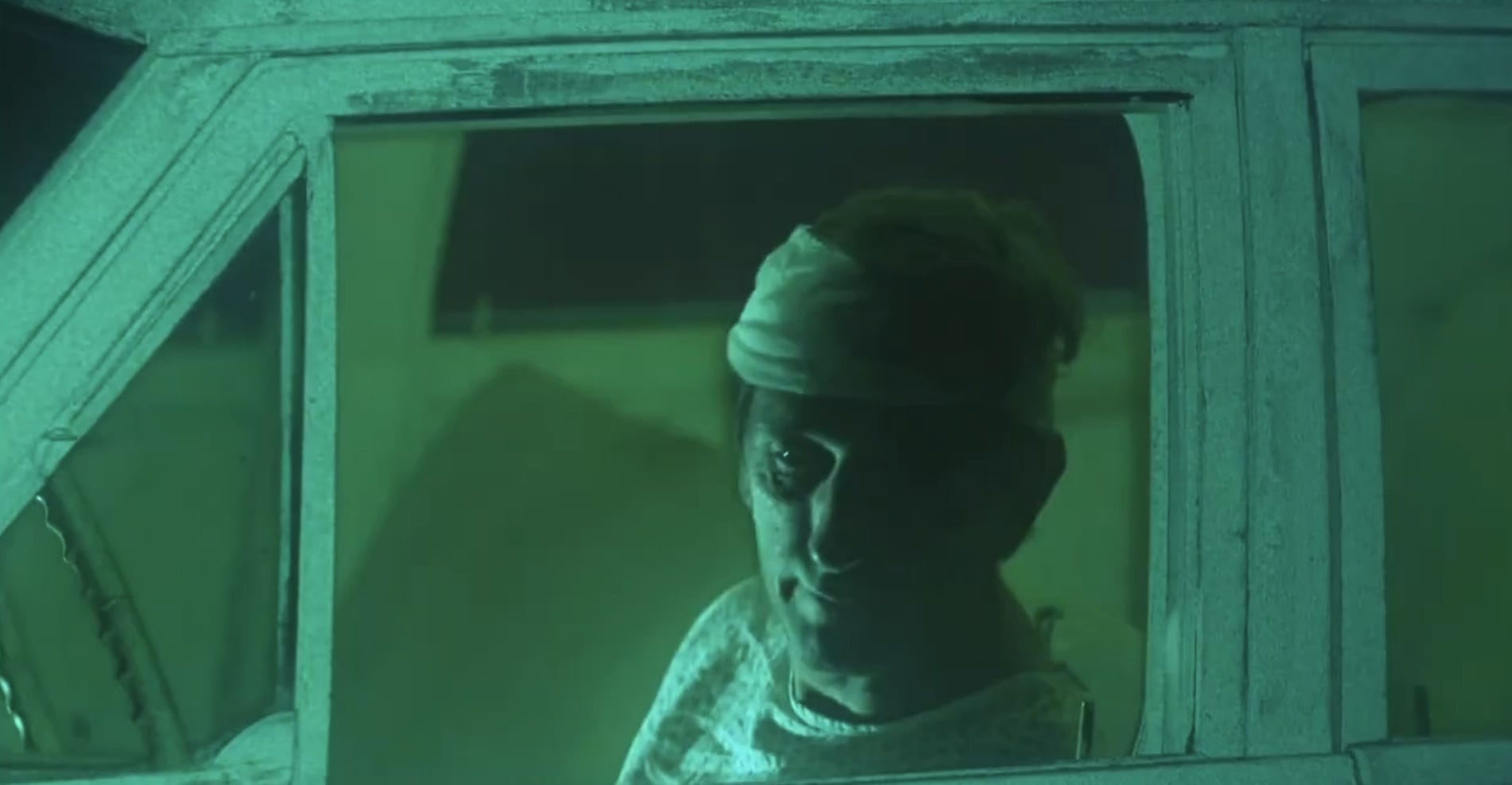
“Eleven years of repoing cars.”
Nothing.
Otto still hears the number first.
Twenty thousand dollars.
Turn it in. Split it. Sixty-forty. You and me.
The old language survives right up to the edge of the impossible. Commission still knows how to speak through him. Partnership still sounds like a way out. The lot is wrong around him. The car is glowing in front of him. The bodies that get too close are learning the rule in public, and Otto still reaches for the smallest familiar shape.
Score.
Split.
Payday.
A person does not stop wanting the way he was taught to want just because the world has become too strange to justify the lesson.
The Malibu does what it has always done.
Approach and burn.
No courtroom gathers around it. No press conference finally forces the truth into daylight. No confession breaks open the state. No clean vindication waits for Leila. No restored honor waits for Bud. No purified rebellion waits for Otto. Attention fills the yard, and attention still does not become understanding.
Miller gets in because Miller has never needed the car to become useful in the same way.
That does not make him prophet.
He has been near the edges all along. Sweeping. Talking. Watching. Refusing to drive until the one car arrives that makes ordinary driving beside the point. His explanations are cracked too, but they do not harden into a claim the world has to obey. He does not ask the Malibu to become property, proof, payout, or confession.
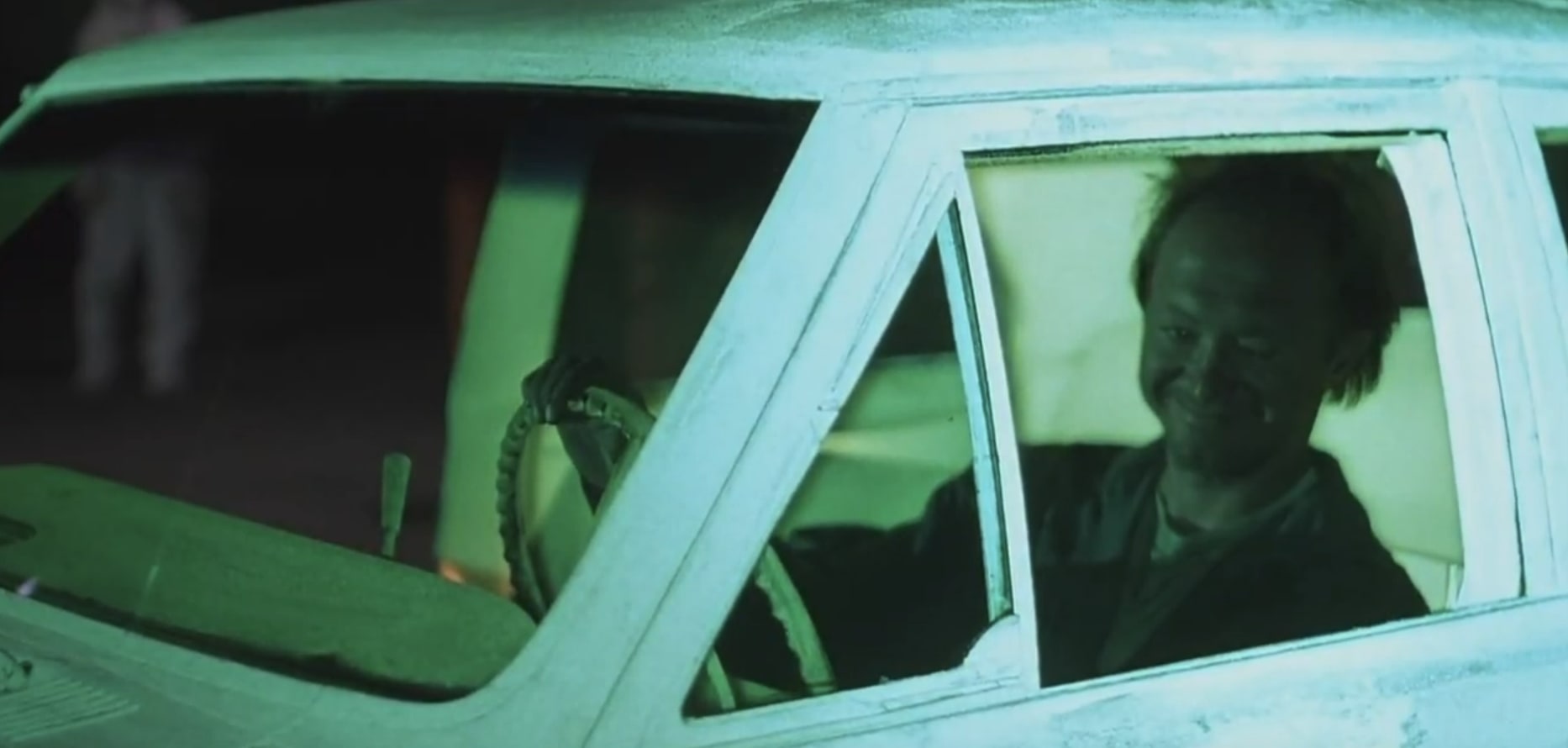
He gestures.
Otto hesitates long enough for one more voice to reach him.
Leila asks about their relationship.
For a second, the old life tries to make one last doorway. Romance. Injury. Accusation. A claim from the ground. Maybe she is right to ask. Maybe she has been right more often than anyone around her could afford to admit. The question still arrives too late to hold him.
Otto looks back with depletion.
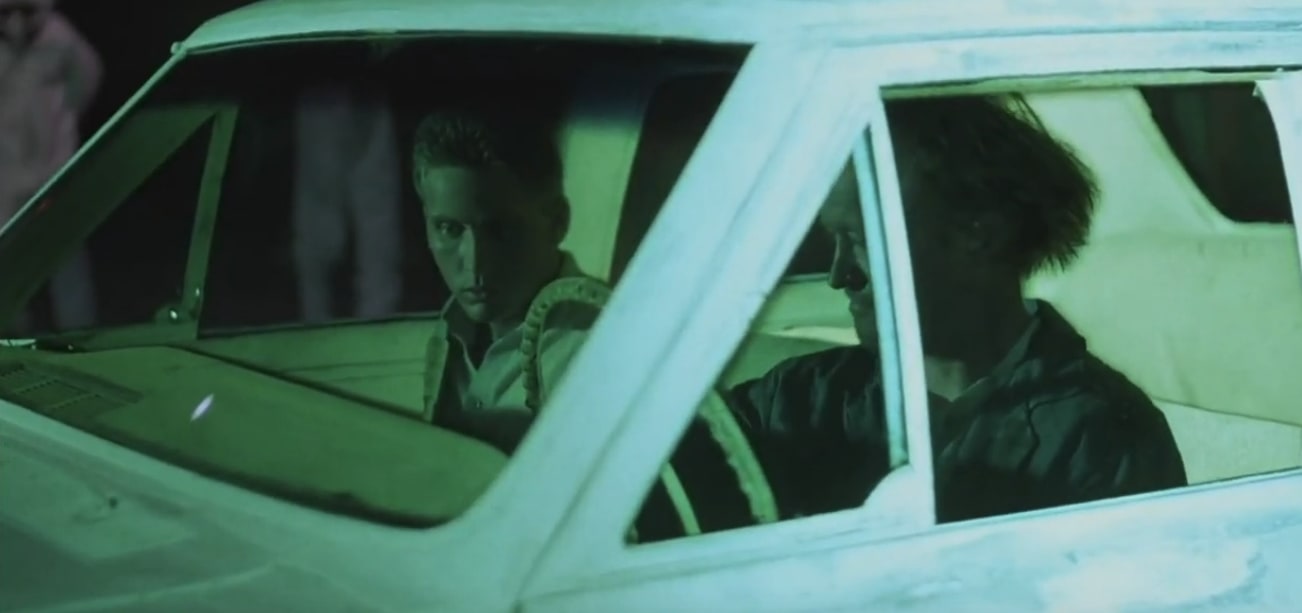
Then he goes.
The car rises because nothing left below can keep it named.
Escape without cleanliness. Departure without wisdom. Light without trust. Otto does not leave because he understands more than everyone else. He leaves because every available explanation has lost its grip.
Below them, the yard stays crowded with failed language.
The money is still real.
The bodies are still burned.
Bud’s nothing still sits in the air.
Leila’s question still has nowhere to land.
The songs are still somewhere behind everything.
Badge. Code. Credit. Proof. Song. Faith. Job. Love. Country.
Everyone looked through the language they had.
The trunk did not answer.
It opened.
And somewhere past the city, past the road, past the old map’s confidence, the Malibu keeps going.
The trunk came first. Everything after was an attempt to make it useful.
I write about the things movies cannot quite turn into answers. Subscribe if you want to stay for the next one.
Works Cited
Cox, Alex. Repo Man. Directed by Alex Cox, performances by Emilio Estevez, Harry Dean Stanton, Tracey Walter, Olivia Barash, Sy Richardson, and Fox Harris, Universal Pictures, 1984.
Cox, Alex. Repo Man. Transcript by Steve Farmer. Unpublished transcript document, uploaded source file.
Works Consulted
“Cinema Style: Repo Man (1984).” Custom visual-analysis source file, focused on Robby Müller’s cinematography, anti-coverage, practical Malibu glow, generic consumer palette, and sound/image tension.
Disclaimer
This essay includes limited excerpts and references to copyrighted material for purposes of criticism, commentary, and analysis under fair use.
All rights remain with their respective copyright holders. Views expressed are the author’s interpretation of the work.
I was struck by the idea that repo work gives Otto a shape before it gives him a belief. That feels like one of the essay’s deepest character insights. He is not converted first by doctrine, money, or even mystery, but by posture: suit, keys, rooms that change when he walks in, people who suddenly answer his presence. The job teaches him how to stand before it teaches him what to think. That is also why the world of the film feels so dangerous: identity arrives through performance before anyone has time to ask what the performance is doing to the person wearing it. The title “repo man” becomes a costume that starts fitting too well.
I really enjoyed this deep dive into a favorite movie of mine! Even when I first saw this film as a kid, the Malibu represented a kind of brutal and pure enlightenment. The glowing car (or the thing in its trunk) was a violent rejection of those following the traditional rigid rules of established society, but also the shallow reactive rebelliousness of those on the periphery, following their own set of rules and roles. Miller gets it.