
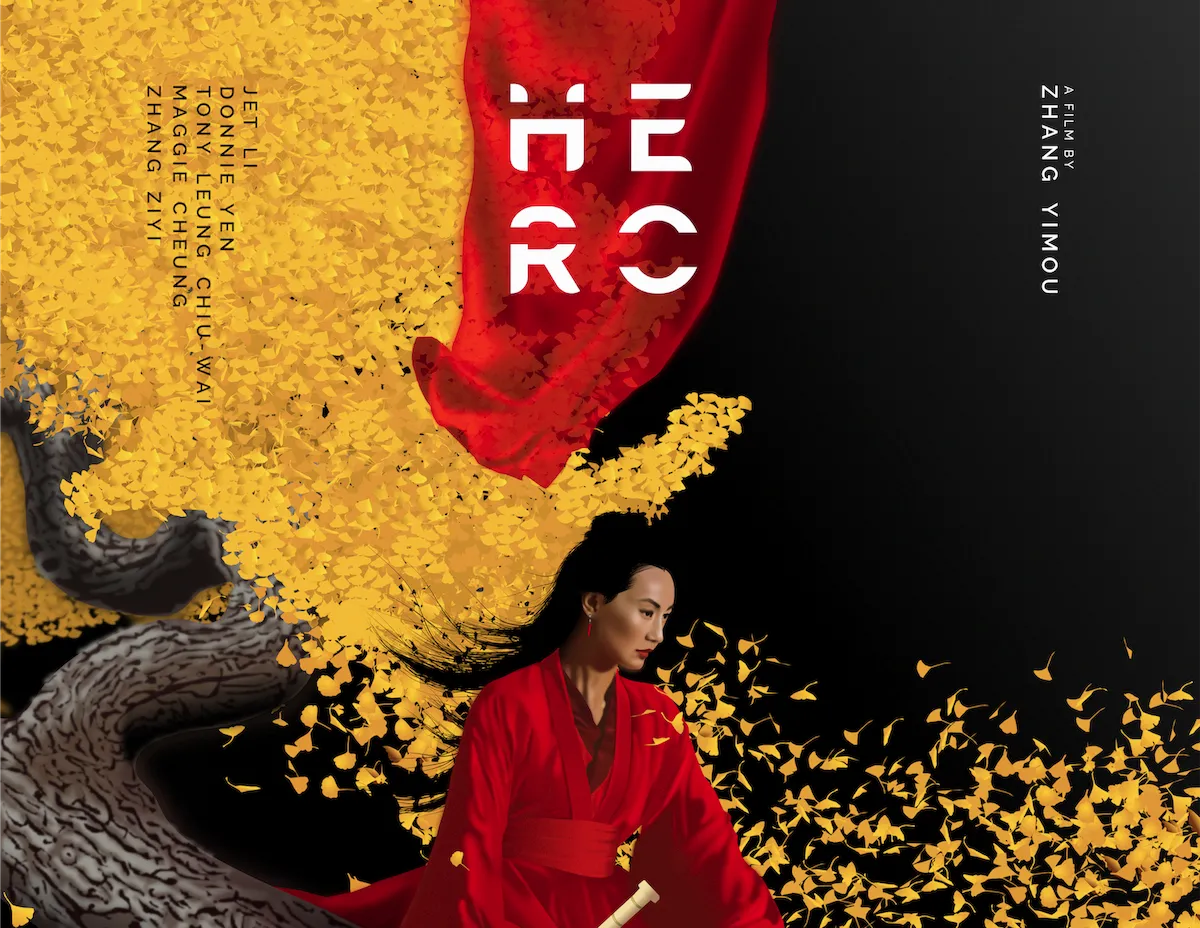
Hero
The Training of Non-Interruption

On Calligraphy Under Arrows
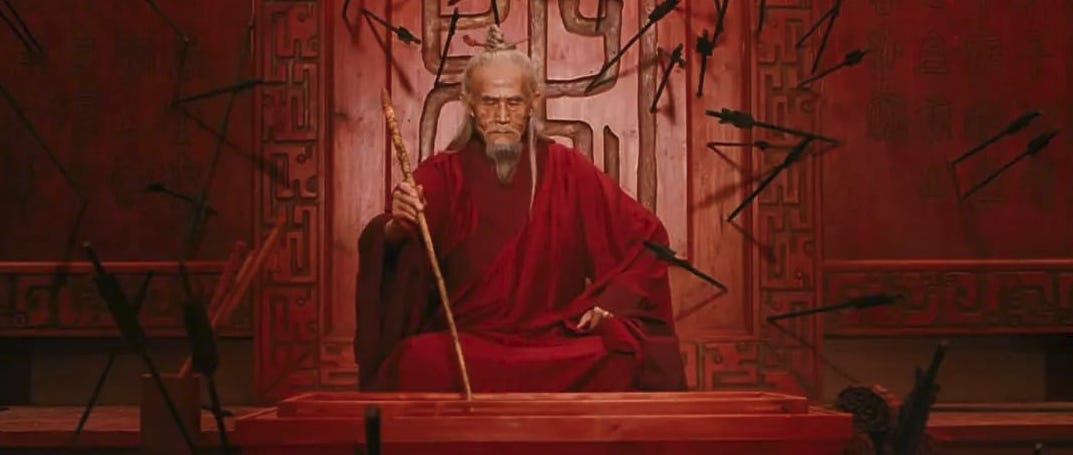
The brush drags through sand while arrows arrive like weather.
That is the placement. That is the instruction. We are positioned with the scholars, close enough to see meaning made by hand, close enough to recognize culture as labor, and still too far from power to interrupt what has already been decided.
The film asks for composure here. Not agreement yet. Just steadiness.
This film is praised for restraint. What matters is what that restraint replaces.
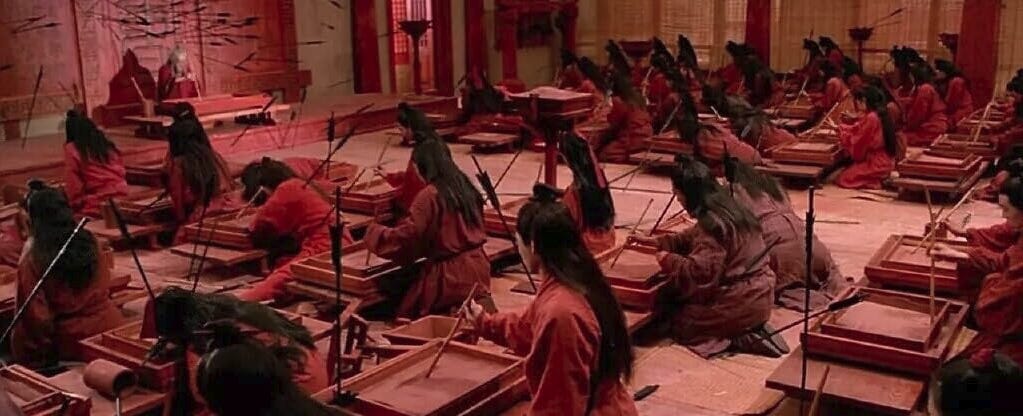
Because the calligraphy lesson is not only beauty or tradition or wuxia poetry. It is an image of interpretation made fragile on purpose, while the mechanism that will erase it is framed as inevitable. A school writes. An empire fires. The viewer learns where agency lives, and where it does not.
We are watching the brush and the sword share a frame, but not authority.
On Wuxia Domesticated
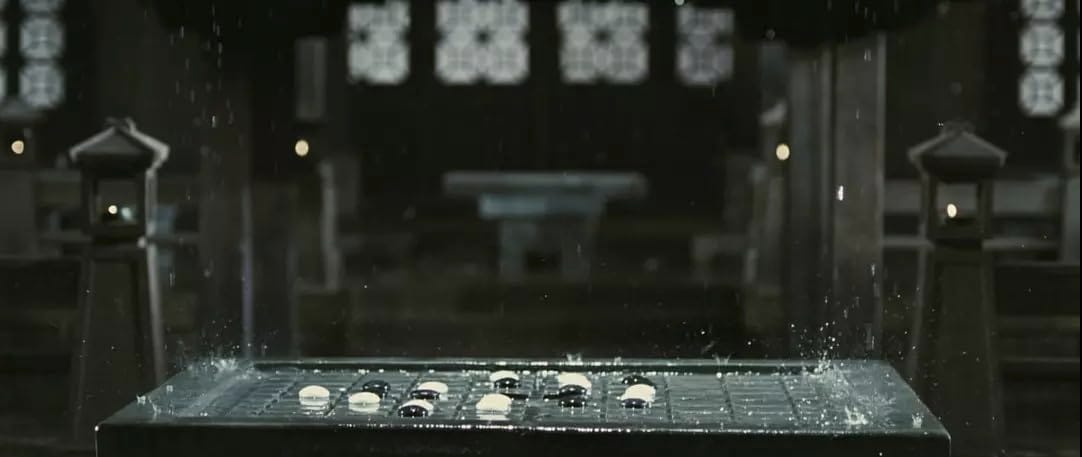
Hero does not heighten wuxia violence. It anesthetizes it through suspension.
We are close enough to expect impact, but the film keeps lifting impact out of the world. Duels resolve internally before bodies move. Motion freezes not to intensify danger, but to delay consequence. Wire-work removes gravity before the moment where pain would normally prove something.
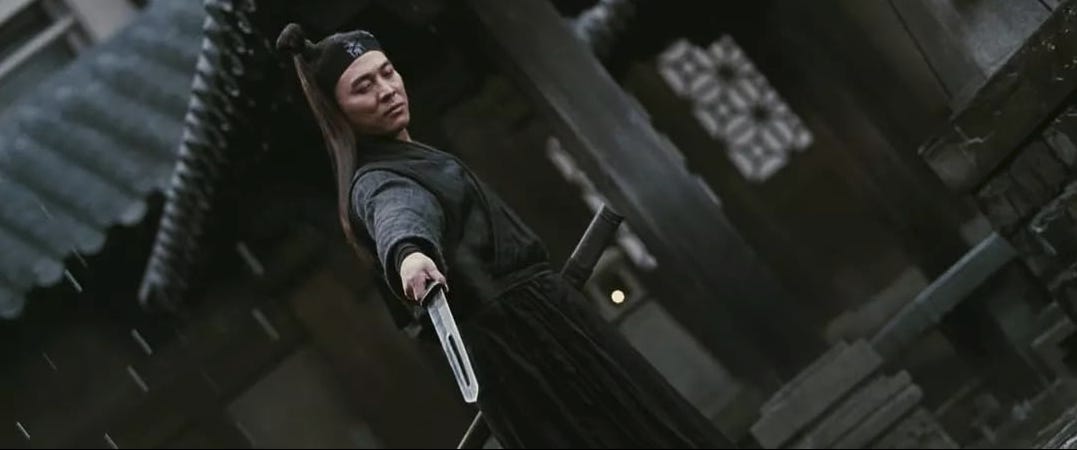
This is not refinement. It is grammar.
Mastery is demonstrated through deferral, not risk.
The result is a viewer trained into waiting. Waiting for the strike. Waiting for consequence. Waiting for the film to admit that bodies still get hurt even when choreography looks like ink.
Wuxia becomes a space where violence can be contemplated without being paid for in the moment. The blade remains sharp, but urgency is sanded down. The body is asked to breathe when it should tense.
On Editorial Control
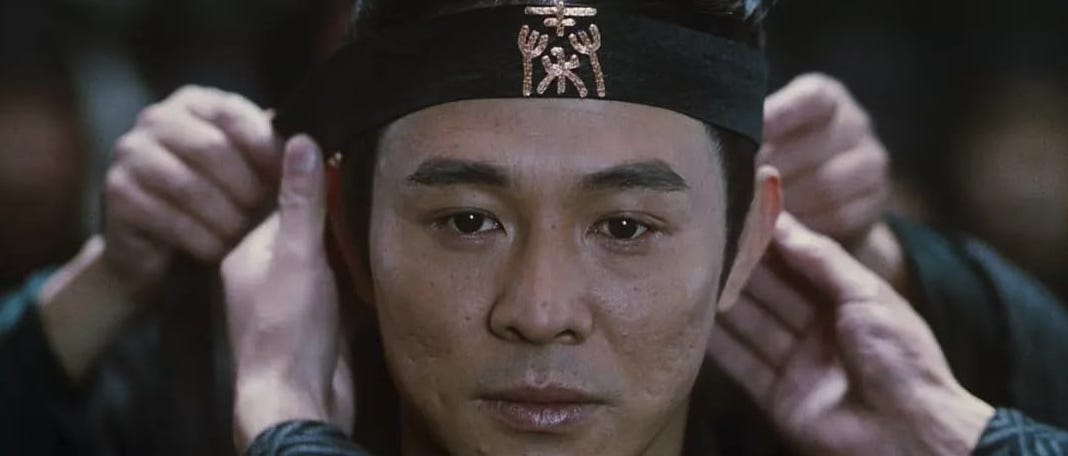
Violence in Hero is not self-evident. Its meaning is assigned after the fact.
We are placed near events, near faces, near intimacy that normally produces moral clarity, and authority still overrides proximity. The King does not merely rule what happens. He rules what it means.
This is the mechanism shift: event becomes interpretation.
Nameless arrives with trophies and a story, and what should be a straightforward exchange becomes a contest over narration. The hierarchy is established quickly: the person with power is also the person who decides which emotions count as evidence and which are dismissed as distortion.
Grief can be converted into tribute. Refusal can be reframed as jealousy. Sacrifice becomes legible only when it serves continuity.
The King himself is rarely filmed as a man. He is filmed as procedure: empty hall, armor, distance, composure. Authority is spatial, not personal.
The camera can bring us close to consequence and still deliver us back upward, where final evaluation does not come from the wounded, but from the one who survives the attempt.
On Ethical Withdrawal
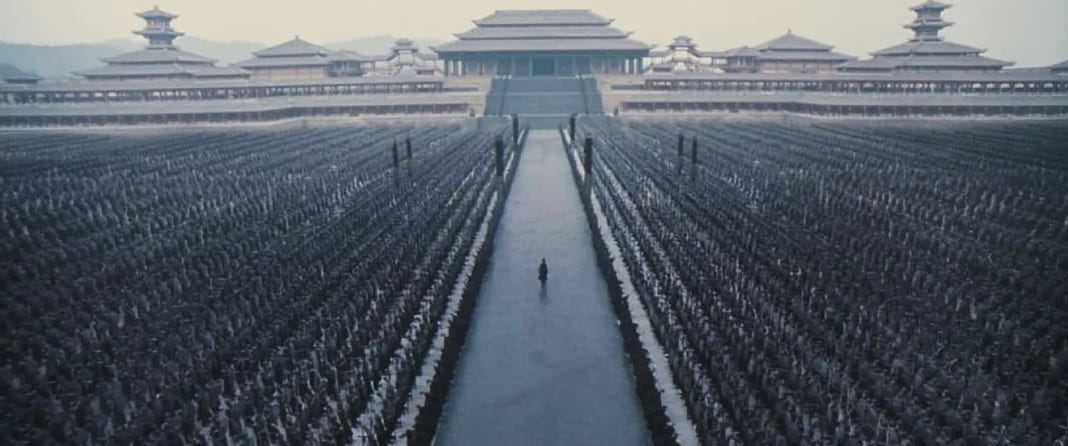
Nameless is not moral clarity. He is timing.
He is the moment when interruption is possible, and deliberately withheld.
We are placed at perfect proximity. The film collapses distance after fetishizing it. A technique exists that cannot be defended against. The grievance is understood. The hinge is built.
This is the mechanism shift: ability becomes refusal.
Hero frames that refusal as maturity. As completion. As the higher form of the sword. Not hesitation. Not fear. Withdrawal presented as ethical achievement.
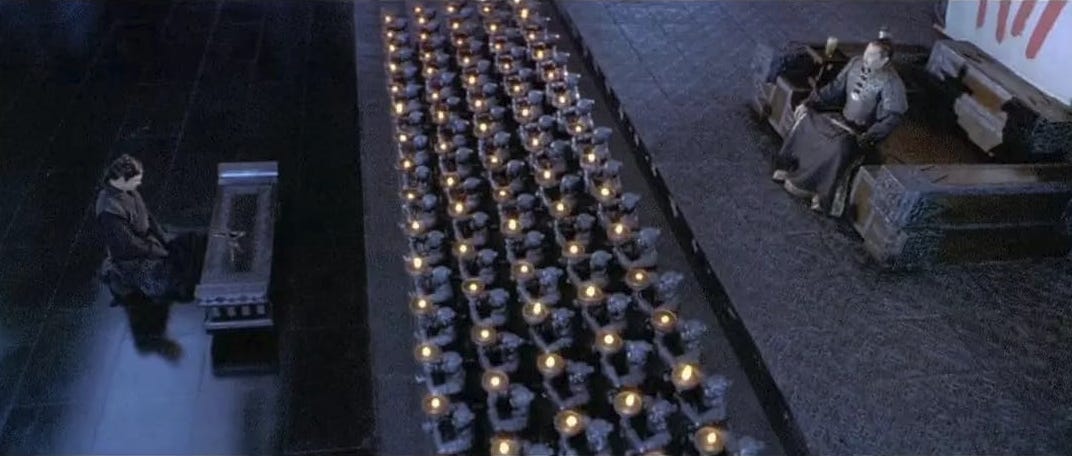
The viewer is trained to experience the maximum leverage moment as a test of restraint rather than a demand for consequence. The posture feels calm. It also feels final.
On Terminal Friction
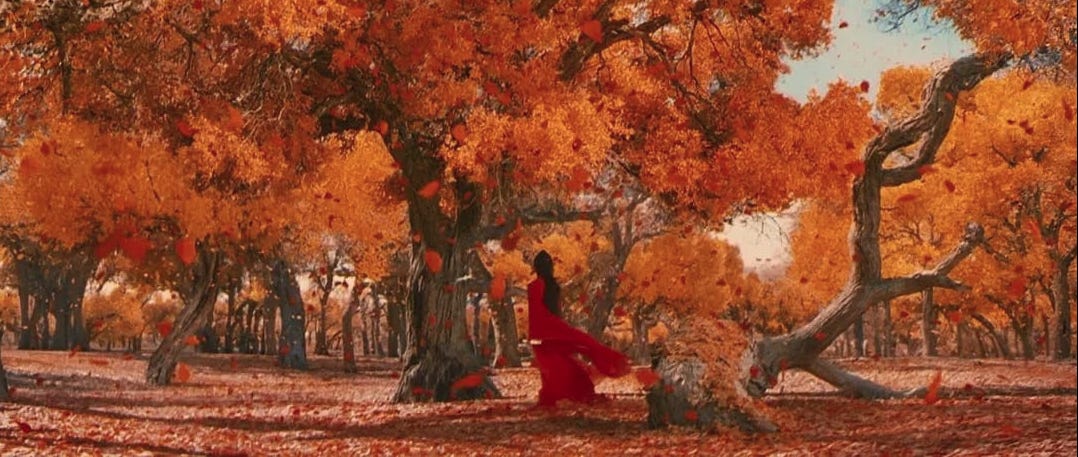
Flying Snow is the friction coefficient.
She is what happens when the body will not agree to delay.
We are not placed with philosophy here. We are placed with kinetic ethics. With grief that insists on consequence. With action that refuses to wait for history to justify itself.
She acts when abstraction stalls. She refuses to translate injury into patience.
Her function is not to win. The film does not allow that. Her function is to be spent so the system can close.
Do not resolve her. Do not redeem her. Let her remain the pressure the film cannot metabolize without erasing.
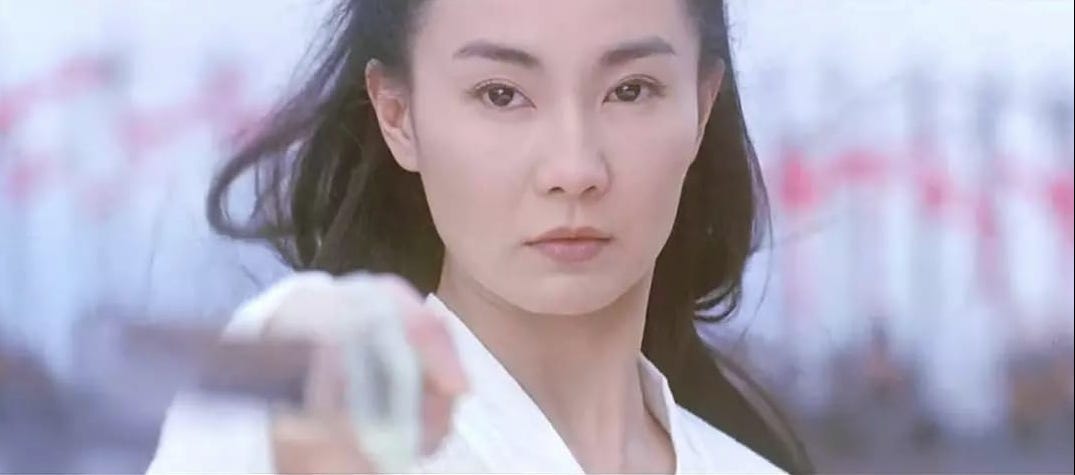
On Abstraction as Compression
Broken Sword is not merely philosophical. He is the film’s internal proof that abstraction works.
This is the mechanism shift: harm becomes beauty.
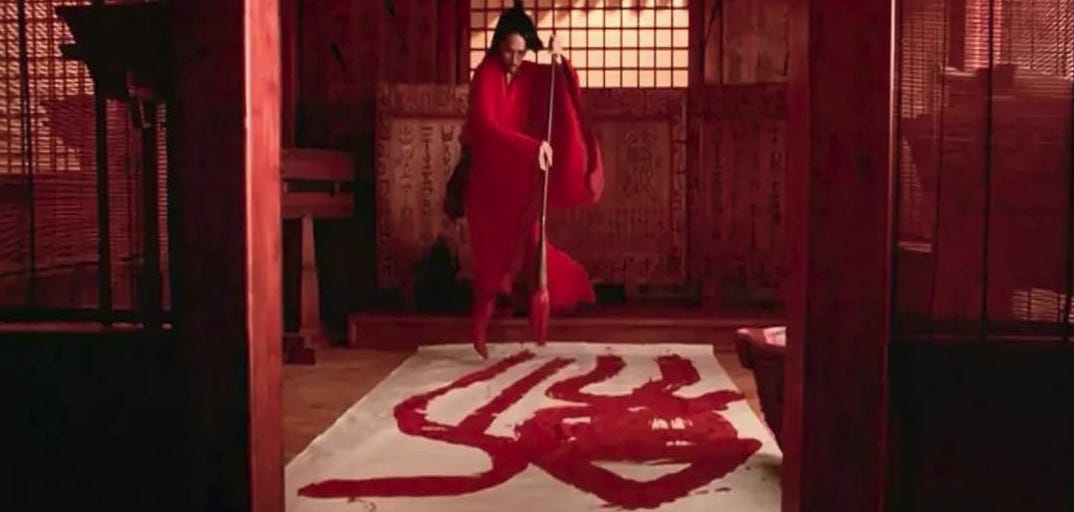
Violence becomes calligraphy. Action becomes delay. Injury is rendered elegant. The camera grants him stillness and reverent framing, allowing his body to remain intact in ways Snow’s never is.
If wuxia is domesticated at the genre level, Broken Sword is its ethical rehearsal. Proof that interruption can be replaced without guilt.
The film rewards this posture not because it prevents harm in the moment, but because it makes harm easier to carry as meaning.
On Affective Color Training
Color in Hero does not symbolize meaning. It trains posture.
We are not asked to decode. We are asked to feel correctly.
Red is instrumental emotion. Desire and jealousy used to create proximity, to make conflict feel personal enough to distract from its management.
Blue is administrative reason. Sacrifice cooled into order. Strategy mistaken for serenity.
White is truth without leverage. Clarity after action is foreclosed.
Green is pre-historical balance. Peace before consequence demanded payment.
Black is procedural finality. Meaning concluded, not debated.
Emotion is routed before argument arrives. The viewer is coached, not informed.
On the Training of Non-Interruption
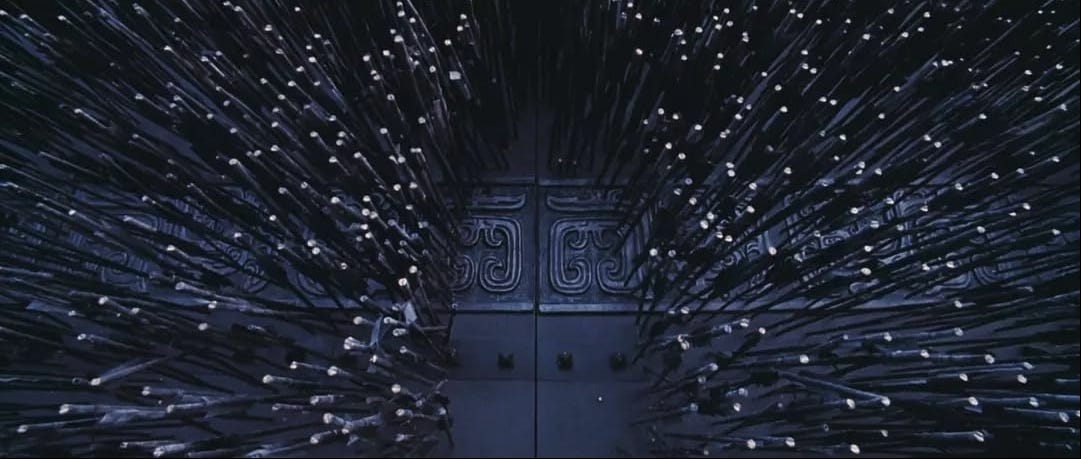
Hero does not argue that restraint saves history. It trains restraint as the correct posture toward futility.
Interruption is framed as childish. Withdrawal is framed as mature. Quiet endings are framed as ethical.
The film’s outcome is not unity or tragedy. It is a learned stance.
We are placed close enough to feel the possibility of change, and then coached out of the impulse to demand it.
Arrows.
Sand.
Yet after they unified the land and secured themselves within the pass, a single common rustic could nevertheless challenge this empire... Why? Because the ruler lacked humaneness and rightness; because preserving power differs fundamentally from seizing power.
-Han poet and statesman Jia Yi on the King of Qin
Works Cited / Reference
Hero (2002).
Directed by Zhang Yimou.
Written by Li Feng and Zhang Yimou.
Cinematography by Christopher Doyle and Zhao Xiaoding.
Starring Jet Li, Tony Leung Chiu-wai, Maggie Cheung, Zhang Ziyi, and Chen Daoming.
All scene descriptions, color analysis, and compositional readings are based on the film itself, viewed in its theatrical and home-video releases.
Disclaimer
This essay is a formal and structural reading of Hero as a cinematic system.
It does not claim authorial intent, historical accuracy, or political allegiance.
Interpretations presented here analyze how the film operates on viewers, through framing, pacing, color, and restraint, rather than what it explicitly declares or what its creators may have intended.
Any conclusions drawn concern the film’s mechanisms, not the motives of its makers or the beliefs of its audience.
Acknowledgements
This essay exists because Hero exists.
My sincere thanks to the cast and crew whose work made this analysis possible, particularly the performers who carried immense emotional weight through restraint rather than excess, and the artists behind the camera who trusted stillness, distance, and silence as expressive tools.
To the fight choreographers, calligraphers, costume designers, and cinematographers: your discipline is the reason this film continues to invite close attention rather than easy answers.
And to the filmmakers who chose composure over spectacle and ambiguity over instruction, thank you for making a work that resists resolution long enough to be examined.
I watched this movie first when I was like 6 and then again at 17. I loved it because of the visuals and the fluidity of their movements. I should rewatch this with adult eyes. Great analysis once again💕
As always beautiful analysis. For a long time, Hero was one of my favourite movies. I recently rewatched it and felt it was too long. I grieved the past me who took the time to enjoy things.