
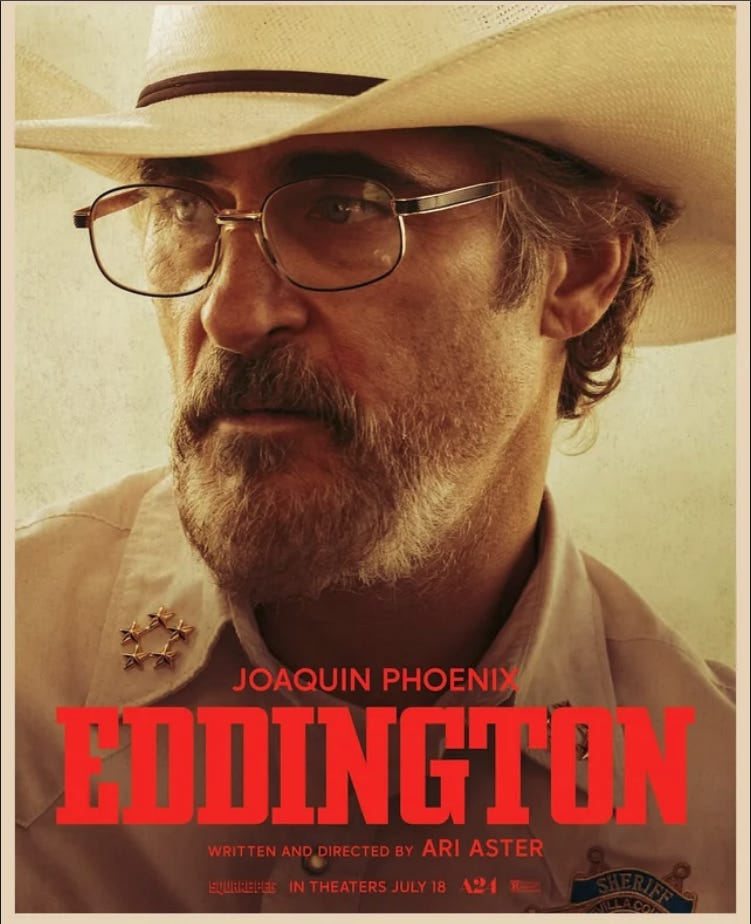
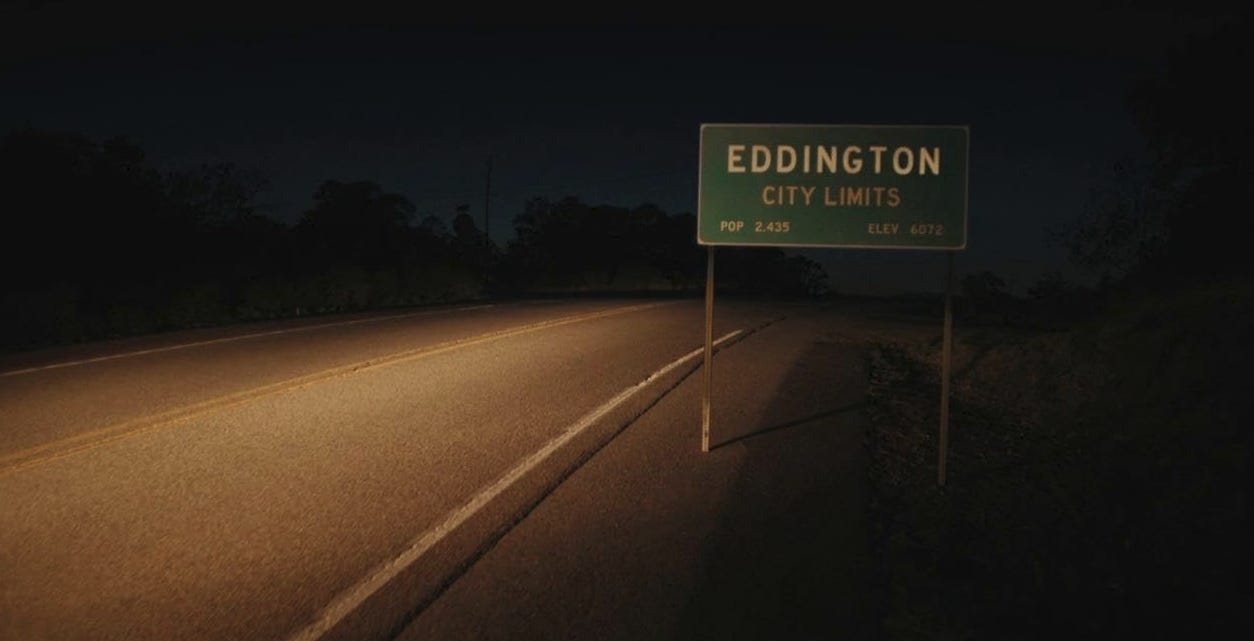
Eddington
Governance at the Scene of Its Own Crime

Denial as Circulation
The first body in the film is already unsteady.
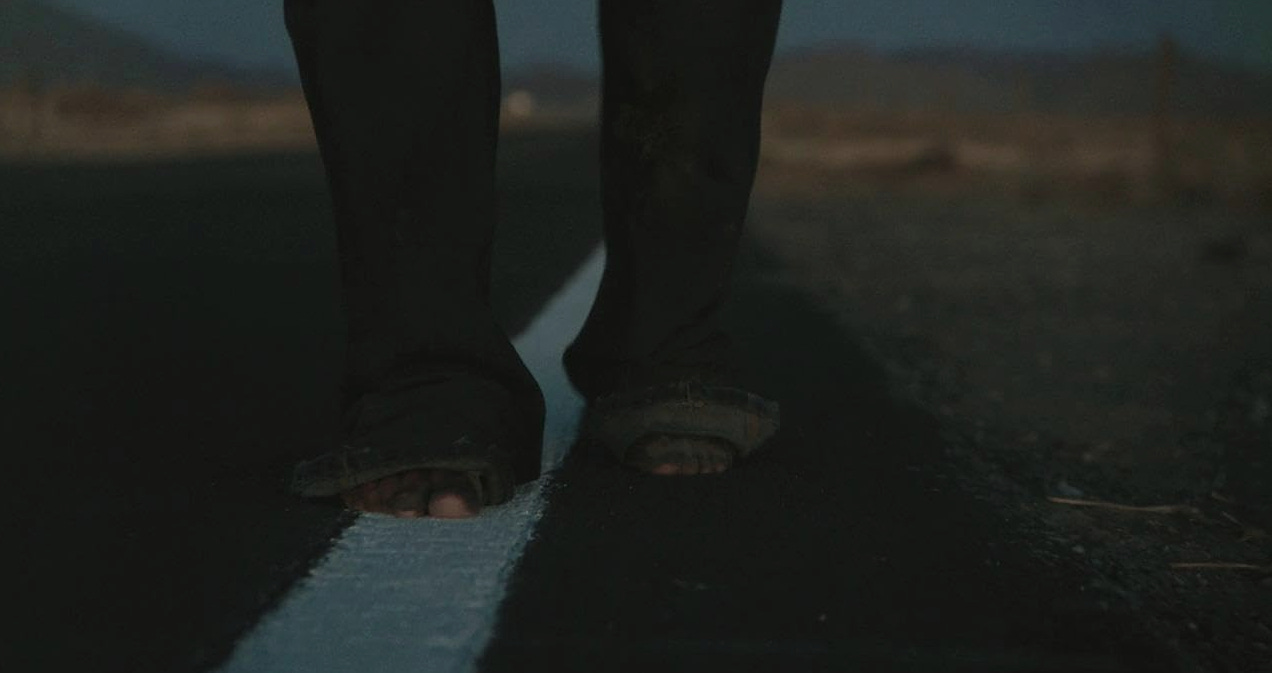
A man staggers down from the hills, infected, shouting into the open air. The town does not ask what he needs. It asks where he crossed.
“You’re trespassing.”
The argument is not medical. It is territorial. The sheriff disputes the line. The Pueblo officer insists on it. The camera holds the horizon wide enough that the man seems small inside it. Geography dominates the frame. The body is incidental.
Breath fogs in the morning air. Masks are visible. Joe refuses his.
He personalizes breath. He treats air as choice.
Later, the infected man is dead.
The camera does not close in when he falls. It does not confer intimacy. The frame remains composed, as if documenting weather.
The border remains intact.
The report is filed.
The town continues.
If denial spreads here, it does not spread through shouting. It spreads through posture. Through refusal that does not require argument. Through the comfort of treating exposure as jurisdiction.
But there is something fragile beneath it.
Because if breath were acknowledged as shared, if the frame tightened, the line would collapse. The argument about trespass would become an argument about obligation.
The film never allows that tightening.
The air stays contested.
And the body stays small.
The town debates jurisdiction while a body collapses.
Stillness as the Threat
Joe is most dangerous when he is alone.
Not because he acts, but because he might stop.
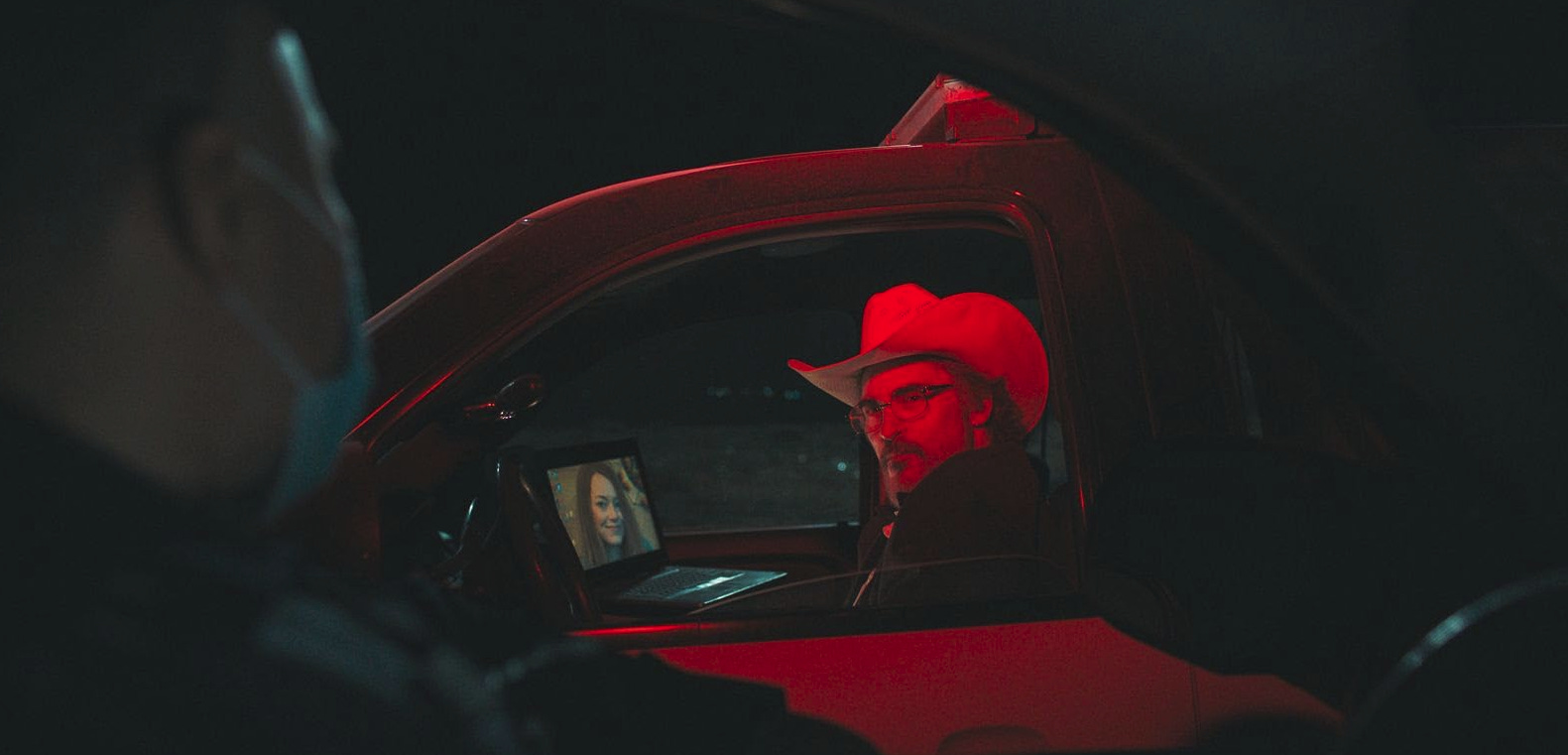
There is a moment when he looks at an image of his wife. The camera does not rush him. It holds, wide and indifferent, the desert light bleaching the edges of the room. For a beat, nothing moves.
He does.
The interruption comes quickly. A call. A complaint. A task. He answers it. He always answers it.
The film’s frames remain static while he crosses them. The horizon does not follow him. The land does not adjust.
He escalates. He makes calls. He pursues noise. He inserts himself into disputes that might otherwise cool.
It reads as aggression.
But stillness would be worse.
If he stayed in that room long enough, the image would become evidence. The accusation would rebound. The border he enforces outside would appear inside.
The crime scene would not be outside him anymore.
And so he keeps moving.
Not triumphantly. Not wildly.
Procedurally.
Motion becomes containment. Escalation becomes insulation. The only way to govern your own crime scene is never to stop governing.
The film does not show panic. It shows maintenance.
And that is more disturbing.
Performance Replacing Care
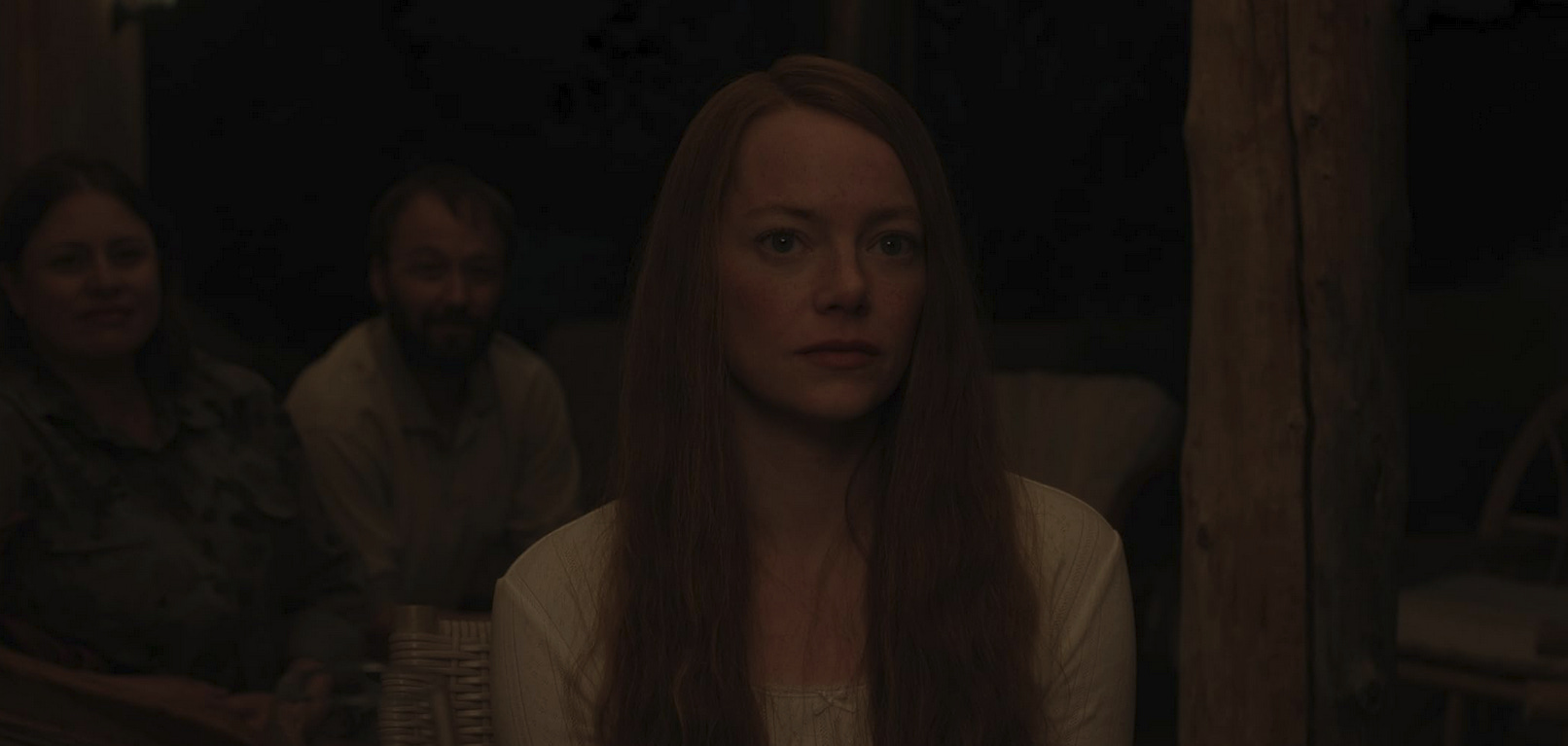
Louise names harm at a table that cannot hold it.
The word lands.
Her mother stands first. The chair scrapes. The conversation shifts.
Ted responds carefully. He reframes. He contextualizes. He does not shout.
Joe does not remain either.
No one mocks her.
No one consoles her.
The room rearranges itself around discomfort.
Later, Vernon speaks without redirecting. He stays in the sentence. He offers coherence where others offer distance.
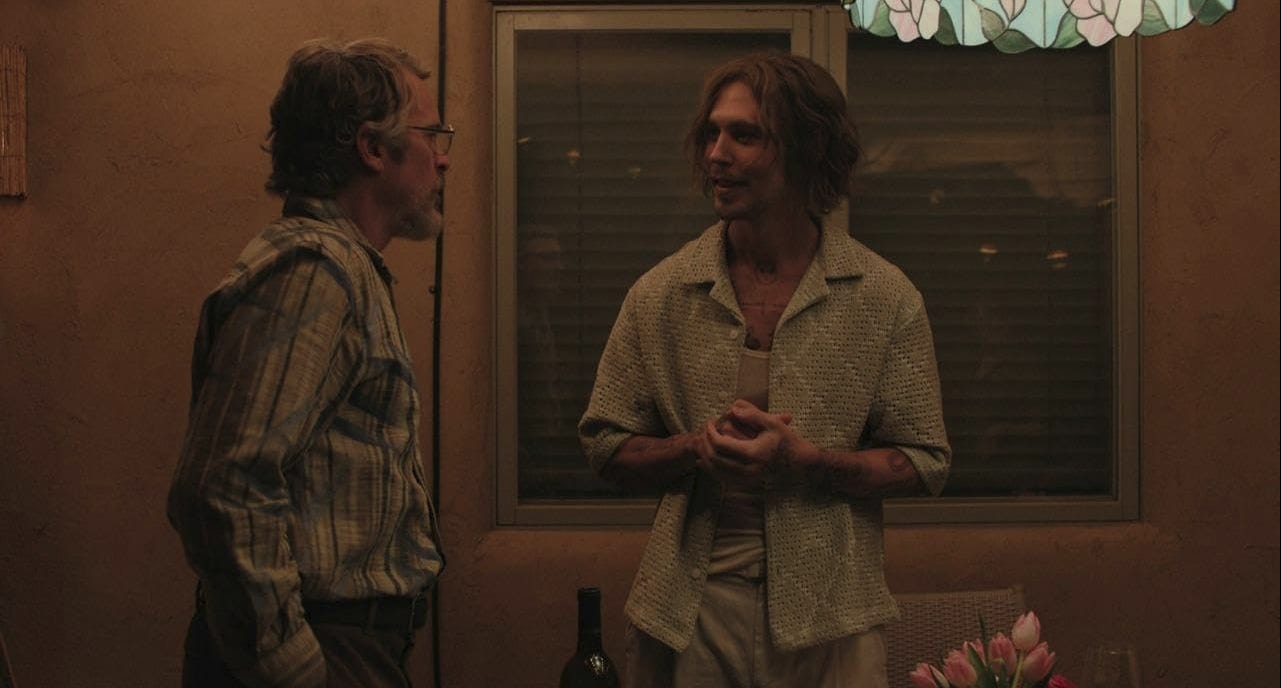
Belonging forms around shared narrative, not verification.
Care would require staying in the rupture.
Performance allows the town to proceed.
Not because no one tries.
But because staying would fracture something larger than the room.
The Invisible Body
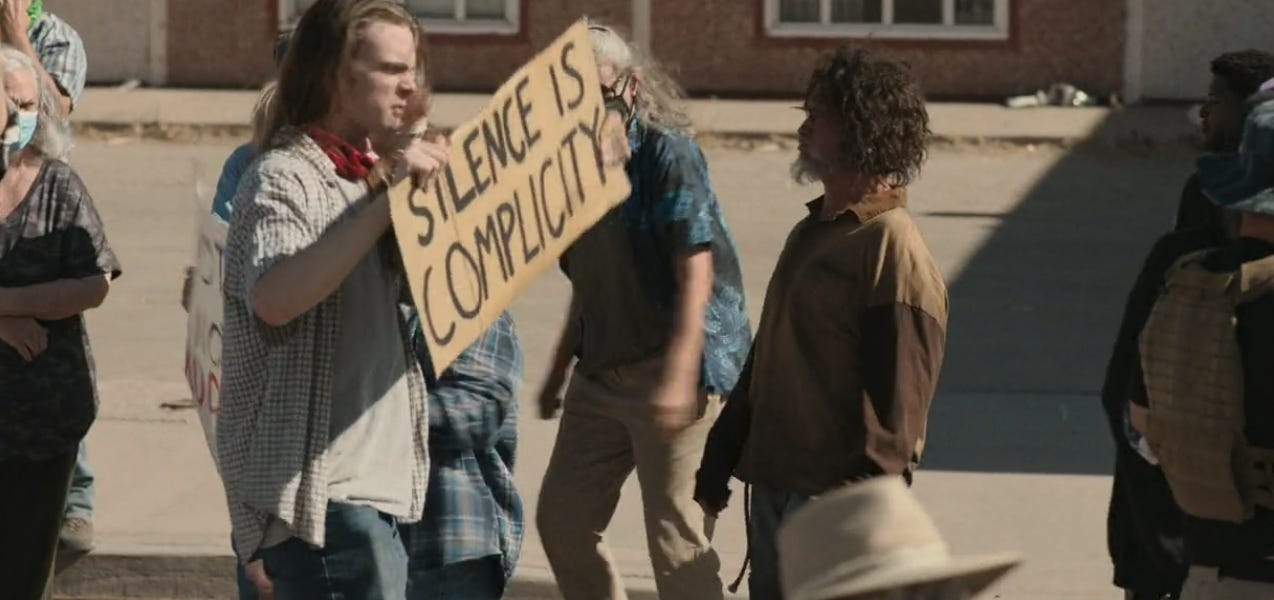
The homeless man is processed before he is recognized.
At the protest, he enters the frame coughing.
He gags and sputters into the crown.
No on recoils
No on turns.
The argument continues.
When the camera cuts away, the confrontation with Joe fills the frame.
when it returns, the man is drifting behind it.
Louise’s harm circulates before it is tended.
Butterfly Jimenez investigates without spectacle. He documents quietly across contested ground.
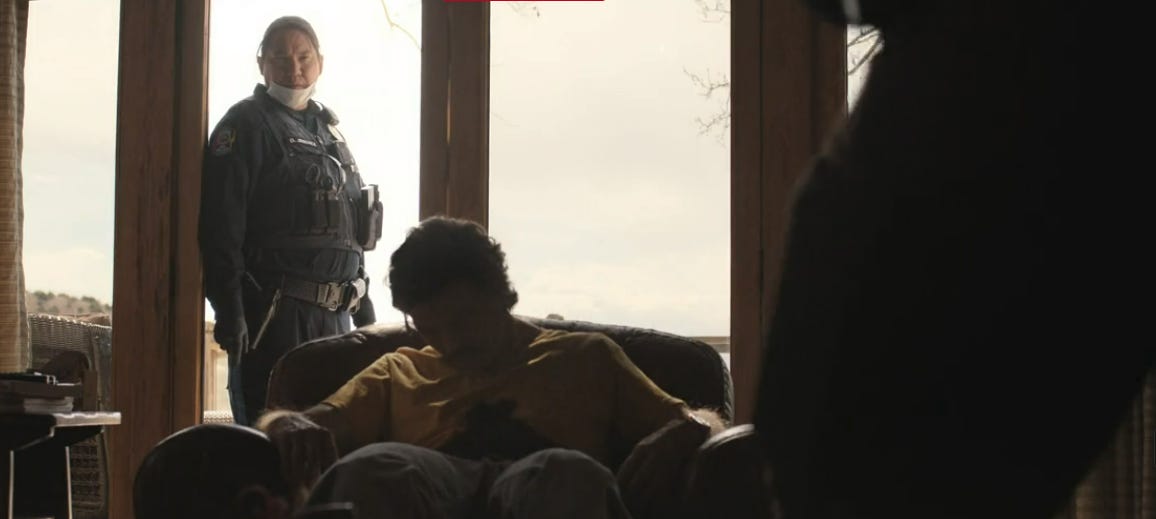
Bodies in Eddington matter most when they can be argued about.
When they cannot be leveraged, they are stepped around.
Not violently.
Efficiently.
The camera sees more than the town does.
But seeing does not prevent absorption.
Forced Intimacy
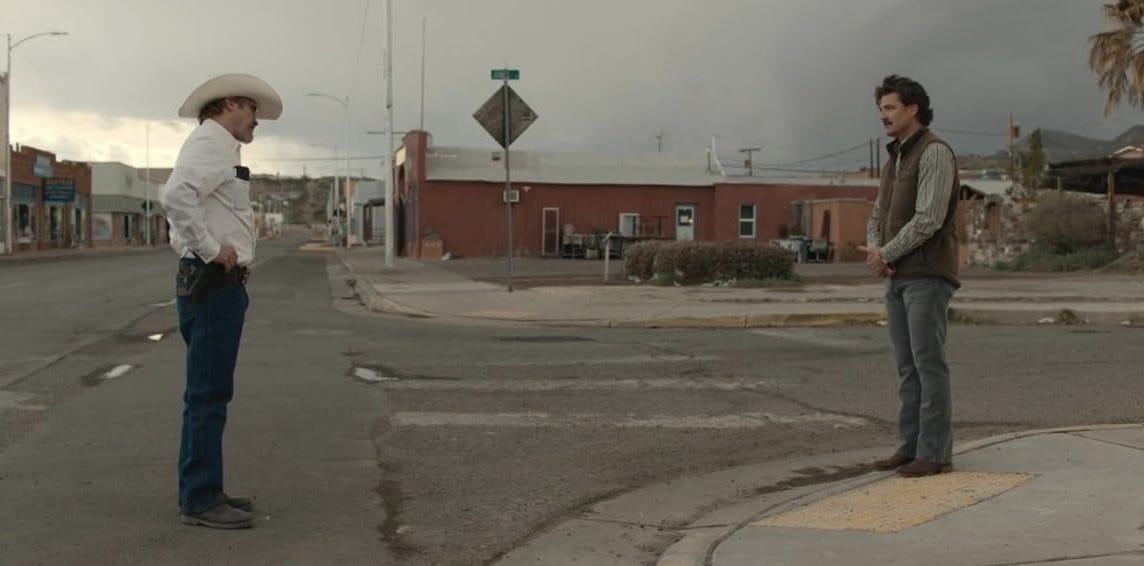
Joe accuses Ted publicly.
Later, in uniform, he stands on Ted’s property responding to a noise complaint.
The badge remains visible.
Procedure requires neutrality. History makes neutrality impossible.
In front of donors and guests, Ted slaps him.
It is not a fight.
It is exposure.
That night, Joe returns with a rifle.
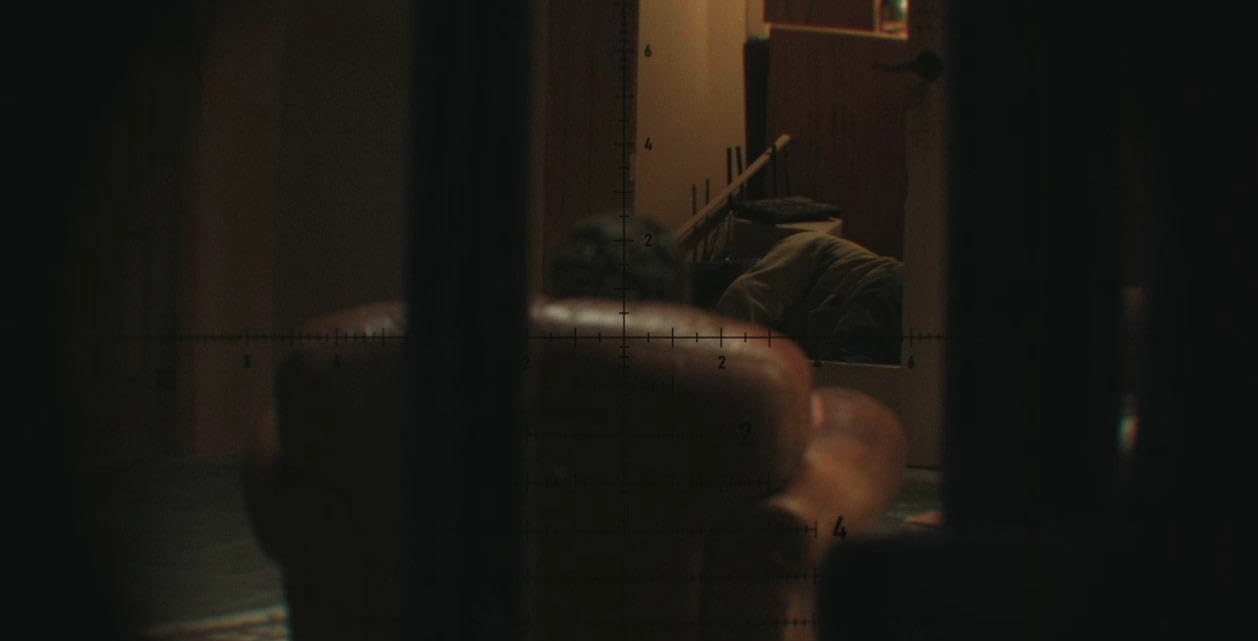
He positions himself at distance, across the same divide the film opened on.
He shoots Ted.
Then he shoots Ted’s son.
The land does not shift.
Morning comes.
The sheriff must govern the scene of his own crime.
He cannot recuse.
He cannot investigate.
So he governs.
Affective Ideology
Ideology in Eddington does not spread through argument.
It spreads through temperature.
Rooms grow louder.
Certainty becomes currency.
The person who hesitates speaks less each time.
Brian does not arrive convinced.
He arrives restless.
He listens.
He nods.
He laughs at a line he might have questioned weeks earlier.
Nothing dramatic happens.
No manifesto.
No conversion speech.
Just recognition.
Vernon offers coherence.
Not proof.
He stays in the sentence when others drift.
He names what feels unstable and lets it sit without flinching.
In a town where care collapses into performance, that steadiness feels like shelter.
The ideas matter less than the feeling of being aligned.
Heat does not ask for evidence.
It asks for belonging.
And belonging moves faster than thought.
Plausible Deniability
Joe names Antifa before the attack arrives.
The word circulates in advance of proof. It does not fabricate the enemy. It conditions the town for it.
Money moves elsewhere. A private jet lands. Armed men step into a conflict already heated.
Joe does not give orders. He does not coordinate the arrival. He speaks in atmospheres.
The town adjusts.
Men arm themselves before the jet touches down. Rumors travel faster than confirmation. By the time the outsiders arrive, the ground has been prepared.
Butterfly continues his investigation. Notes. Photographs. Lines of inquiry narrowing toward Joe.
The camera remains steady while tension accumulates. No frantic reframing. The town is held at distance, as if the land itself were absorbing the escalation.
When the armed group moves through the streets, they are masked and tactical, but not imagined. The threat exists.
What preceded it also exists.
No clean line connects Joe’s rhetoric to the jet’s landing. No documented chain links speech to gunfire. The result still unfolds inside the climate he amplified.
Butterfly’s leg is torn away inside a frame that does not flinch.
He is there to arrest Joe.
Joe fires during the chaos. A sniper ends the investigation.
The attack is real.
So is the preparation.
That is where deniability lives.
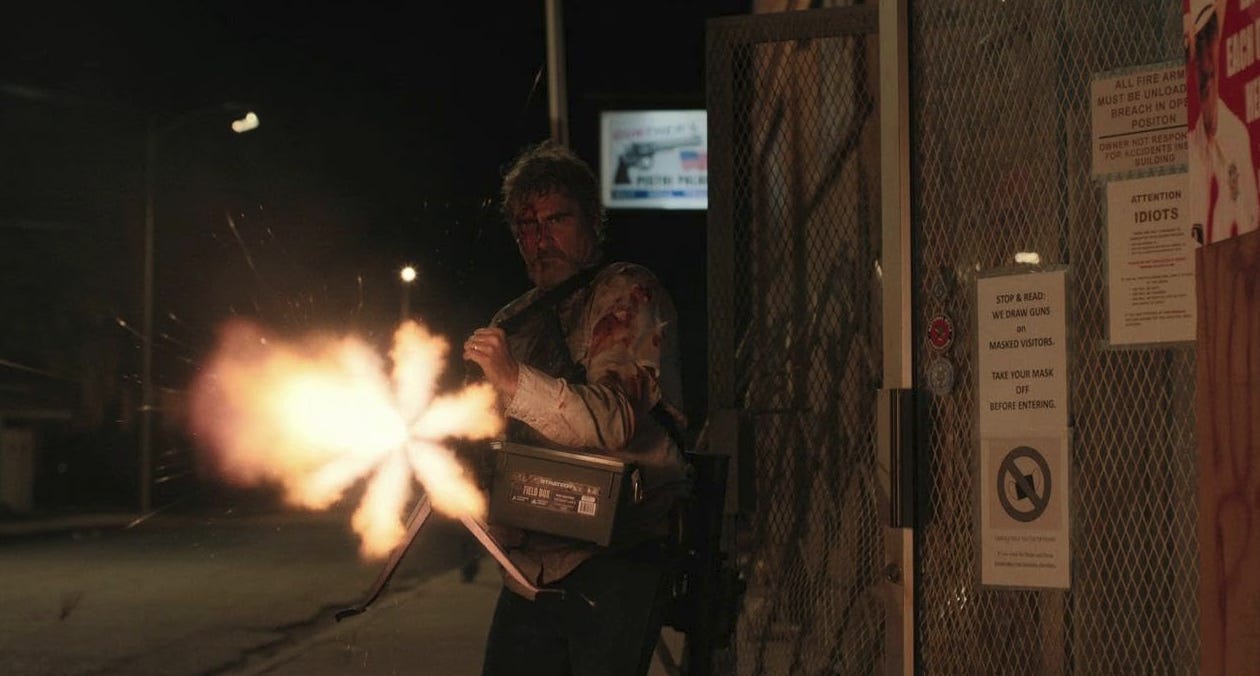
Chorus Without Protagonist
Eddington refuses to centralize anyone.
Joe is not tragic.
Ted is not corrective.
Vernon is not salvation.
Butterfly is remembered — but only on one side of the line.
A mural appears on his stretch of border. Paint fixes his face against a wall. The camera does not elevate it into closure. It passes as it passes everything else.
Memory, like jurisdiction, remains local.
Brian drifts from porch to porch. He laughs at a line he might have challenged weeks earlier. The frame does not follow him when he exits.
Attention disperses.
Rooms. Porches. Patrol cars. Cooling units. Dust.
Without a singular moral center, blame cannot be localized.
Recognition exists.
It just does not travel.
The chorus speaks in fragments.
The film does not tell us which voice to trust.
And that feels less like neutrality than fracture.
When the Song Ends
Violence peaks.
Accusations circulate.
Rooms fracture.
Joe moves toward confrontation.
Then, paralysis.
Not death.
Not redemption.
Immobility.
The body that escalated every interruption now cannot stand.
He cannot command.
He cannot perform anger.
He cannot move.
Outside, nothing stalls.
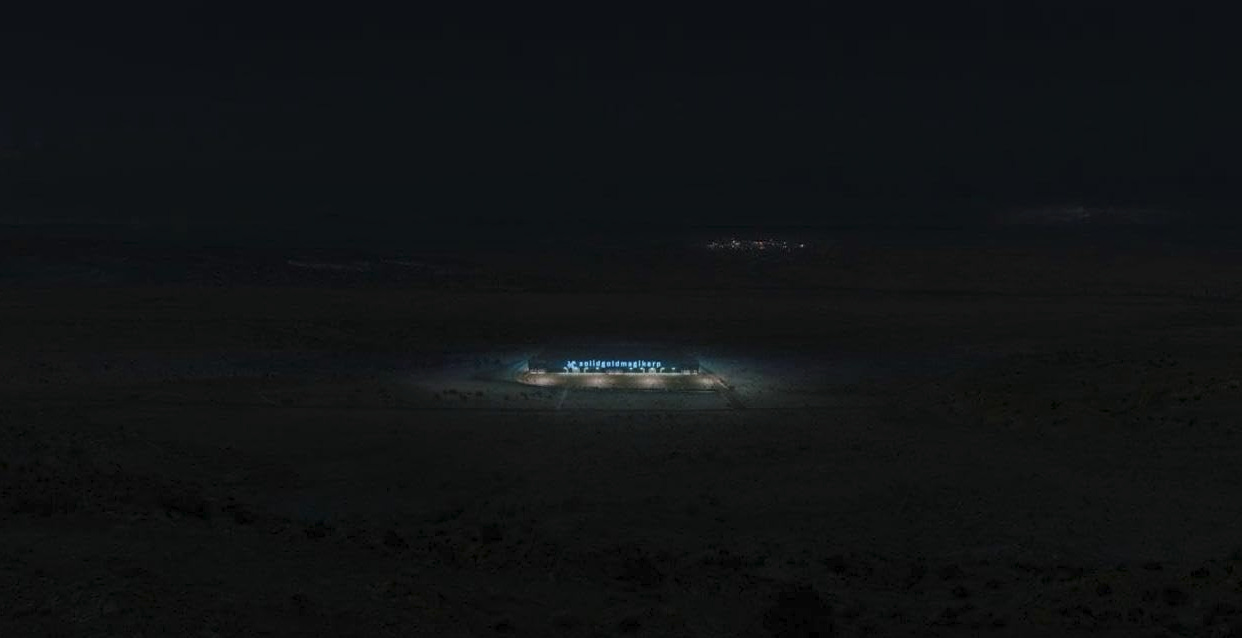
A data center rises on contested ground.
Cooling systems hum.
Water is diverted.
Datacenter
Industrial rates sit below the national average.
Datacenter
Land is cleared.
Lights stay on through the night.
The town calls this development.
The hum does not pause.
It does not need music.
It does not need belief.
It only needs power.
And it has it.
Works Cited
Ari Aster, dir. Eddington. A24, 2025.
Hudson, Valerie M., and Andrea M. den Boer. Bare Branches: The Security Implications of Asia’s Surplus Male Population. MIT Press, 2004.
Altman, Robert, dir. Nashville. Paramount Pictures, 1975.
U.S. Energy Information Administration. “Electricity Consumption by Data Centers.”
Disclaimer
This essay is a work of critical analysis and interpretive commentary.
All film stills, dialogue excerpts, and narrative references remain the property of their respective copyright holders.
Interpretations presented here reflect the author’s reading of the film’s structure, rhetoric, and thematic architecture. They are offered for analytical and educational purposes.
No affiliation with the filmmakers or distributors is implied.
This looks bleak! I'm currently infected myself so maybe I'll queue this up and give myself some great dreams haha.