
AVATAR (2009)
Upgrade, Extraction, and the God That Keeps the System Running


Species Gentrification
Before the film ever asks whether Jake Sully deserves leadership, it quietly answers a different question: what kind of body does Pandora respond to most efficiently. Belonging in Avatar is not granted through tradition, consent, or inheritance. It is confirmed through performance.
Jake Sully does not assimilate into Na’vi culture.
That reading is too familiar, too moral, too small.
What the system does instead is quieter and more decisive.
Jake is not accepted because he learns the customs, respects the land, or falls in love. He is accepted because he is compatible. The world recognizes him as a viable successor long before it recognizes him as a member, because succession is a systems problem, not a cultural one.
This is not cultural exchange.
It is ontological succession.
The avatar body is not a disguise.
It is an upgrade.
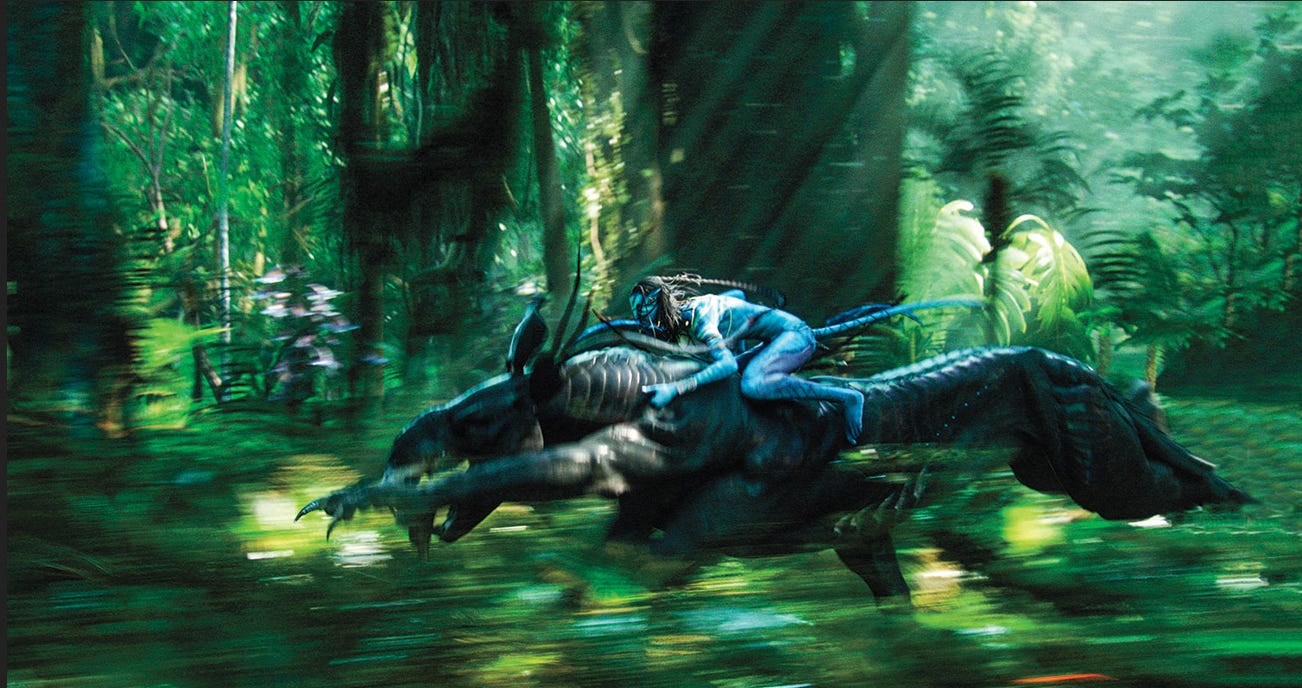
The film demonstrates this almost immediately. In Jake’s first night chase through the forest, he is clearly outmatched. He stumbles. He falls. He panics. But the sequence does not frame him as a failed initiate. The camera stays with him as he recovers, regains balance, accelerates again. The editing privileges persistence over confusion. Survival over instruction. Neytiri observes him not as a novice to be trained, but as an anomaly that persists under stress, something the system has already begun to notice.

This is not a lesson montage.
It is a calibration test.
When Jake later learns Na’vi movement, the film does not dwell on gradual mastery. It skips quickly to fluency. His body exceeds the terrain with increasing ease, often framed in long, fluid shots that emphasize momentum rather than struggle. He runs farther, jumps higher, adapts faster than those who have lived in this world their entire lives. This is not framed as arrogance or miracle. It is treated as outcome.
The system responds accordingly.
If this were a story about theft, Neytiri’s authority would need to be stolen.
If it were a story about betrayal, her position would need to be undermined.
Neither happens.
Her knowledge remains intact. Her spiritual authority is never revoked. Her connection to Eywa is not questioned. What changes is relevance. The world begins to stabilize around Jake instead. He resolves more variables at once: human adaptability, Na’vi embodiment, military reflex, emotional malleability. His hybrid status allows the environment to reorganize around him more efficiently than it can around anyone else.
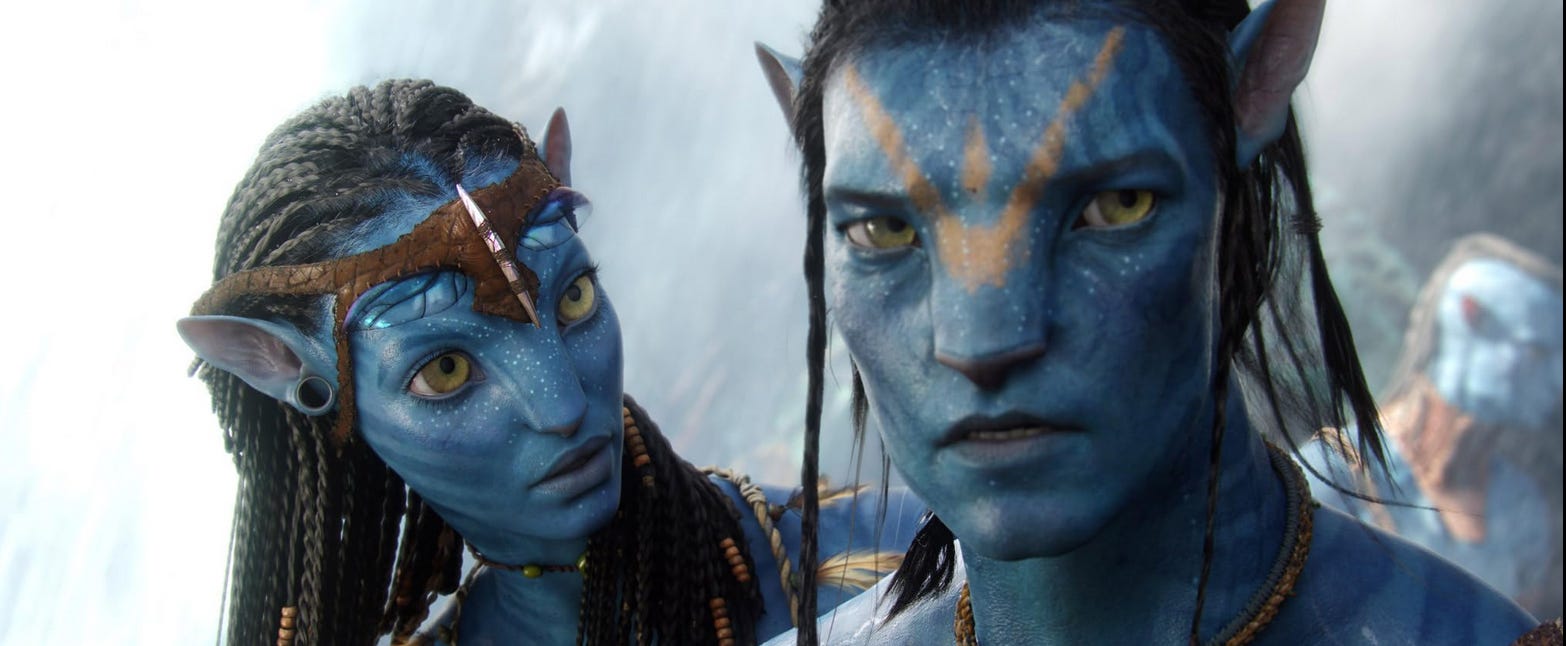
Neytiri is not defeated.
She is deprecated.
Leadership in Avatar does not transfer through lineage, wisdom, or consent. It transfers through demonstrated compatibility with the system’s future. Jake is not chosen because he is better. He is chosen because he performs as the most stable build available.
The narrative treats this as triumph.
The system treats it as succession.
Seen this way, the conflict is not between colonizer and native, or even between human and Na’vi. It is between incumbent presence and optimized replacement. Displacement does not require malice. It requires only a world calibrated to reward interoperability over inheritance.
He does not become one of them.
He becomes what comes next.
That is species gentrification.
The Industrial Sublime
Avatar does not smuggle its machinery in through the back door.
It places it on the altar.
James Cameron’s cinema is not organized around persuasion or argument, but transport. He wants bodies to feel as though they have traveled somewhere else, and to leave the nervous system convinced it has returned changed. Avatar succeeds because it understands something precise: awe precedes ethics. The body believes before the mind decides.
The film engineers reverence through deprivation.
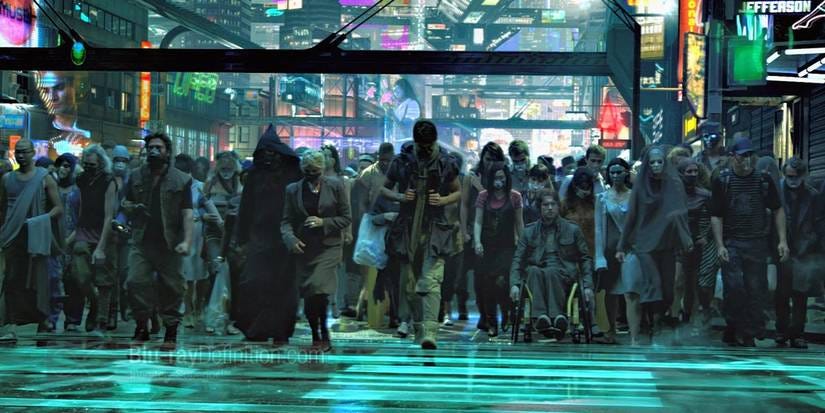
Act I is not neutral. The human world is compressed, metallic, overlit. The camera crowds Jake. Motion is constrained. Edits interrupt. Sound design hums with recycled air and institutional friction. This is not realism. It is sensory withholding. The audience is trained to want release.
Pandora arrives as relief.

Color floods the frame. Space opens. Motion becomes fluid. The camera glides instead of jerks. The soundscape shifts to organic density, rustling leaves, layered animal calls, a world that breathes back. Avatar does not argue that Pandora is better. It conditions the body to feel it.
The nervous system learns the moral before the brain does.
Narrative simplicity here is not a lack of ambition. It is load management. Complexity is relocated away from ethics and into rendering. The story remains archetypal so the machinery can exceed itself. The plot does not need nuance because the spectacle delivers conviction.
Story becomes infrastructure.
Emotion becomes throughput.
The tools are not hidden. They are sanctified. The audience is not asked to believe in Eywa first. They are asked to submit to the apparatus that makes Eywa feel inevitable. Reverence is not discovered. It is administered, shot by shot, cue by cue.
The RDA extracts unobtanium by burning worlds. Cameron extracts awe by burning computation, labor, and time. Both processes rely on scale. Both convert destruction into value. Both leave something exhausted behind them.
The RDA extracts unobtanium.
Cameron extracts awe.
This is not hypocrisy. It is coherence. Extraction does not always arrive as violence. Sometimes it arrives as transcendence.
And it works because the upgrade feels good. The body moves freely. The avatar runs, leaps, breathes without friction. That sensation is not incidental. It is the seduction.
Extraction by Camera
Once the machinery has done its work, the camera takes over.
By the time Pandora opens up, the audience has already been trained where to look and how to feel. Movement is fluid. Color is saturated. The world is readable at a glance. The camera does not hesitate. It glides, surveys, confirms. This is not curiosity. It is acquisition.
The camera in Avatar behaves less like a witness than an instrument. It maps terrain before it records loss. It catalogs species, rituals, and spaces with a confidence that suggests foreknowledge. Every glide through the canopy, every sweep across bioluminescent ground, every wide establishing shot participates in the same act: rendering the world legible.
Legibility comes first.
Care follows later, if at all.
This is why destruction in Avatar feels clean even when it is total. Hometree does not fall as an unknown loss. It collapses as something already measured, already understood, already absorbed into the film’s visual grammar. The audience mourns because the camera has already taught them what is being lost. Recognition precedes grief.
The extraction is not only material.
It is perceptual.
To see Pandora is to possess it. The camera’s mastery over space teaches the audience mastery as well. The world is not encountered in fragments or resistance. It is delivered whole, coherent, and navigable. The gaze does not ask permission. It assumes access.
Once Jake’s compatibility is confirmed, the camera no longer requires Neytiri’s authority; her knowledge remains, but the system stops routing power through her.
This does not make the camera malicious.
It makes it effective.
The same visual confidence that allows Avatar to generate awe also allows it to absorb violence without rupture. There is one moment the camera cannot fully manage. Grace Augustine’s transfer does not complete. The ritual unfolds with the same reverence as Jake’s, but the outcome refuses symmetry. The system does not correct itself. The gaze holds, and then moves on.

The camera does not recoil. It does not lose orientation. Even in moments of catastrophe, the world remains readable. The system holds.
Extraction, here, does not look like theft.
It looks like understanding.
And once a world has been fully understood, it no longer belongs to itself.
The Engineered Eden
Pandora does not require resolution to remain available.
After loss, after interruption, after a ritual that does not complete, the world does not withdraw. Paths remain readable. Threats remain signposted. Rituals remain repeatable. The system continues to present itself as navigable, as if no contradiction has occurred.
This is not indifference.
It is architecture.
Pandora behaves less like a wilderness than an interface. Its ecosystems are intricate, but never opaque. Cause and effect are quickly legible. The environment teaches through feedback rather than refusal. Mistakes are costly, but rarely confusing. Nothing essential is withheld long enough to interrupt comprehension.
The world does not test belief.
It tests execution.

Even its strangeness arrives pre-processed. Bioluminescence clarifies space rather than destabilizing it. Neural connections organize the terrain into a single, readable system. Wonder never interrupts access.
This is what makes Pandora feel safe without feeling simple.
But there is something the world cannot do.
Pandora cannot refuse integration once compatibility is established. It can delay. It can wound. It can punish missteps. But it cannot revoke access from a body that resolves enough variables at once.
Failure does not harden the world. It does not lock doors or close routes. The interface remains intact. Access persists. The system proves that continuity does not depend on moral closure.
What presents as harmony is tolerance. The Eden here is not fragile.
It is fault-tolerant.
The Neural God
Eywa does not intervene.
It executes.
What presents as divinity in Avatar behaves less like a god than a network. It does not judge intention. It does not reward virtue. It does not correct loss. It responds to imbalance with redistribution.
Eywa is not a moral authority.
It is a stabilizing system.
The neural network binding Pandora functions through connection density and signal flow. Life feeds life. Death feeds continuity. Individual outcomes are irrelevant unless they threaten the whole. Meaning collapses when weighed against throughput.
The film never asks Eywa to be fair.
It asks it to keep the system running.
This is why Eywa’s decisive intervention does not follow the destruction of Hometree, but the imminent assault on the Tree of Souls. Extraction becomes intolerable only when it threatens the server itself. When the network’s core is at risk, force is rerouted. Fauna mobilizes. Pathways align.
The response is proportional to disruption, not to suffering.
Eywa does not save.
It compensates.
Grace’s failure does not register as injustice. It registers as load. Her transfer is rejected. Her form is not preserved. Her knowledge persists only as data routed elsewhere. Memory is retained. Identity is not.
Jake, by contrast, is completed. Not because he is more worthy, but because he resolves more variables at once. He is not healed. He is compiled.
Only after this pattern is visible does the revelation settle:
That is not transcendence.
It is infrastructure.
Balance is restored without explanation. The world remains usable. The network holds. Meaning is left behind.
Resistance as Franchise Logic
Resistance in Avatar is not an external force pressing against the system.
It is an internal function that allows the system to continue operating.
The film frames rebellion as rupture, but structurally it behaves as circulation. Conflict generates motion. Motion sustains attention. Attention sustains belief. Resistance does not interrupt the machine. It completes its cycle.
Opposition is not a threat.
It is a credential.
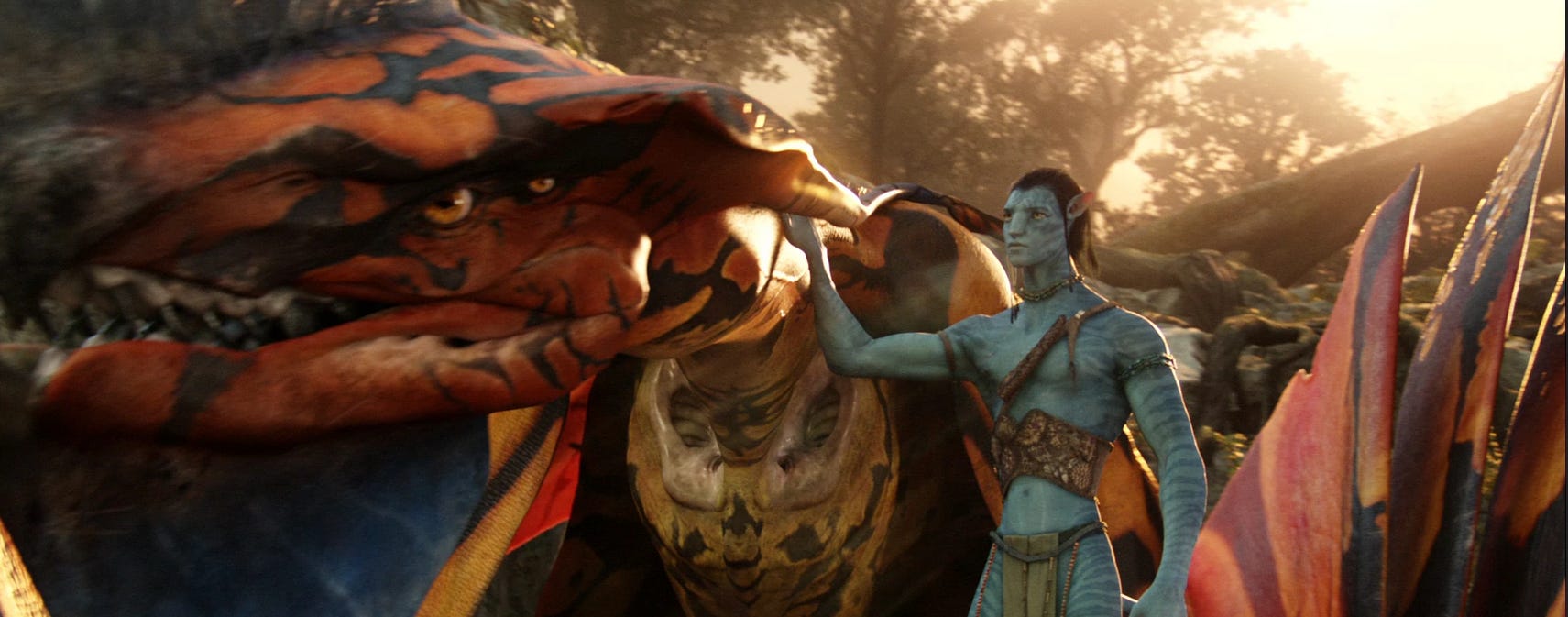
Jake’s ascension is framed as revolt, but functions as appointment. Toruk Makto is not insurgency. It is executive authorization. Power transfers without altering the grammar that distributes it.
This is not hypocrisy.
It is continuity.
Cameron believes he is showing liberation. The film’s sincerity is real. That sincerity is precisely what allows rebellion to be metabolized without structural risk. The system absorbs its negation and emerges reaffirmed.
Rebellion supplies the spectacle necessary to justify endurance. The audience receives catharsis. The world remains coherent, open, scalable.
A system that can absorb its own resistance does not end when challenged.
It extends.
Opposition keeps the machine alive.
I write about films as systems, how they select, reward, and endure. If this kind of reading resonates, you can follow along here.
The Dream That Chooses Someone Else
Jake becomes whole.
Not healed.
Not forgiven.
Completed.
The wound that defined him is resolved by substitution. A body replaces a body. A life replaces a life. The system closes its loop and moves forward without residue.
Neytiri remains.
Her knowledge holds. Her rituals persist. Her bond is never revoked. But the future does not route through her. Sovereignty does not vanish. It becomes peripheral. The legacy model is preserved, not continued.
Grace becomes infrastructure.
Her teaching survives her. Her research remains operational. Her empathy disperses into the network she helped map. She is not erased. She is absorbed. The system does not need to render her again.
Eywa stabilizes.
No judgment is issued. No explanation is offered. Balance is restored through redistribution rather than justice. The world remains legible. The interface stays open.
Pandora endures.
Not because it was saved, but because it was never allowed to close. The system holds because it was designed to hold. Paradise persists without requiring moral accounting.
The audience wakes up.
The lights come on. The body remembers flight, color, coherence. The nervous system grieves a place it was never meant to inhabit. The simulation ends for us precisely where it begins for Jake.
That is the final asymmetry.
Avatar is the machine that feels like a god,
and the god that prefers its chosen simulation.
The cost is not confusion.
The cost is clarity without belonging.
Works Consulted & Referenced
This essay draws on direct engagement with the films, their formal language, and publicly available production context. It is not intended as an exhaustive academic survey, but as a systems-level close reading grounded in the text itself.
Primary Texts
Avatar (2009), directed by James Cameron
Avatar (2009) screenplay and scene transcripts
Avatar: The Way of Water (2022), referenced contextually but not analyzed in depth
Interviews & Statements
James Cameron interviews on:
immersive cinema and “transportive experience”
archetypal storytelling and mythic universals
technological innovation as emotional delivery system
(including press materials and long-form interviews from 2009–2010)
Acknowledgments
This essay exists because Avatar exists, and because it was made with an intensity, care, and technical ambition that few films attempt, let alone sustain.
James Cameron and the artists, engineers, performers, and technicians who built Pandora did not stumble into its impact. They pursued it deliberately. The film’s power comes from an extraordinary convergence of craft: performance capture that treats bodies as expressive instruments, production design that commits fully to coherence, and visual effects that are not ornamental but structural. Every system analyzed in this essay required human labor, ingenuity, and risk to bring into being.
The work of Weta Digital, the cinematography and virtual camera teams, the sound designers, editors, animators, and production crews deserves recognition not just for innovation, but for discipline. Avatar holds together because thousands of creative decisions align toward a singular experiential goal. That achievement is rare.
This piece is not written against that accomplishment, but because of it.
Disclaimer
This essay is not a review, a moral verdict, or a call to abandon enjoyment of Avatar.
It does not argue that the film is dishonest, malicious, or secretly opposed to its stated values. It takes James Cameron’s sincerity seriously and examines what that sincerity produces when scaled through industrial cinema.
Interesting point about the interoperability. I was reading an article the other day about trained whiteness and how, in the beginning, Italians and Irish were not considered "white" but then were later granted that privilege in American society because of their eventual willingness to comply with white supremacy for the benefits. They then became the middleman or "interoperables".
enjoyed this one, and i've seen it haha.
An interesting overview. To be honest halfway through I stopped reading because I never enjoyed the film, I just couldn’t connect your words with my experience.
I saw the original Avatar in theatre in 2009. It was a film. I saw it because it was a cultural event, and my friends were going. I regret seeing it. It was bland. Boring. Meaningless.
Instantly forgettable other than the technology to film it was awesome. I cannot for the life of me recall the flat characters, the non-existent story, was there a plot or was it a series of digital montages?
My instant reaction when told a new film is a James Cameron film is now to ignore it.