
A Quiet Place Day One
Her Silence, Her City: Dying at the End of the World

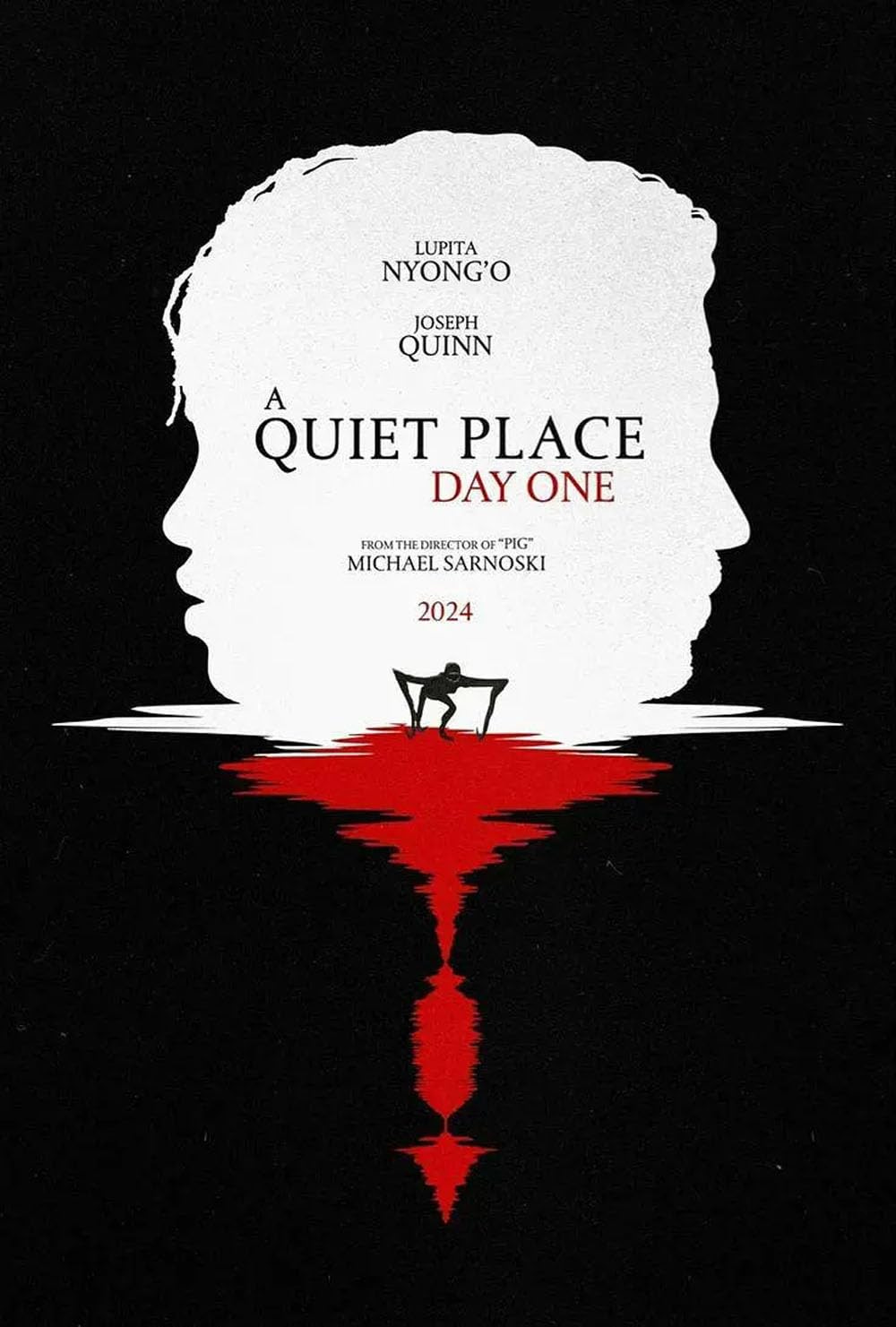

I left New York at thirteen, losing friends and streets that once felt like mine. Grief came later, heavy with the impossibility of returning to those versions of them, or myself. I remember night drives into the city, my mother seeking comfort for the monkey in her soul. Buildings loomed like teeth as jazz spilled from open windows, Steely Dan, Miles Davis, weaving chaos into rhythm. Noise was the city’s pulse, its rhythm between notes.
That loss haunts A Quiet Place: Day One. New York doesn’t resist her leaving; it moves with her, breathes only when she does.
The film doesn’t ask how we survive. It asks how we go, and who notices when we do.
Hospice to Manhattan
The frame holds her small in deserted streets, swallowed by absence. The city doesn’t collapse around her, it joins her. Matches her pace. Mirrors her breath. As if it was always her role to walk ahead, to hold the hush others cannot.
Hospice rooms cut tight, then give way to yawning city emptiness. Negative space doesn’t just isolate, it records her withheld presence. Eric stands at the threshold, unsure whether to knock.
Stillness precedes upheaval. The lull before the siren.
And in that pause, the elegy arrives. The city doesn’t resist her leaving, it breathes with her. The end doesn’t chase; it settles beside her. She began with a poem spat like bile,
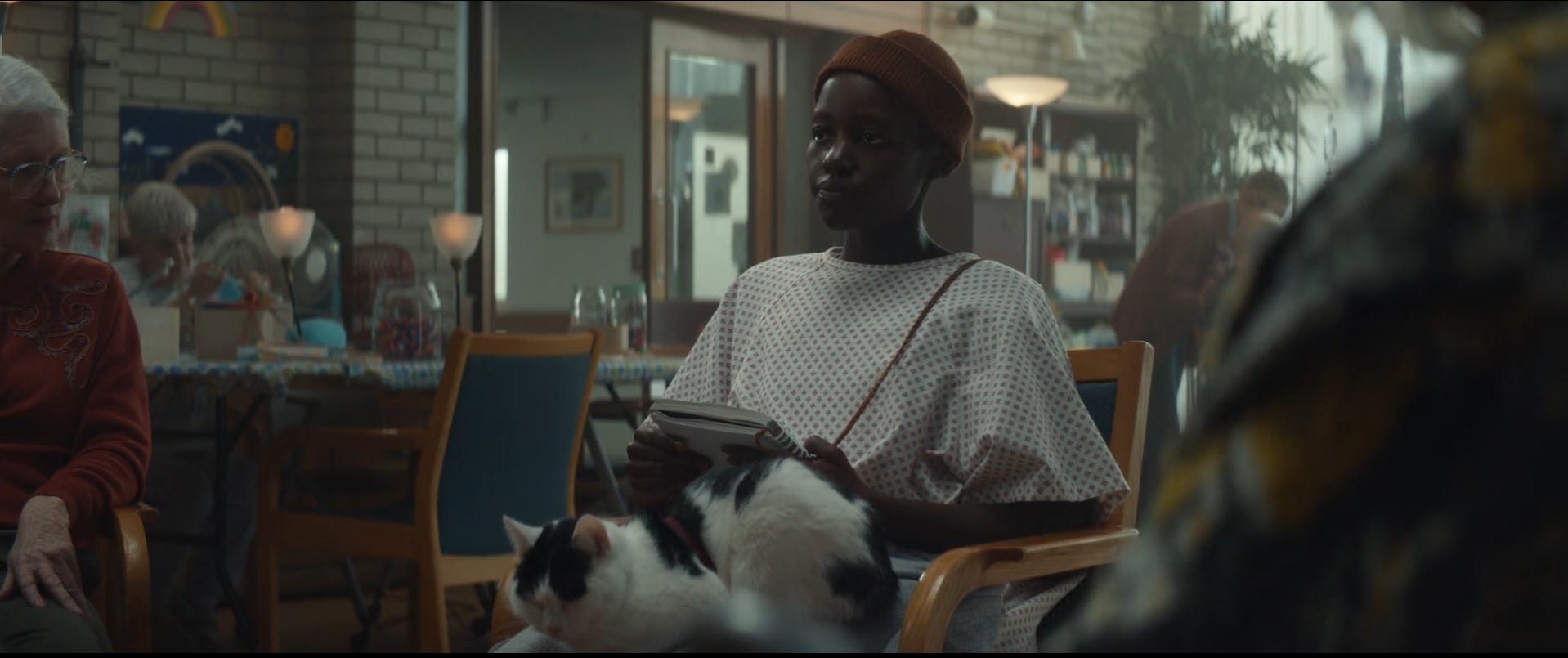
Bitterness as opening note, ritual as closing one.
→ This story doesn’t begin with lore. It begins with lungs giving out.
But if lungs give out, what follows is still spectacle, monsters, ritual, music. If the going was chosen, why dress it as pursuit?
Bridges Falling: New York as a Dying Organism
Washed-out grays, hospice whites. Sam wears the city’s pallor, clothes fading into concrete. Against it, Eric’s darker tones orbit her, like static pulled into signal.
Her presence camouflaged, not for safety, but for surrender. His disorder contrasts her steady hush.
Static wide shots linger, surveillance-like, elegiac. The city watches, complicit, indifferent.
She passes a bench with a cushion folded from someone who used to wait there. She doesn’t look in.
The streets breathe shallow. Each corner she turns feels less like escape, more like memory traced with fading ink. The city is not battlefield but body, unsteady, loud in its breaking, still in its surrender. Every turn is inheritance, grief carried in her body, expectation carried on her shoulders, the heaviness in her gait, shoulders bent with stories. Each turn toward Patsy’s isn’t hunger but ritual.
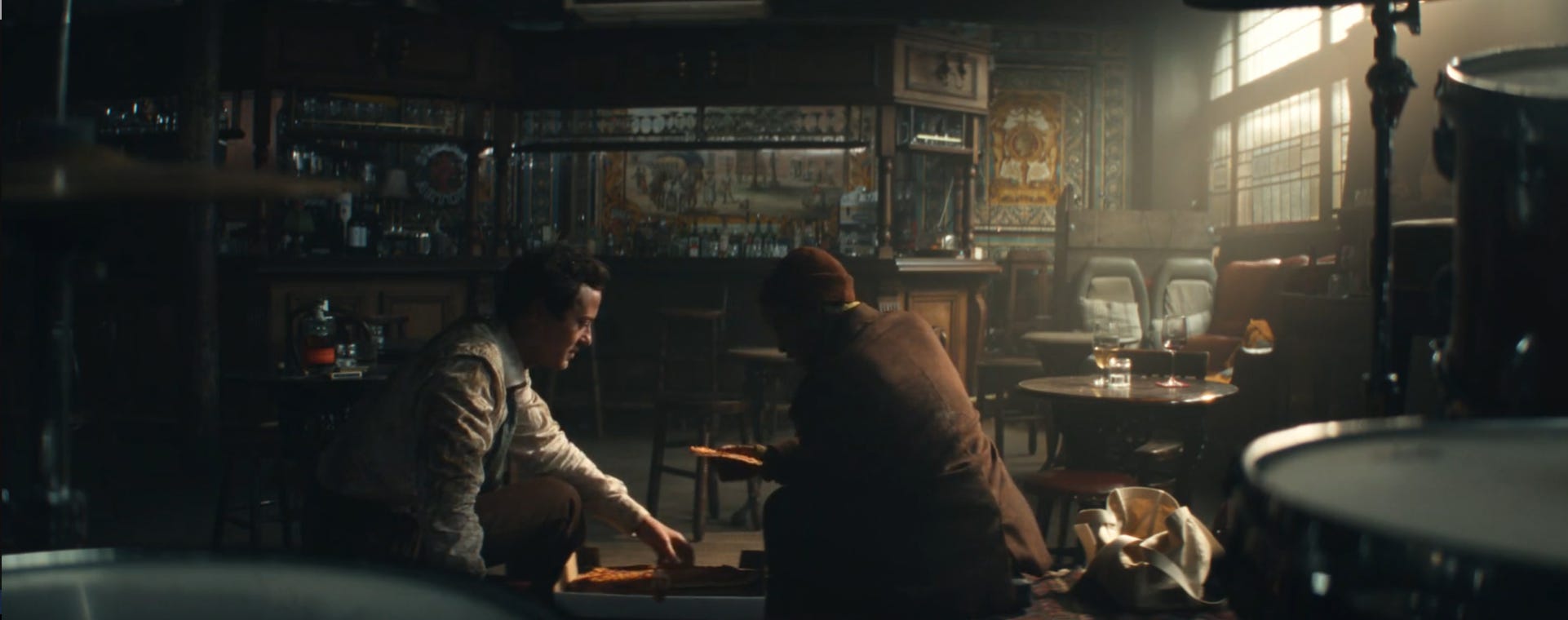
The walk is memory, a nerve ending retraced, a taste carried from her father’s hand into the city’s ruin.
→ Not collapse, but exhalation.
Or maybe not elegy at all. Maybe just atmosphere, shots that could serve any thriller, emptied streets with no mourning in them, only mood. If that’s true, the grief is ours, not the film’s.
Subways and Sirens: Predators of the Quiet
Long static takes rupture into sudden chaos when sound enters. The lens itself holds its breath, waiting for someone to slip.
The creatures don’t arrive until noise escapes. Symptoms revealing themselves late. They correct. That is all. They are not chaos. They are inevitability, the cruel reinterpretation that nihilism names as truth. Not disorder, but correction. Correction has always arrived first for her.
He whispers too loud. She doesn’t shush him. But that night, she sits farther away. Distance folded into stillness.
Hush. Lull. Withheld sound. Not absence, but etiquette, like living in a house not yours, careful not to disturb what waits upstairs.
The creatures do not stalk; they wait. And waiting is its own violence. The danger isn’t pursuit but revelation, sound exposing what should have stayed hidden. Eric learns this too late, his breath carrying further than hers. The invasion itself begins not with bodies but with sound, sirens, horns, voices stacking until they collapse into absence. Stillness arrives first, creatures only afterward, as if the rule of the world rewrote itself in a single cut.
→ Danger isn’t in the chase; it drifts in the hearing, a sound slipping loose where it should have stayed hidden.
Yet if the creatures are correction, inevitability itself, then her ritual is illusion. Choice shrinks beneath mechanism. Authorship dissolves when inevitability writes the script, leaving only the weight of hush pressing in.
Harlem and the Last Note
Eric trails like Frodo, the stray cat. Hesitant, persistent. Not savior. Just shadow.
He tries too hard. A gesture folded wrong, a kindness that doesn’t quite land. Says too much. She doesn’t correct him, but one day she chooses a different bench.
She doesn’t hand him wisdom. She lets him stay. Presence, not cure.
“You’re not my friend. You’re a nurse.”
He isn’t kin, isn’t savior. Just the orderly left to sit with what cannot be undone. Even here, her stillness instructs. Her dying becomes someone else’s lesson.
Yet the nurse still remains, folded into ritual. Not savior, but not absent either. His proximity is scripted, softening the asymmetry of care. Stillness is framed as respect, but what if it is just narrative habit? Meaning here isn’t cosmic. It’s intimate. Quiet. Uncertain. He arrives as we do, late, awkward, still asking what it means to sit beside someone who doesn’t need saving.
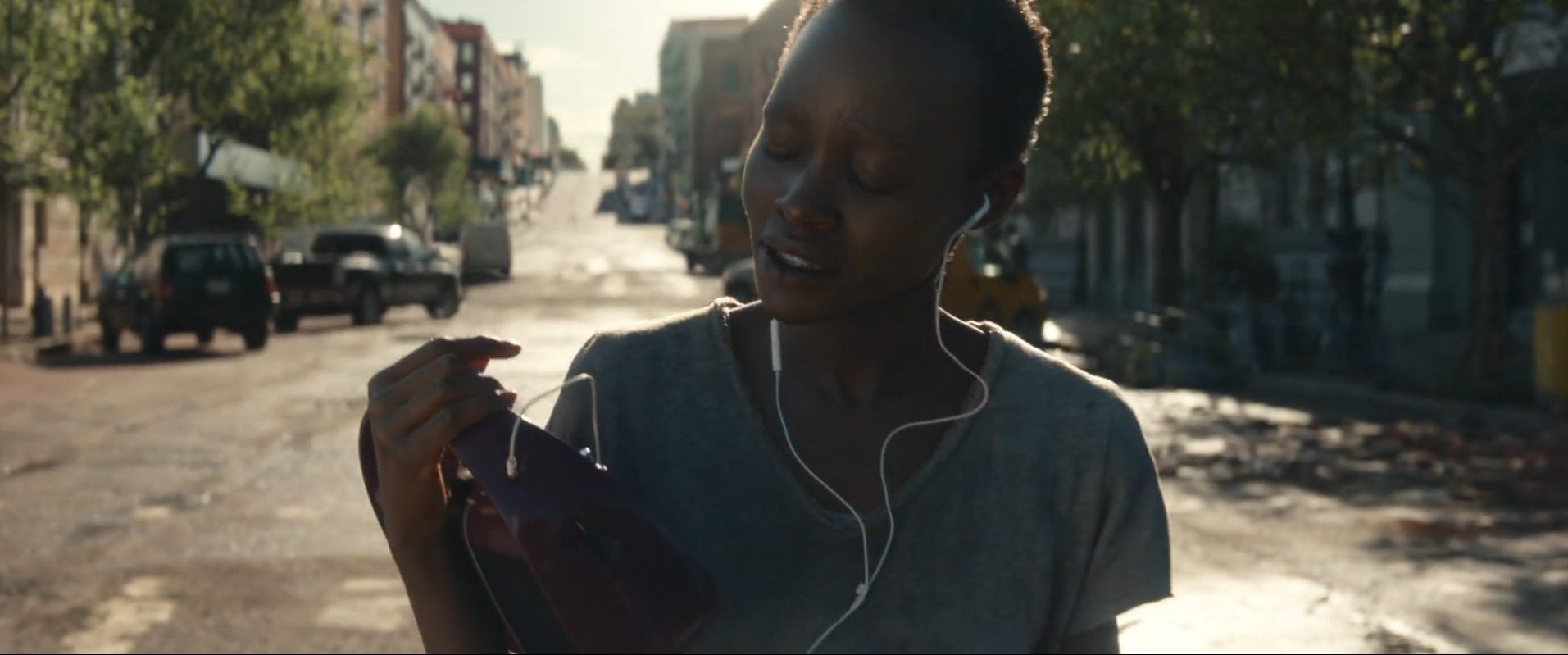
Nina Simone rises. Not liberation. Ritual. The exit she chose. The sound carries back to those rides into the city, jazz through open windows, rhythm cut into night. What was once arrangement is now farewell, the last bar played before stillness.
He stands beside her, unsure whether to speak, unsure if stillness is consent or dismissal. The music carries them both, though only one has chosen what follows. He is not the first. He may not be the last. But today, he is the one beside her.
→ A lifeline, or a release, sometimes you can’t tell which.
Broadway’s Curtain Call: When the Franchise Falls Silent
The farm was built for survival. The city is built for farewell. Concrete ruins don’t guard life; they stage an exit.
Wide ruin collapses to one woman, one song. The camera grants devotion she never asked for.
She didn’t ask for meaning. But the frame gave it anyway, caught her stillnesss like pearls, called her decision brave, or gentle, or final. All patterns are made up. She didn’t ask for them. But the camera gave them anyway.
Was it reverence, or just the demand that she endure one more time? As if the story itself needed her endurance more than it needed her, until even tribute risks erasing her.
“I had forgotten how the city sings. You can hear it when you’re muted.”
The city itself becomes elegy, its song the last sound before the lights go out.
Maybe she would’ve done it anyway. Maybe she already had.
And so the story falters on its own tenderness. Maybe that’s what stories do, lie with reverence. Not to deceive. Just to make it bearable.
→ The story ends where it began: in the space between a breath held, and the one never taken, the city exhaling with her.
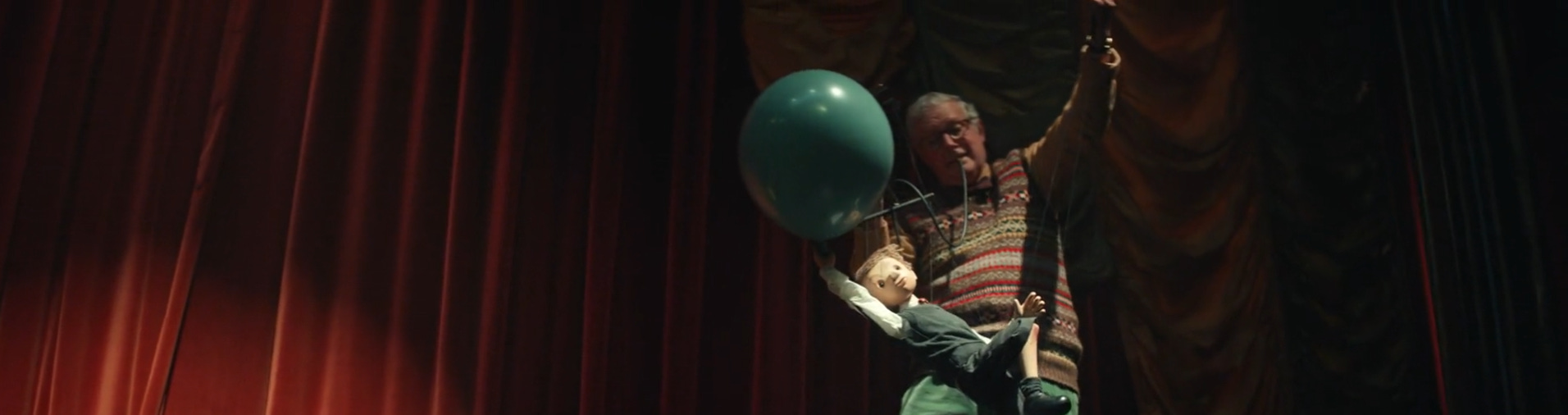
Maybe she was denied meaning, and we dressed the denial as homage. Held too long, even homage begins to sound like suffocation. If that’s all stories do, then this elegy drifts into sedation, peace made where none was given.
Works Cited
A Quiet Place: Day One. Directed by Michael Sarnoski. Paramount Pictures, 2024.
Wikipedia contributors. “A Quiet Place: Day One.” Wikipedia.
Fandom contributors. “A Quiet Place Wiki.” A Quiet Place Fandom.
Transcripts: A Quiet Place: Day One, as shared in community archives.
Disclaimer
This essay engages critically with A Quiet Place: Day One through still images, transcripts, and commentary. Images are used under fair use for the purposes of analysis and cultural critique. All rights remain with the original creators and copyright holders.
Acknowledgments
To those who keep the city’s songs alive, the readers who follow me into silence, who sit with these films not for survival but for the echo that lingers after.
Special thanks to community archivists and transcript keepers, whose quiet labor makes close reading possible.
And to the artists whose work I inhabit here: your frames and silences made this elegy possible.

Gotta let us know when you write a book. I will be on that pre-order list. Excellent as always. Thank you.❤️🔥
I loved this movie and I’m so happy you did a piece on it. I saw many people write it off as franchise shlock but Day One is one of the most thoughtful, character driven genre pictures we’ve gotten in years.